Selecting the right sandblasting machine manufacturer is one of the most consequential procurement decisions in any surface treatment operation. A blast machine is not a consumable item that can be replaced casually every season — it is a long-life production asset that determines surface cleanliness grade, coating adhesion, throughput, abrasive consumption, operator safety and environmental compliance for a decade or more. When a machine is undersized, poorly sealed or built from substandard plate, the cost does not appear on the purchase order; it appears later as downtime, rework, rejected coatings and regulatory risk.
This guide is written for plant engineers, procurement managers, coating contractors and project owners who are evaluating suppliers for abrasive blasting equipment. It explains what a genuine sandblasting machine factory should be able to deliver, how to compare machine categories against real workpiece profiles, which technical benchmarks actually matter, and how to structure a purchasing decision so that price, performance and after-sales support are balanced rather than traded against each other. The focus throughout is on verifiable engineering facts rather than marketing claims, because that is what separates a dependable long-term partner from a supplier that disappears after delivery.
Why the Choice of Sandblasting Machine Manufacturer Determines Project Outcomes
Surface preparation is the foundation of every protective coating system. If the substrate is not cleaned to the specified standard — whether that is a near-white metal finish or a commercial blast grade — the subsequent paint, zinc or powder coat will fail prematurely, regardless of how expensive the coating material is. The blast machine is the equipment that creates that foundation, so its stability, abrasive flow consistency and nozzle pressure directly control the quality of the entire coating lifecycle.
Beyond coating quality, the machine governs operating economics. A well-designed system with efficient abrasive recovery, intelligent pressure regulation and low leakage will consume less abrasive and less compressed air per square meter of treated surface. Over a full production year, that difference can be larger than the initial price gap between a cheap machine and a properly engineered one. This is why experienced buyers evaluate a sandblasting machine supplier on total cost of ownership rather than on quotation headline figures alone.
Finally, the manufacturer determines how quickly a plant recovers from an unexpected breakdown. Surface treatment is usually a bottleneck operation: when the blast line stops, downstream painting, assembly and shipping all stop with it. A supplier with genuine engineering depth, spare parts inventory and remote diagnostic capability can shorten that interruption from weeks to hours.
What a Qualified Sandblasting Machine Manufacturer Should Supply
A capable sandblasting machine manufacturer should offer a complete equipment family rather than a single catalogue model, because workpiece sizes, production volumes and site conditions vary enormously across industries. A supplier that can only offer one machine type will inevitably force the buyer into a compromise — either an oversized machine running inefficiently at low load, or an undersized machine that cannot keep pace with peak demand.
A complete product system normally spans manual cabinet machines for small precision parts, open mobile blasters for outdoor structural work, wet or high-pressure water blasting for sensitive substrates, dust-free enclosed units for indoor workshops, and fully automated conveyor-type systems for high-volume production lines. Alongside the machine itself, the manufacturer should also provide the pressure vessel blast tank, the abrasive recovery and dust extraction system, and the compressed air source, so that the entire process chain is engineered as one integrated unit instead of a collection of mismatched components.
Core Equipment Categories in a Complete Product System
- Cabinet (enclosed) sandblasting machines — for small and medium parts such as dies, fasteners, castings, glass and hardware, with contained abrasive circulation and operator protection.
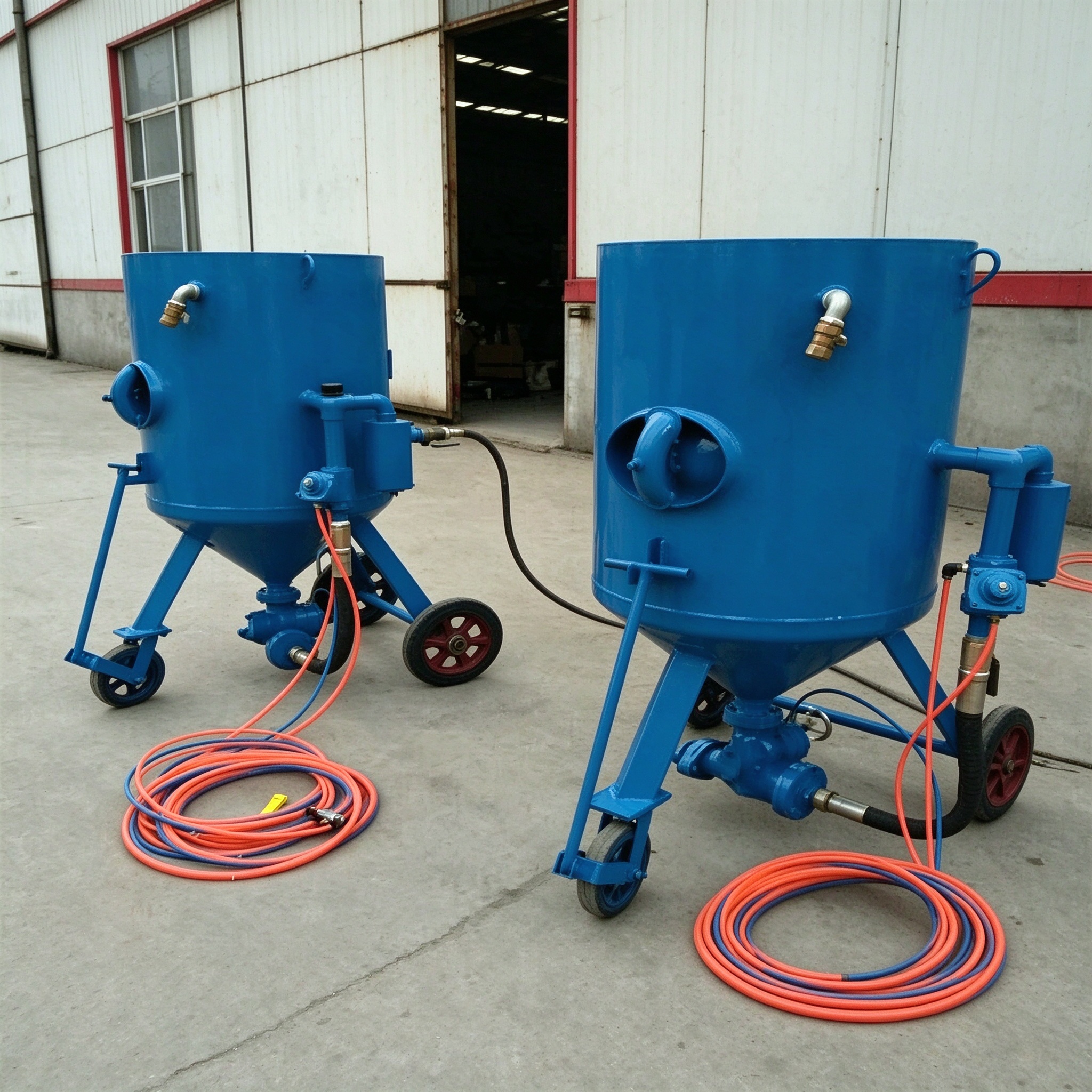
- Open mobile sandblasting machines — for large structures, bridges, storage tanks and ship hulls where the workpiece cannot be moved into a booth.
- High-pressure water blasting equipment — for coating stripping and cleaning where dry abrasive contamination must be avoided.
- Dust-free environmentally enclosed blasting units — for indoor workshops with strict emission and noise requirements.
- PLC automatic conveyor sandblasting machines — for continuous, repeatable processing of high-volume parts with consistent surface uniformity.
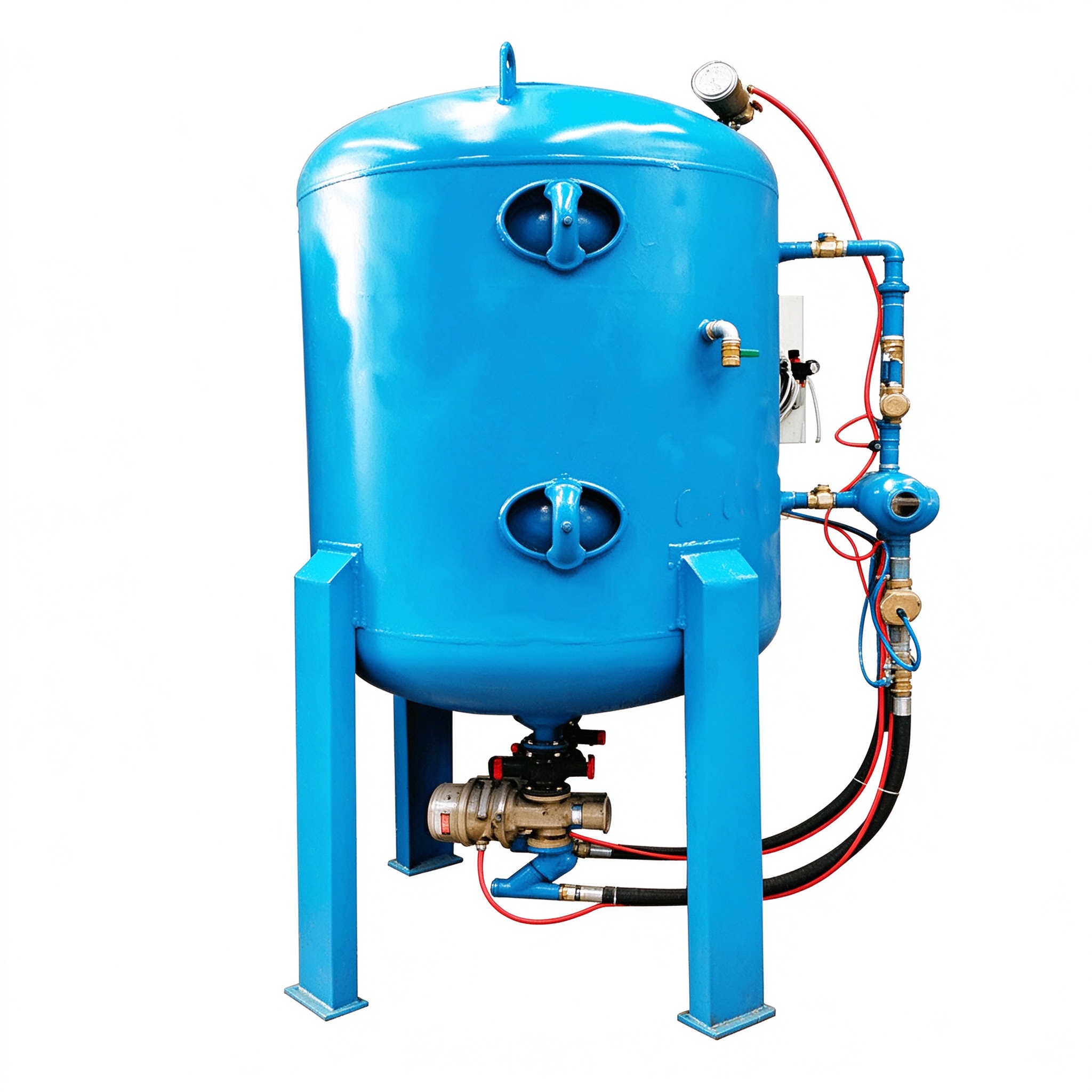
- Pressure blast tanks — fixed, mobile, electric-control and pneumatic-control configurations, built to pressure vessel standards in multiple capacity sizes.
- Turnkey blast room systems — automatic and recovery-integrated blast rooms designed around building dimensions and workpiece envelope.
- Supporting equipment — permanent-magnet variable-frequency air compressors, blast nozzles, wear-resistant blast hoses, abrasive recovery units and pulse-jet dust collectors.
Source Factory Versus Trading Company: What It Means for Cost and Lead Time
One of the first questions a buyer should ask is whether the sandblasting machine source factory actually owns the production process. A trading company can quote a competitive price, but it cannot control welding quality, pressure testing records, nozzle material specification or delivery scheduling. When a nonconformance appears — a leaking tank seam, an inconsistent abrasive valve, a delayed shipment — the trading company must relay the problem to a third party, and the buyer loses direct visibility into the corrective action.
A genuine manufacturer with its own fabrication and assembly capacity can offer three advantages that matter commercially. First, design changes requested during project review can be implemented directly, without a chain of intermediaries. Second, production progress can be inspected at any stage, including weld preparation, tank hydrostatic testing and full-load running trials. Third, spare parts remain available years after delivery because the same factory that built the machine still holds the drawings and tooling.
Scale is the other differentiator. Manufacturers operating standardized assembly lines with annual output in the thousands of units can hold delivery dates stable even during peak demand, and can absorb large single orders — dozens of machines in one shipment — without pushing smaller customers to the back of the queue. Buyers should ask directly about monthly assembly capacity, standard lead time and the process for expediting urgent projects.
Technical Benchmarks to Verify Before Placing an Order
Price comparison is meaningless without a technical baseline. Buyers should require the sandblasting machine manufacturer to document specific engineering parameters, and should verify that those parameters are backed by measurable production controls rather than descriptive brochures. Three areas deserve particular attention: pressure vessel integrity, wear-part life and machine-level reliability.
For blast tanks, the material specification should be stated explicitly. Vessels fabricated from compliant pressure-vessel-grade steel plate, correctly welded and stress-controlled, behave very differently from tanks built from general structural plate. Every vessel should undergo a hydrostatic test at a defined multiple of rated working pressure before leaving the factory, with test records traceable to the serial number. This is not a formality — it is the primary safeguard against catastrophic failure in a pressurized abrasive system.
Wear parts determine long-term operating cost. Nozzle material is the clearest indicator: a wear-resistant ceramic nozzle typically lasts about three times longer than a conventional alloy nozzle under the same abrasive load, which directly reduces both replacement spend and the labour hours spent on nozzle changes. Abrasive hoses, control valves and recovery piping should be specified with comparable attention, because these are the components that erode fastest in daily service.
Machine-level reliability should be expressed as measurable performance rather than adjectives. Engineering improvements in adaptive pressure regulation, automatic abrasive recirculation and intelligent dust suppression with noise reduction can reduce overall failure rate substantially compared with conventional designs, while lowering energy consumption per operating hour. Buyers should ask for the specific design features behind those claims — how pressure is regulated, how abrasive is recirculated, how dust collector pulsing is sequenced — and then confirm them during factory acceptance testing.
Equipment Comparison: Matching Machine Type to Workpiece and Output
Machine selection should always start from the workpiece, not from the catalogue. The table below summarizes how the main equipment categories are typically applied, so that buyers can shortlist configurations before requesting a formal quotation.
| Machine Type | Typical Workpiece | Production Mode | Key Selection Factor |
|---|---|---|---|
| Cabinet enclosed blaster | Dies, castings, fasteners, glass, small hardware | Batch, manual or semi-automatic | Cabinet internal dimensions and abrasive recovery design |
| Open mobile blaster | Bridges, pipelines, storage tanks, ship hulls | On-site, outdoor | Air flow capacity, hose length, operator protection |
| High-pressure water blaster | Coating stripping, sensitive or oily surfaces | On-site or in a contained bay | Working pressure, water treatment, surface tolerance |
| Dust-free enclosed blaster | Indoor parts processing with emission limits | Batch, indoor workshop | Dust collector capacity and emission performance |
| PLC automatic conveyor blaster | High-volume repeatable parts | Continuous, automated | Cycle time, uniformity specification, line integration |
| Turnkey blast room | Large fabrications, structural sections, heavy equipment | Batch or continuous, in-house | Building dimensions, abrasive recovery floor, dust extraction |
Customization and Turnkey Blast Room Solutions
Standard machines cover a large share of industrial demand, but a significant portion of projects require custom sandblasting machine engineering. Large weldments, oversized pressure vessels, wind-turbine components and rail structures frequently exceed the envelope of any catalogue model. In these cases the manufacturer must be able to design around the workpiece rather than asking the customer to redesign production around the machine.
A proper customization process begins with site measurement and process review. The manufacturer should confirm workpiece maximum dimensions, batch weight, required surface finish, available compressed air capacity, electricity supply, floor loading limits and the physical layout of the building. From that data, engineers produce equipment drawings, a blast room layout and an abrasive recovery plan. For integrated blast rooms, the design must also define the recovery floor configuration, the dust extraction airflow path, lighting placement and the operator access strategy — all of which affect both cleaning efficiency and long-term maintenance cost.
Turnkey capability is the strongest test of a manufacturer’s engineering maturity. Supplying a blast room means coordinating structural fabrication, abrasive recovery, pulse-jet dust collection, ventilation, electrical control and compressed air supply as a single functioning system, then commissioning it on site and training the customer’s operators. Buyers should expect documented layout drawings before fabrication begins, and a commissioning report at handover that records measured performance.
Dust Control and Environmental Compliance
Abrasive blasting generates substantial airborne particulate, and in many regions the permitting authority treats blast operations as a controlled emission source. This makes the dust extraction system as important as the blasting equipment itself. A sandblasting machine manufacturer that treats dust collection as an accessory rather than an integral part of the design will create compliance problems that surface only after installation.
An effective system combines enclosure, capture and filtration. Blasting should take place inside a contained space wherever possible; airborne dust is then drawn through a capture hood into a pulse-jet filter unit sized to the actual airflow of the blasting operation. Filter area, can velocity, pulse sequencing and cartridge selection all determine whether the unit maintains a stable pressure differential over a full shift, or slowly chokes and loses capture efficiency.
Environmental management certification provides useful evidence that the manufacturer applies systematic controls to its own production and to the equipment it designs. Buyers should ask for emission performance data, filter specifications, noise levels and the maintenance schedule for filter replacement. Where local regulations are strict, it is also worth confirming that the design has been applied in similar regulatory environments, since practical compliance experience is difficult to substitute with documentation alone.
Selection Checklist: Matching Equipment to Real Operating Conditions
Before requesting a sandblasting machine price quotation, buyers should assemble a clear technical brief. Suppliers who receive complete data respond with accurate proposals; suppliers who receive vague enquiries respond with generic offers that later require costly revision.
| Evaluation Item | What to Confirm |
|---|---|
| Workpiece profile | Maximum dimensions, weight, material, geometry complexity |
| Surface requirement | Target cleanliness grade, roughness, coating system to follow |
| Throughput | Square meters or parts per shift, peak versus average load |
| Utility capacity | Compressed air volume and pressure, power supply, floor space |
| Pressure vessel documentation | Plate grade, weld procedure, hydrostatic test record at multiple of rated pressure |
| Wear parts | Nozzle material and expected life, hose specification, valve type |
| Dust extraction | Filter area, airflow, emission data, noise level, maintenance interval |
| Commercial terms | Lead time, packing method, installation scope, warranty, spare parts list |
After-Sales Support and Spare Parts Availability
The value of a manufacturer is most visible after the machine is installed. Blast equipment operates in an abrasive, high-dust environment, so wear and periodic adjustment are inevitable. What separates a strong supplier is how fast and how reliably those routine issues are resolved.
A complete service structure typically includes pre-sales site survey with a written selection proposal and layout drawing, production progress updates with photographs and inspection records, on-site installation and commissioning with operator training covering daily operation, maintenance and basic troubleshooting, and a post-delivery response mechanism combining remote technical guidance with field visits. For export customers, remote support quality matters enormously, because a field visit may take days to arrange; the supplier should therefore maintain a documented troubleshooting procedure and a spare parts inventory for fast dispatch.
Buyers should request a recommended spare parts list at the quotation stage, covering nozzles, hoses, control valves, seals, filter cartridges and abrasive recovery wear plates. Knowing the consumption rate and unit price of these items allows a realistic maintenance budget to be built into the project cost model.
Delivery Capacity, Export Experience and Total Cost of Ownership
For projects involving multiple machines or a full production line, delivery reliability is as important as technical capability. A manufacturer operating several standardized assembly lines with annual output in the thousands of units can schedule bulk orders predictably and hold committed dates. Long experience serving large industrial groups — shipbuilding, steel structure fabrication, automotive parts, precision manufacturing and construction machinery — is a useful indicator that the factory can handle volume orders without compromising inspection standards.
Export experience should be examined in practical terms: which regions have received repeat orders, how equipment is packed for sea freight, what documentation is provided for customs and installation, and whether the supplier can support voltage and frequency requirements outside its home market. Repeat purchasing from distributors and end users in Europe, the Middle East and Southeast Asia is a stronger signal than a list of one-off shipments, because repeat orders imply that machines performed as promised in real operating conditions.
Total cost of ownership should be calculated over a five-year horizon. The model should include purchase price, freight, installation, abrasive consumption per square meter, compressed air and power consumption per operating hour, wear part replacement, filter replacement, planned maintenance labour and expected downtime cost. When evaluated this way, the cheapest quotation is frequently not the lowest-cost machine — efficiency, reliability and part life usually dominate the calculation.
FAQ
How do I choose the right sandblasting machine for my workpiece?
Start from the workpiece, not the machine catalogue. Define maximum part dimensions, batch weight, material type, required surface cleanliness and roughness, and the number of parts or square meters you need to process per shift. With that data, a sandblasting machine manufacturer can recommend a cabinet machine for small precision parts, an open mobile blaster for large on-site structures, a dust-free enclosed unit for indoor work with emission limits, or a PLC conveyor system for high-volume repeatable production. Request a written selection proposal with drawings before confirming the order.
Can a sandblasting machine manufacturer customize equipment for my factory layout?
Yes, and for large workpieces this is usually necessary. A proper customization process begins with site measurement and process review, then produces equipment drawings, a blast room layout and an abrasive recovery plan before fabrication starts. Custom engineering can cover cabinet dimensions, blast room envelope, recovery floor configuration, dust extraction airflow path, control logic and voltage/frequency requirements for the destination market. Confirm that layout drawings and a commissioning report are part of the agreed scope, and that a custom sandblasting machine is engineered around your production flow rather than adapted from a fixed catalogue model.
What pressure vessel standards apply to pressure blast tanks?
Blast tanks are pressurized vessels and must be built accordingly. Vessels should be fabricated from compliant pressure-vessel-grade steel plate with controlled welding, and each tank should undergo a hydrostatic test at a defined multiple of rated working pressure before shipment, with results traceable to the vessel serial number. Ask the supplier to state the plate grade, welding procedure, rated working pressure and test multiple, and request the inspection record for your specific unit rather than a generic certificate.
How is dust emission controlled in industrial blasting operations?
Dust control relies on three elements working together: containment, capture and filtration. Blasting should take place inside an enclosure or blast room where possible, airborne particulate is then drawn through a capture hood into a pulse-jet filter unit sized to the actual airflow, and the filtered air is discharged. Filter area, can velocity and pulse sequencing determine whether the collector maintains stable performance across a full shift. Request emission data, filter specifications, noise levels and replacement intervals, and confirm the design suits the environmental requirements of your region.
What is the typical lead time for a bulk order of sandblasting equipment?
Lead time depends on machine type, configuration and factory loading. Standard catalogue machines from a manufacturer with multiple assembly lines and annual output in the thousands of units can be scheduled relatively predictably, while turnkey blast room projects require additional time for design, structural fabrication and site coordination. Ask for a written production schedule with inspection milestones, clarify how bulk orders are sequenced against existing commitments, and confirm the packing and shipping plan so that delivery dates are realistic from the outset.
How do I evaluate the sandblasting machine price quotation fairly?
Compare quotations on identical technical scope. Check whether each offer includes the same pressure vessel specification, nozzle material and expected life, dust collector capacity, control system, spare parts package, installation scope and warranty terms. Then build a five-year total cost of ownership model covering abrasive consumption, power and compressed air use, wear parts, filters and expected downtime. A lower purchase price with higher abrasive consumption, shorter nozzle life or frequent unplanned stoppages usually costs more in the long run, which is why the sandblasting machine price should always be assessed together with documented performance data.
Summary
Choosing a sandblasting machine manufacturer is fundamentally a risk decision. The right partner provides a complete equipment family rather than a single model, engineers custom sandblasting machine solutions around real workpiece constraints, builds pressure blast tanks to verifiable vessel standards with documented hydrostatic testing, supplies wear parts engineered for long service life, integrates dust extraction as a core system rather than an accessory, and supports the equipment with spare parts and responsive technical service long after delivery. Each of these capabilities translates directly into coating quality, uptime and operating cost.
Buyers who structure their evaluation around documented technical parameters, factory acceptance testing, delivery capacity and total cost of ownership consistently make better decisions than those who compare headline prices alone. A source factory with decades of accumulated engineering experience, standardized production lines, verifiable export references and a complete turnkey surface treatment solution portfolio is positioned to deliver equipment that keeps performing through years of abrasive industrial duty — which is, in the end, the only measure of a supplier that matters.