
Buying a sandblasting machine is rarely an impulse purchase. For a shipyard, steel structure fabricator, foundry, or automotive parts plant, the equipment sits at the front of the production line and determines how fast downstream painting, coating, and inspection work can move. That is why the single most important decision in the procurement process is not the model number or the discount — it is choosing a truly reliable sandblasting machine manufacturer.
This guide is written for international buyers, project engineers, and procurement managers who are comparing sandblasting machine suppliers and want a structured way to judge sandblasting machine quality, understand what drives the price and quotation, and confirm that after-sales support will still exist three years after installation. It also introduces Wuqiao Anxing Sandblasting Machinery Co., Ltd., a Chinese sandblasting equipment factory with more than three decades of continuous manufacturing experience, as a reference case for what a dependable supplier profile looks like.
Why Supplier Selection Matters More Than the Machine Itself
Industrial surface treatment equipment is a long-life asset. A pressure vessel sandblasting pot or an automatic sandblasting room is expected to run for a decade or more, often in a dusty, abrasive, high-cycle environment. During that life, nozzles wear out, hoses abrade, dust collector filters load up, and pressure regulators drift out of calibration. If the manufacturer has disappeared, or if spare parts must be reverse-engineered locally, the real cost of ownership climbs quickly.
A reliable sandblasting machine manufacturer therefore delivers three things at once: a correctly specified machine, a documented quality control process, and a spare parts and service channel that survives the warranty period. Buyers who focus only on the initial quotation often discover the gap later, when a single worn blast wheel or a failed solenoid valve stops an entire production shift.
There is also a compliance dimension that is easy to underestimate. Dust emission limits, pressure vessel safety regulations, and occupational noise rules differ between markets. A supplier who has never delivered equipment against environmental and pressure safety standards will struggle to document compliance for an overseas project, and the buyer inherits that risk at customs, at commissioning, and during the first factory audit.
Building a Reliable Supplier Profile: The Wuqiao Anxing Reference Case
Wuqiao Anxing Sandblasting Machinery Co., Ltd. is based in Wuqiao County, Cangzhou City, Hebei Province, an industrial region in northern China with a long manufacturing tradition. The company operates two production sites — a standardized factory area in the development zone and a second facility in Anling Town — and describes itself as a research, production, sales, customization, and after-sales integrated enterprise specialized in industrial surface treatment equipment.
Its history is one of the more useful signals a buyer can look for. The enterprise traces its sandblasting equipment development and manufacturing work back to 1991, starting with simple manual sandblasting units and gradually expanding into standardized volume production, large non-standard custom equipment, and complete sandblasting and dust removal system contracting. Thirty-plus years in a single product category is a meaningful indicator of process stability, supplier relationships, and accumulated engineering knowledge.
The company was recognized as a Hebei Province science and technology SME in 2023 and was selected as a national-level science and technology SME in 2025. It holds more than ten utility model patents related to sandblasting structures, dust recovery, and intelligent pressure regulation, and states that its self-developed adaptive pressure regulation, abrasive automatic circulation, and intelligent dust removal and noise reduction technologies reduce overall equipment failure rates by roughly 30% compared with the industry average while lowering energy consumption by approximately 15%.
Product Range: What a Full-Service Sandblasting Equipment Factory Should Offer
One practical test of a sandblasting machine supplier is whether it can cover the whole workflow. A buyer who has to source the blast machine from one vendor, the pressure pot from a second, the dust collector from a third, and the compressor and abrasives from a fourth will spend far more time on interface problems than on production. An integrated manufacturer can take responsibility for the complete system.
Wuqiao Anxing’s product structure is organized into four main blocks, covering both small precision parts and large outdoor structural steel. The table below summarizes how the categories map to typical buyer requirements.
| Product Category | Typical Configurations | Best Fit for |
|---|---|---|
| Sandblasting machines | Cabin-type closed sandblaster, open mobile sandblaster, high-pressure water sandblaster, dustless environmental sandblaster, PLC automatic conveyor-type sandblaster | Small precision components through to large structural workpieces and outdoor rust removal |
| Pressure vessel sandblasting pots | Stationary, mobile, electric-control and pneumatic-control models; custom pressure ratings and tank sizes | Contractors and plants needing high abrasive flow rates and long continuous blast cycles |
| Complete sandblasting room systems | Fully automatic blast rooms, recovery and dust collection integrated rooms, layout design and site construction | Factories that need enclosed, regulated blasting areas sized to their building and workpiece dimensions |
| Supporting equipment and consumables | Permanent magnet variable frequency air compressors, sandblasting compressors, blast guns, wear-resistant blast hoses, abrasive recovery units, pulse dust collector modules | One-stop purchasing and later spare parts replacement |
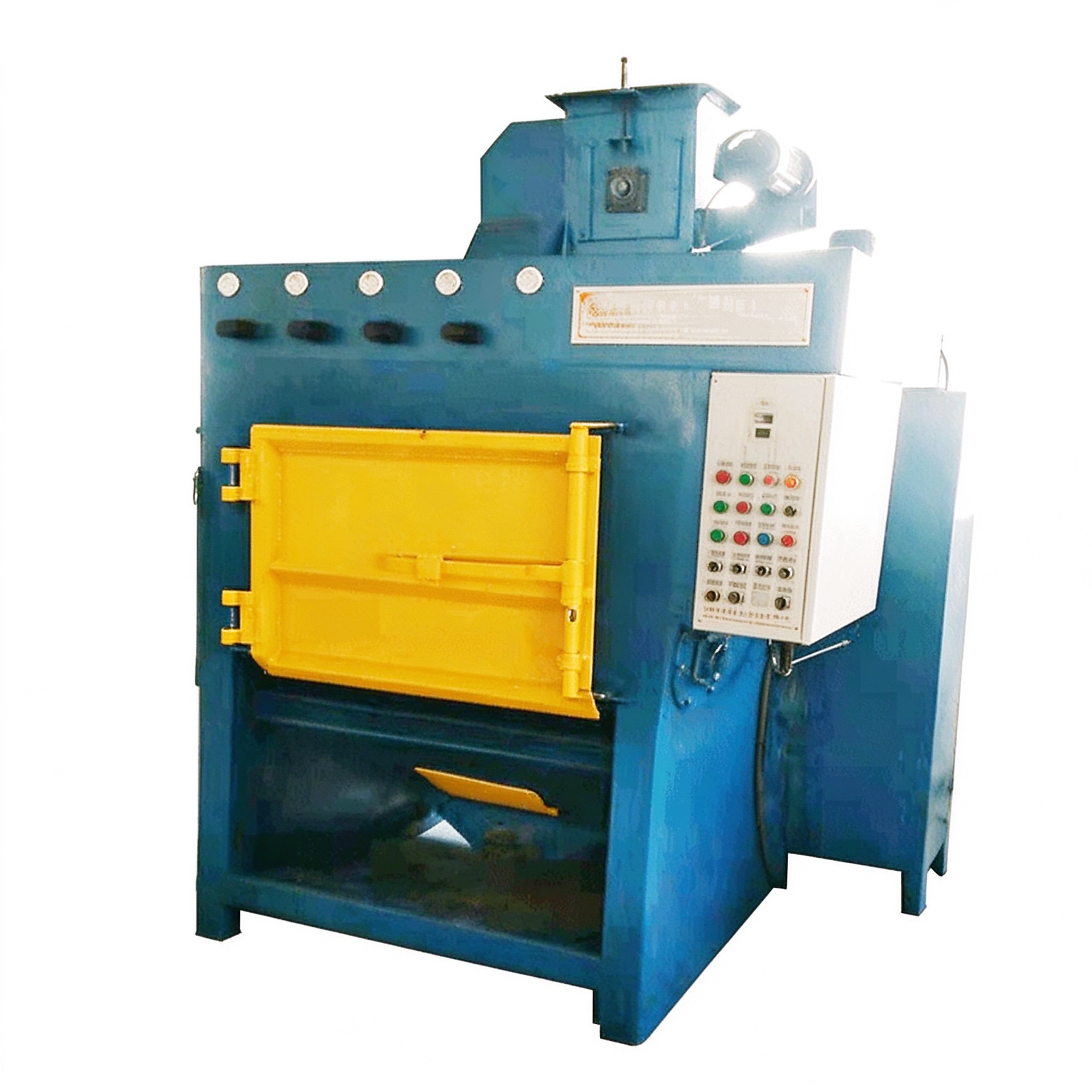
Cabin-Type and Dustless Sandblasting Machines
Closed cabin machines are the workhorse of precision surface treatment. They contain the abrasive and the dust inside an enclosure, protect operators, and allow consistent nozzle-to-workpiece distance. Dustless environmental models add filtration and abrasive recovery so that the same media can be reused across cycles, which directly reduces abrasive consumption and keeps the working area cleaner.
Pressure Vessel Sandblasting Pots
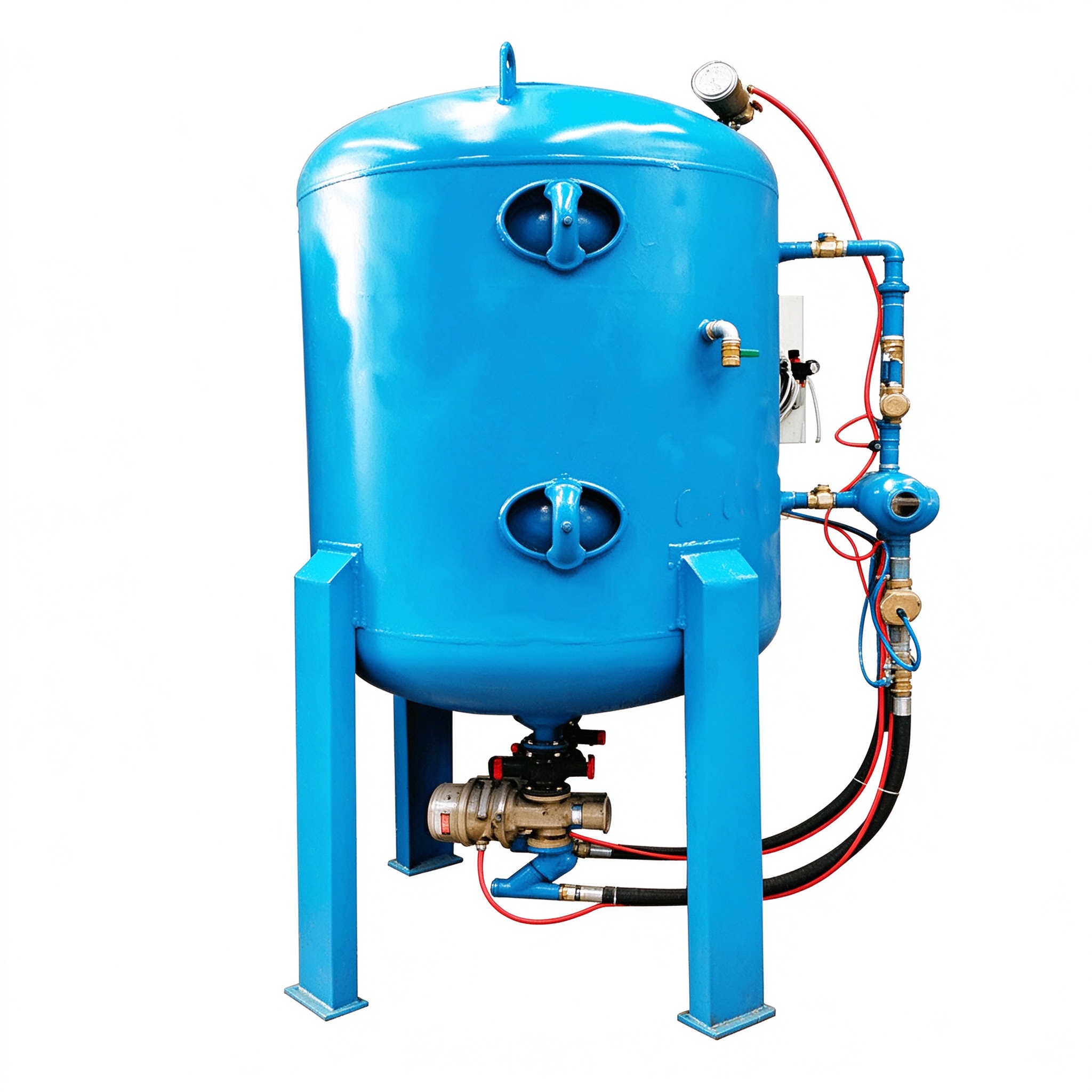
A sandblasting pot is a pressure vessel, and it should be treated as one. The company reports that all of its blast pot bodies are welded from compliant 16MnR pressure vessel steel plate, and that every tank is subjected to a hydrostatic test at 2.5 times the rated working pressure before shipment. For overseas buyers, requesting the material certificate and the pressure test record is a standard and entirely reasonable part of the purchase process.
Fully Automatic and Integrated Sandblasting Rooms
For high-volume operations, an enclosed blast room with abrasive recovery and integrated dust collection is the most efficient configuration. Because these systems must be designed around the customer’s building dimensions, crane capacity, and workpiece envelope, they are inherently custom projects. A supplier that provides layout drawings and site construction planning before fabrication is far easier to work with than one that only quotes a standard catalog item.
How to Judge Sandblasting Machine Quality Before You Buy
Quality in sandblasting equipment is rarely visible from a photograph. It shows up in material selection, welding quality, nozzle life, sealing performance, and blast uniformity. Buyers evaluating a sandblasting machine manufacturer should ask for evidence rather than assurances, and should compare answers across at least three suppliers.
- Pressure vessel documentation. Confirm the steel grade, welding procedure, and the hydrostatic test pressure and duration for every pot, not just a prototype.
- Nozzle and wear-part life. Ask what material the nozzle is made of and what service life the supplier claims. Wuqiao Anxing equips its automatic models with wear-resistant ceramic nozzles and states a service life three times that of conventional alloy nozzles.
- Sealing and blast uniformity testing. Every unit should be tested for blast uniformity, sealing performance, and continuous no-load running before delivery.
- Dust emission performance. Request the emission figures and the environmental management certification. The company’s environmental equipment is covered by ISO 14001 environmental management certification, with dust emissions well below the applicable national limits.
- Failure rate and energy data. Meaningful claims are specific. A stated 30% lower failure rate and 15% lower energy consumption than the industry average is a claim the supplier should be able to explain in engineering terms.
- Reference installations. Ask for a list of comparable projects in your industry and, where possible, speak to an existing user.
It is equally important to match the machine to the job rather than to a specification sheet. A blast pot sized for a large ship hull section will waste energy and abrasive on small castings, while a cabin machine rated for light deburring will not survive continuous structural steel work. A responsible manufacturer will push back on an over- or under-specified request rather than simply accepting the order.
Applications: Matching Equipment to the Surface Treatment Task
Sandblasting is one process family covering many distinct tasks, and the same equipment rarely suits all of them. The company’s equipment is used across shipbuilding and heavy industry, steel structure engineering, automotive components, hardware and molds, aviation parts, glass and stone, bridges and pipelines, and anti-corrosion coating work.
Typical process requirements include metal rust removal and mill scale removal before painting, burr removal and edge finishing on machined parts, paint stripping during refurbishment, matte finishing and surface texturing on decorative or grip surfaces, and surface strengthening where compressive residual stress is beneficial. Each of these implies different abrasive type, pressure range, nozzle selection, and dust handling capacity.
For anti-corrosion coating lines, the blast profile achieved before coating is what determines coating adhesion, so blast pressure stability and consistent nozzle traverse matter more than raw blasting power. For deburring and cosmetic finishing, controllability and repeatability matter more. A supplier with genuine application experience will ask about the downstream process — coating system, inspection standard, cycle time — before recommending a configuration.
Manufacturing Capacity, Delivery, and Customization
Capacity matters when a project involves dozens of units or a compressed installation window. The company operates multiple standardized assembly lines with total annual capacity reaching over a thousand units and sets, and reports a stable and controllable delivery cycle for large batch orders. It has long supplied batch procurement projects to large heavy industry groups, including shipbuilding enterprises, and can complete concentrated delivery of dozens of units in a single order.
Customization capability is the other half of that equation. Beyond standard machines, the company supports small-batch custom orders and special-condition equipment modification, and it can take on complete sandblasting and dust removal system contracts. For a buyer with an unusual workpiece geometry, restricted floor space, or a specific environmental requirement, the ability to obtain a tailored design from the same manufacturer that will later supply the spare parts is a substantial advantage.
Service, Spare Parts, and After-Sales Support
For overseas buyers, after-sales support is often the deciding factor. The company’s stated service model covers the full lifecycle: pre-sales engineers survey the working conditions and provide equipment selection proposals and factory layout drawings free of charge; production progress is communicated with details during manufacturing; and after shipment, technicians attend site for installation, commissioning, and operator training covering operation, routine maintenance, and basic troubleshooting.
Spare parts availability is supported by a stocked inventory, with remote diagnostic guidance and on-site repair as a dual support channel, which is aimed squarely at reducing unplanned downtime. Domestic sales cover nearly thirty provinces and regions with resident after-sales personnel and distributors in major manufacturing clusters, and export business extends to Europe, North America, the Middle East, Southeast Asia, and Hong Kong, Macao, and Taiwan, with repeat orders reported from Myanmar, South Korea, and several Middle Eastern markets. Long-term cooperating customers include large shipbuilding groups, steel structure plants, automotive parts manufacturers, 3C precision manufacturing companies, and construction machinery makers, totaling more than three hundred manufacturing units.
How to Request a Quotation and Compare Suppliers Fairly
When requesting a sandblasting machine price and quotation, give the supplier enough information to quote accurately. Include workpiece dimensions and weight, material, required surface finish or cleanliness standard, hourly or daily throughput target, available floor space and ceiling height, power supply and compressed air availability, and any local dust or noise regulations. Suppliers who quote without asking these questions are quoting a catalog number, not a solution.
Compare quotations on total cost of ownership rather than purchase price alone: abrasive consumption per square meter, nozzle and hose replacement frequency, energy draw, dust collector filter life, and the cost of a service visit. Then confirm the commercial basics — warranty terms, spare parts lead time, documentation language, and whether installation and training are included. Buyers who follow this process usually find that the cheapest quotation and the most reliable sandblasting machine manufacturer are rarely the same supplier.
FAQ
How do I identify a reliable sandblasting machine manufacturer?
Look for a long operating history in the same product category, documented quality control such as pressure vessel material certificates and hydrostatic test records, verifiable certifications, a real spare parts inventory, and reference projects in your own industry. A supplier that has manufactured sandblasting equipment continuously for decades, holds recognized science and technology SME status, and can explain its failure rate and energy consumption figures in engineering terms is generally a safer choice than one competing purely on price.
What determines the quality of a pressure vessel sandblasting pot?
The steel grade, welding quality, and testing regime are the core factors. Pots should be welded from compliant pressure vessel steel plate and pressure tested beyond the working rating — a hydrostatic test at 2.5 times rated pressure, as carried out on every tank by Wuqiao Anxing, is a strong indicator. Ask for the material certificate and test report for the specific unit you are buying, and confirm that the rated pressure matches the abrasive flow and duty cycle you actually need.
What information do I need to provide to get an accurate sandblasting machine price?
Provide workpiece size, weight, and material; the required surface cleanliness or roughness standard; target throughput per hour or per shift; available floor space and height; power and compressed air supply; and any local dust or noise limits. With those details a manufacturer can quote a correctly sized machine or blast room. Without them the quotation will either be over-specified and expensive, or under-specified and unsuitable.
Can a dustless sandblasting machine help meet environmental requirements?
Yes. Dustless and enclosed designs capture dust at the source and recover abrasive for reuse, which reduces both emissions and media consumption. The company’s environmental equipment is covered by ISO 14001 environmental management certification and reports dust emissions well below applicable limits, which helps buyers satisfy factory inspections and emission permits. Buyers should still confirm that the specified configuration matches their own local limits.
Do you support custom sandblasting rooms and non-standard equipment?
Yes. Complete sandblasting room systems, including fully automatic rooms and recovery and dust collection integrated rooms, are designed around the customer’s building dimensions and workpiece envelope, with layout planning and site construction included. Non-standard equipment modification and small-batch custom orders are also supported alongside standard machine production.
What after-sales support is available for overseas customers?
Support typically includes installation and commissioning by technicians on site, operator training covering operation, daily maintenance, and basic fault finding, stocked spare parts for fast dispatch, and a combination of remote diagnostic guidance and on-site repair. Before ordering, confirm the response time, the spare parts lead time for your region, and the documentation language, and ask which consumables you should keep in local stock.
How long does delivery take for large batch orders?
Delivery depends on configuration and quantity, but a manufacturer with multiple standardized assembly lines and annual capacity above a thousand units and sets can maintain a predictable schedule and has completed concentrated deliveries of dozens of units in single orders for large heavy industry clients. Request a production schedule with milestone dates rather than a single delivery estimate.
Which industries use this type of sandblasting equipment?
Common applications include shipbuilding and heavy industry, steel structure fabrication, automotive components, hardware and molds, aviation parts, glass and stone processing, bridge and pipeline work, and anti-corrosion coating operations. The equipment handles rust and mill scale removal, deburring, paint stripping, matte finishing, surface texturing, and surface strengthening.
Summary
Choosing a reliable sandblasting machine manufacturer comes down to evidence: a long track record in the same product category, transparent quality control including pressure vessel testing and emission data, a product range broad enough to cover the whole system, documented capacity for both standard and custom orders, and an after-sales structure that will still be there when the first nozzle wears out. Price matters, but it should be compared on total cost of ownership across abrasive, energy, wear parts, and downtime.
Wuqiao Anxing Sandblasting Machinery Co., Ltd. fits that profile as a reference point: manufacturing since 1991, recognized as a provincial science and technology SME in 2023 and a national-level one in 2025, more than ten patents in blast structures and dust recovery, four integrated product lines spanning sandblasting machines, pressure vessel sandblasting pots, complete blast rooms, and supporting compressors and consumables, batch delivery capability for large projects, and a service model built around site survey, installation, training, and stocked spare parts. For buyers comparing sandblasting machine suppliers for shipbuilding, steel structures, automotive parts, or anti-corrosion coating work, evaluating candidates against the checklist in this guide — and requesting a properly specified quotation rather than a catalog price — is the most reliable way to avoid a costly wrong choice.