Surface preparation is one of the most important steps in any industrial coating, fabrication, or maintenance process. Whether a workshop is preparing steel structures for painting, removing rust from pipelines, deburring machined parts, or creating a uniform matte finish on metal components, the performance of the blasting equipment directly affects productivity, coating adhesion, and long-term asset protection. For procurement teams, plant managers, and project engineers, choosing the right industrial sandblasting machine is not simply a matter of comparing prices. It requires an understanding of workpiece size, production volume, abrasive type, environmental regulations, and the level of automation that fits the available workforce and facility.
This guide examines the main categories of blasting equipment used in modern manufacturing and maintenance operations, including mobile rust removal sandblasting machines, cabinet sandblasting machines, wet sandblasting machines, pipeline rust removal sandblasting machines, pressure vessel sandblasting tanks, and complete sandblasting room systems. It also explains how to evaluate a sandblasting machine manufacturer, what to consider during selection, and how to build a surface treatment process that is safe, compliant, and cost-effective over the long run.
Understanding Industrial Sandblasting Machines and Their Role in Surface Preparation
An industrial sandblasting machine uses compressed air or pressurized water to accelerate abrasive media toward a workpiece. The impact of the abrasive removes contaminants, scale, rust, old coatings, and burrs, while also creating a surface profile that improves the mechanical bonding of subsequent coatings. In some applications, blasting is used not to remove material but to modify the surface, such as producing a uniform satin or matte finish, enhancing fatigue resistance, or preparing a surface for inspection and non-destructive testing.
The range of equipment available today reflects the wide variety of industrial surface preparation tasks. Small precision components are often processed in cabinet sandblasting machines, where the operator works through gloves inside an enclosed chamber. Large steel structures, bridge sections, ship hulls, and storage tanks usually require mobile rust removal sandblasting machines that can be moved to the job site. Pipelines and process tubing benefit from specialized pipeline rust removal sandblasting machines designed to handle internal or external surfaces. Facilities with strict dust control requirements may choose wet sandblasting machines that suppress dust by introducing water into the abrasive stream.
Because blasting affects downstream processes, selecting the wrong machine can create bottlenecks, increase abrasive consumption, or cause rework. A machine that is too small for the workload will slow production, while a machine that is oversized for the application may waste energy and floor space. The correct choice balances chamber size, abrasive handling capacity, dust extraction performance, and the skill level of the operators who will use the equipment every day.
Complete Product Range from a Professional Sandblasting Machine Manufacturer
A capable sandblasting machine manufacturer should offer more than a single product line. Surface treatment projects often require a combination of machines, tanks, rooms, and accessories that work together as a system. Wuqiao Anxing Sandblasting Machinery Co., Ltd., based in Wuqiao County, Cangzhou, Hebei Province, has focused on industrial surface treatment equipment since 1991. The company operates standardized production facilities and has developed a product portfolio that covers four major categories: sandblasting machines, pressure vessel sandblasting tanks, complete sandblasting room systems, and supporting equipment such as air compressors, blast guns, abrasive hoses, recovery systems, and pulse dust collectors.
This integrated product range allows buyers to source the main machine, the pressure vessel, the dust collection system, and the consumable parts from one supplier. For projects that require a coordinated installation, this reduces interface risk and simplifies technical communication. The company also provides customized engineering, including non-standard equipment design and turnkey sandblasting and dust removal system contracting, which is useful for factories with unusual layouts, large workpieces, or specific environmental requirements.
Cabinet Sandblasting Machines for Precision and Small-Part Processing
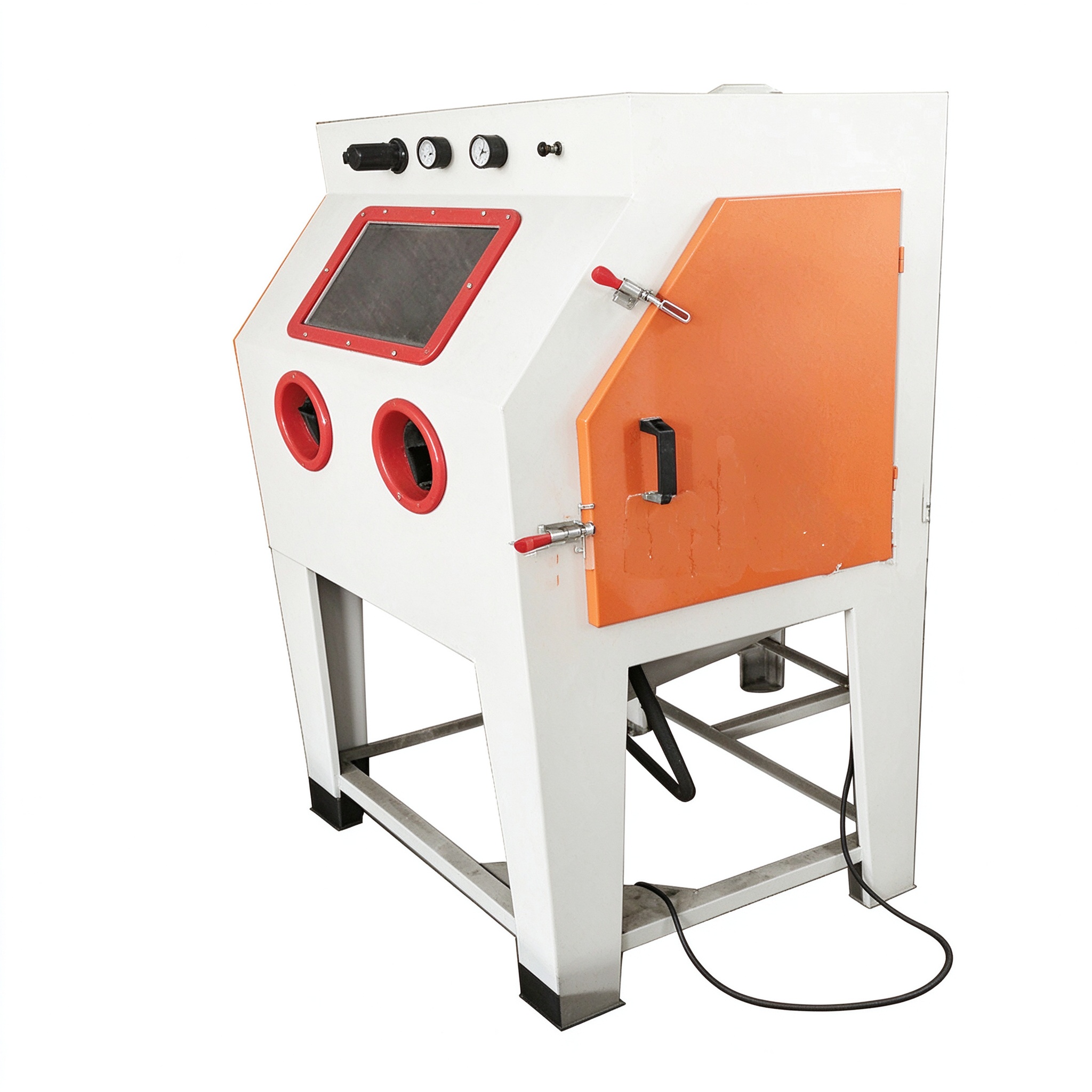
Cabinet sandblasting machines are enclosed units designed for manual or semi-automatic processing of smaller workpieces. They are commonly used for deburring, removing oxide scale, cleaning molds, preparing surfaces for bonding, and creating decorative finishes. Because the blasting process takes place inside a cabinet, abrasive and dust are contained, making these machines suitable for workshops where space is limited and cleanliness is important. Typical users include automotive component suppliers, hardware and tool manufacturers, dental and medical instrument producers, and precision engineering shops.
When selecting a cabinet machine, buyers should confirm the internal chamber dimensions, the maximum workpiece weight, the abrasive recovery system, and the dust extraction configuration. A well-designed cabinet should provide good visibility, easy access for loading and unloading, and reliable glove port sealing. The blast gun, nozzle material, and pressure control also affect cycle time and abrasive consumption, so these details should be reviewed with the manufacturer before ordering.
Mobile Rust Removal Sandblasting Machines for On-Site and Large-Structure Work
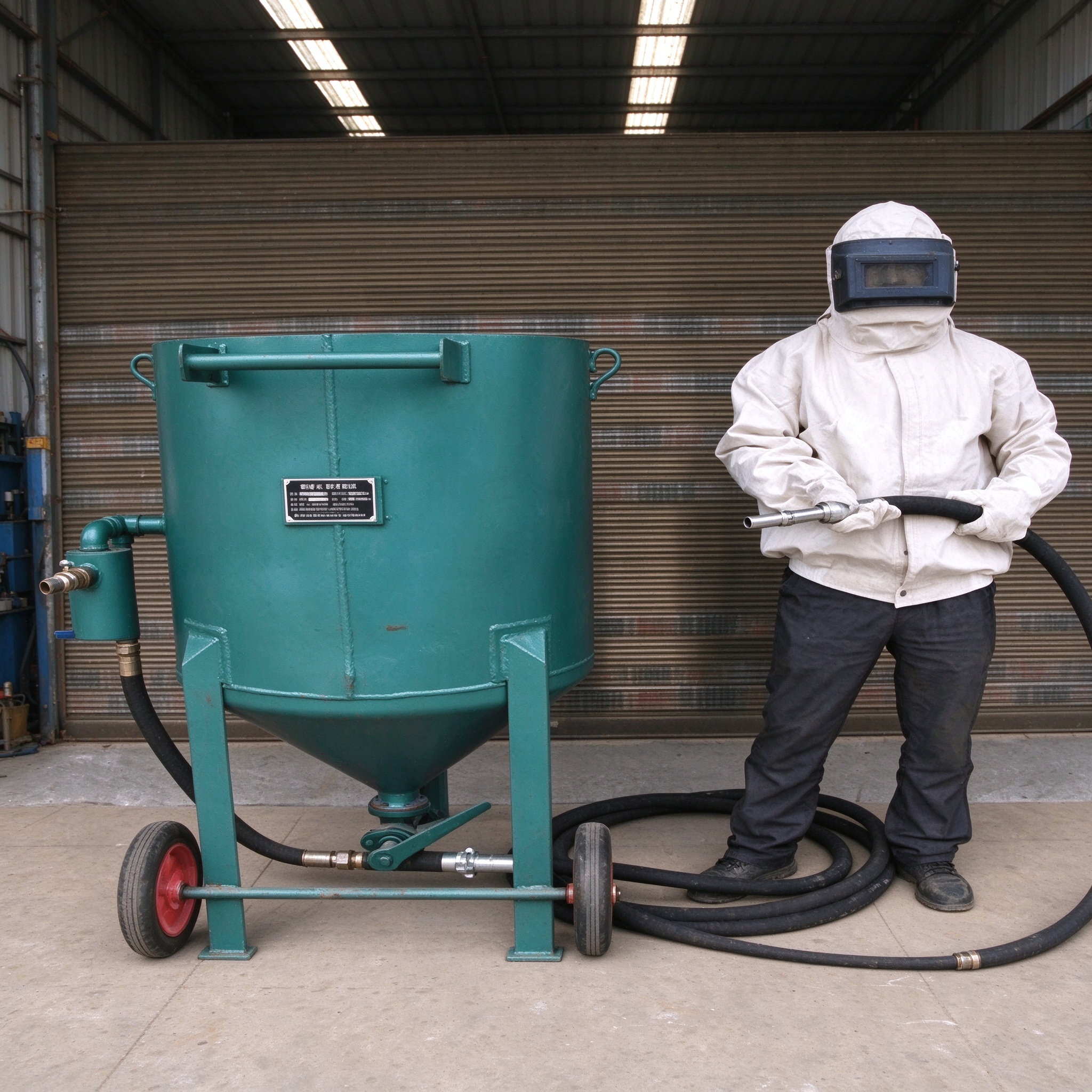
Mobile rust removal sandblasting machines are built for field work and large assemblies that cannot easily be moved into a blasting cabinet or room. These units are often mounted on wheels or a skid, making it possible to move them around a fabrication yard, shipyard, bridge site, or maintenance depot. They are used to remove rust, mill scale, and old paint from steel structures, storage tanks, pipe racks, and heavy equipment before recoating.
The key selection factors for mobile machines include mobility, pressure rating, abrasive tank capacity, and operator safety. A machine with a larger abrasive tank can run longer between refills, which is important when working on remote sites. The pressure vessel should be manufactured to applicable pressure vessel standards and tested before delivery. Dust suppression or containment may also be required depending on the site location and local environmental rules. For outdoor work, a mobile machine with a reliable remote control system and durable blast hose is often preferred because it reduces operator fatigue and downtime.
Wet Sandblasting Machines for Dust-Sensitive and Pipeline Applications
Wet sandblasting machines introduce water into the blasting process to reduce airborne dust. This approach is particularly valuable when working in confined spaces, near sensitive equipment, or in areas where dry blasting would create unacceptable dust levels. Wet blasting can also be used for cleaning surfaces that are contaminated with oils or soluble residues, because the water helps flush away loosened material.
For pipeline maintenance, a pipeline rust removal sandblasting machine may be configured to treat internal or external surfaces. Internal pipeline blasting requires careful control of abrasive size, air volume, and dust extraction to avoid leaving abrasive residue inside the pipe. External pipeline blasting often uses mobile or semi-mobile equipment that can follow the pipeline route. In both cases, the machine must be matched to the pipe diameter, length, and access conditions. A manufacturer with experience in pipeline work can recommend the appropriate nozzle type, hose length, and recovery method.
Pressure Vessel Sandblasting Tanks and Complete Sandblasting Room Systems
Pressure vessel sandblasting tanks are the core pressure-generating component in many blasting systems. They are available in stationary, mobile, electric-control, and pneumatic-control configurations. The tank stores abrasive under pressure and delivers it to the blast hose at a controlled rate. Buyers should pay attention to the tank material, wall thickness, welding quality, pressure rating, and safety accessories. Tanks manufactured from qualified pressure vessel steel and tested at a multiple of the rated working pressure provide a higher level of confidence for continuous industrial use.
For higher production volumes or larger workpieces, a complete sandblasting room system may be the better solution. These rooms combine a blasting enclosure, abrasive recovery floor, ventilation, dust collection, and often automated or semi-automated handling equipment. They are used in shipbuilding, steel structure fabrication, heavy machinery, and coating plants. A well-designed room improves operator comfort, reduces abrasive waste, and makes it easier to maintain consistent surface quality across large batches. Because room systems are built around the building and the workpiece flow, they require engineering input from the supplier, including layout drawings and utility requirements.
Selection Guide: How to Match Sandblasting Equipment to Your Workpiece and Workflow
Choosing the right equipment starts with a clear definition of the workpiece and the required surface finish. The same workshop may need a cabinet machine for small parts and a mobile unit for large fabrications. The following table summarizes the main selection criteria for common equipment categories.
| Equipment Type | Typical Workpiece | Key Selection Factors | Best Fit |
|---|---|---|---|
| Cabinet sandblasting machine | Small to medium precision parts | Chamber size, abrasive recovery, dust extraction, visibility | Workshops with repetitive small-part cleaning |
| Mobile rust removal sandblasting machine | Large steel structures, tanks, frames | Mobility, tank capacity, pressure rating, site dust control | On-site maintenance and fabrication yards |
| Wet sandblasting machine | Dust-sensitive parts, oily surfaces, pipelines | Water supply, slurry handling, corrosion protection after blasting | Confined spaces and environmentally sensitive sites |
| Pipeline rust removal sandblasting machine | Internal and external pipe surfaces | Pipe diameter, length, access, abrasive recovery | Pipeline maintenance and pre-coating preparation |
| Sandblasting room system | Large batches, oversized components | Room dimensions, recovery floor, ventilation, automation level | Shipyards, steel structure plants, coating facilities |
Beyond the equipment type, buyers should consider production rhythm. A job shop that processes a wide variety of parts may value flexibility and quick changeover more than raw speed. A high-volume manufacturer may benefit from a PLC-controlled automatic conveying system that moves parts through the blasting zone at a consistent rate. The abrasive itself also matters: different media produce different surface profiles and consume different amounts of energy. The manufacturer should be able to recommend a media type based on the target finish and the workpiece material.
Environmental and safety requirements are equally important. Dust collection efficiency, noise levels, pressure vessel certification, and operator protection all affect whether a machine can be used legally and safely in a given location. A supplier that understands local emissions standards can help configure the dust collector and ventilation system correctly from the start, avoiding costly modifications later.
Quality Assurance and Manufacturing Capabilities
Reliability in blasting equipment comes from disciplined manufacturing and testing. A pressure vessel sandblasting tank, for example, should be fabricated from qualified steel and subjected to a hydrostatic test at a pressure well above the rated working pressure before shipment. This verifies weld integrity and gives the end user confidence that the tank can withstand continuous industrial operation. The blast gun, nozzle, and hose should also be selected for wear resistance, because these components have a direct impact on downtime and abrasive consumption.
Wuqiao Anxing Sandblasting Machinery has built its production around a full-process quality control system. The company uses 16MnR pressure vessel steel for tank fabrication and performs hydrostatic testing on every tank before delivery. Automatic models are equipped with wear-resistant ceramic nozzles that last significantly longer than standard alloy nozzles, reducing replacement frequency. Each complete machine is checked for blasting uniformity, sealing performance, and continuous no-load operation before shipment. These checks help identify assembly issues before the equipment reaches the customer site.
The company also invests in research and development. Its engineering team works on blasting structure design, dust recovery, pressure control, and noise reduction. Several utility patents cover adaptive pressure regulation, automatic abrasive circulation, and intelligent dust removal. In practice, these technologies help lower failure rates and energy consumption compared with conventional equipment. For buyers, this translates into fewer unplanned stoppages and lower operating costs over the life of the machine.
Industry Applications and Surface Treatment Solutions
Industrial blasting equipment is used across a wide range of sectors, each with its own requirements. In shipbuilding and heavy engineering, large-scale blasting is used to prepare steel plates and hull sections before painting. The equipment must handle high volumes and produce a consistent surface profile that meets coating specifications. In steel structure fabrication, mobile and room-based systems remove mill scale and rust from beams, columns, and connection details before protective coating.
Automotive and transportation component manufacturers use cabinet machines and automated systems for deburring, surface cleaning, and preparation for bonding or painting. Hardware, tooling, and mold makers rely on blasting to clean cavities, remove heat treatment scale, and create uniform surface textures. Pipeline contractors use specialized equipment to clean internal and external pipe surfaces before applying protective coatings. Glass, stone, and architectural product manufacturers use blasting to create matte, etched, or textured finishes.
- Shipbuilding and heavy engineering: large-scale rust removal and surface profiling before coating.
- Steel structure fabrication: removal of mill scale and rust from beams, columns, and frames.
- Automotive and machinery parts: deburring, cleaning, and surface preparation for bonding.
- Pipeline maintenance: internal and external rust removal before lining or wrapping.
- Glass and stone processing: matte finishing, etching, and surface texturing.
- Coating and anti-corrosion projects: surface preparation to improve coating adhesion.
Because each industry has different workpiece sizes, production rates, and finish requirements, a single standard machine rarely fits every case. This is why customization is an important part of the supplier relationship. A manufacturer that can modify chamber dimensions, adjust pressure control, add dust collection features, or integrate conveyors is better positioned to deliver a system that matches the actual production environment.
Environmental Compliance and Sustainable Surface Treatment
Dust and noise are two of the most common concerns associated with abrasive blasting. Modern equipment addresses these issues through enclosed cabinets, well-designed ventilation, pulse-jet dust collectors, and noise-reducing components. For outdoor or semi-open operations, water-assisted blasting or temporary containment may be required to keep dust within acceptable limits. Choosing equipment with effective dust extraction from the beginning is usually more economical than retrofitting a containment system later.
Environmental management systems also play a role in supplier selection. A manufacturer that follows recognized environmental standards, such as ISO 14001, demonstrates that it manages its own production processes responsibly. For the buyer, the more practical question is whether the supplied equipment can meet the local emission limits and safety requirements at the installation site. The dust collector capacity, filter media, duct design, and discharge point should all be reviewed against the expected blasting workload.
Energy efficiency is another aspect of sustainable operation. Modern compressors, pressure regulation, and abrasive recovery systems can reduce the amount of compressed air and abrasive consumed per square meter of treated surface. In a high-volume operation, these savings accumulate quickly. Buyers should ask for the expected air consumption, abrasive consumption, and maintenance interval for each proposed configuration so they can compare total operating cost rather than only the purchase price.
Service, Support, and After-Sales: What to Expect from a Reliable Supplier
Blasting equipment is often a long-term investment, and the quality of after-sales support matters as much as the machine itself. A reliable supplier should provide pre-sales engineering support, including site visits or remote assessment, equipment selection recommendations, and layout drawings when a room or system is involved. During production, the supplier should keep the customer informed about progress and key manufacturing details. After delivery, installation, commissioning, and operator training help ensure the equipment starts up correctly and is used safely.
Once the machine is in operation, quick access to spare parts and technical advice reduces downtime. Common wear parts include nozzles, blast hoses, gloves, window panels, and filter cartridges. A supplier with local stock or fast shipping arrangements can shorten repair time. Remote troubleshooting is also valuable for simple issues, while scheduled on-site maintenance may be appropriate for larger systems. Buyers should confirm the warranty terms, spare parts availability, and response process before placing an order.
For international buyers, communication and documentation are particularly important. Clear English-language manuals, wiring diagrams, pressure test certificates, and packing lists help avoid installation delays. It is also useful to confirm the voltage, frequency, and compressed air supply requirements for the destination country. A manufacturer experienced in export projects can prepare the equipment for international shipping and provide the necessary technical documents.
FAQ
What is the difference between a cabinet sandblasting machine and a mobile rust removal sandblasting machine?
A cabinet sandblasting machine is an enclosed unit designed for smaller workpieces that can be loaded into the chamber. It contains the abrasive and dust, making it suitable for workshops and precision parts. A mobile rust removal sandblasting machine is built for large or fixed structures that cannot be moved into a cabinet. It is usually mounted on wheels or a skid and is used outdoors or in fabrication yards for on-site rust removal and surface preparation.
When should I choose a wet sandblasting machine instead of a dry blasting system?
A wet sandblasting machine is a good choice when dust control is a priority, such as in confined spaces, near sensitive equipment, or in areas with strict environmental limits. It can also help when the surface contains oils or soluble contaminants. However, wet blasting requires water supply and slurry handling, and the blasted surface may need corrosion protection sooner than with dry blasting. The decision should be based on site conditions, workpiece material, and the required surface finish.
Can a pipeline rust removal sandblasting machine be customized for different pipe diameters?
Yes. Pipeline rust removal equipment can be configured with different nozzle arrangements, hose lengths, and recovery methods to suit various pipe diameters and access conditions. For internal pipeline blasting, the machine must be matched to the pipe length and the allowable abrasive residue level. For external blasting, mobility and dust control are usually the main considerations. A manufacturer with pipeline experience can recommend the appropriate configuration after reviewing the pipe dimensions and job site conditions.
What should I check on a pressure vessel sandblasting tank before purchase?
Buyers should review the tank material, wall thickness, welding quality, design pressure, and safety accessories. The tank should be manufactured from qualified pressure vessel steel and tested at a pressure above the rated working pressure. Hydrostatic test certificates and material reports should be available. The abrasive metering valve, control system, and pressure relief arrangement should also be inspected to ensure reliable and safe operation.
How do I choose between a standard sandblasting room and a custom-designed system?
A standard sandblasting room may work when the workpiece dimensions and production flow fit within the manufacturer’s predefined range. A custom-designed system is usually necessary when the building layout is unusual, the workpieces are oversized, or the production process requires specific handling equipment. Custom design should include room dimensions, ventilation, dust collection, abrasive recovery, lighting, and safety provisions. The supplier should provide layout drawings and utility requirements before the project begins.
What maintenance is required to keep an industrial sandblasting machine running reliably?
Regular maintenance includes checking nozzle wear, inspecting blast hoses for abrasion or leaks, cleaning or replacing dust collector filters, checking the pressure vessel and safety valves, and verifying the abrasive metering system. Operators should also inspect glove ports, window panels, and seals on cabinet machines. A preventive maintenance schedule based on actual operating hours helps avoid unexpected breakdowns and keeps blasting performance consistent.
How can I reduce abrasive consumption in an automatic sandblasting system?
Abrasive consumption depends on nozzle size, blasting pressure, abrasive type, and the recovery system. Using a properly sized nozzle, maintaining the correct pressure for the application, and ensuring that the abrasive recovery and cleaning system is working efficiently can reduce waste. In automatic systems, consistent part positioning and cycle time control also help. The manufacturer should be able to recommend operating parameters that balance blasting quality with abrasive efficiency.
What factors affect the price of a pipeline rust removal sandblasting machine?
Price is influenced by the machine’s pressure rating, abrasive tank capacity, control type, mobility features, and dust collection requirements. Custom configurations for specific pipe diameters or site conditions also affect cost. For a meaningful quotation, buyers should provide the pipe size range, total length to be treated, required surface finish, available power and air supply, and site environmental rules. Comparing suppliers on total operating cost and after-sales support is often more useful than comparing headline prices alone.
Summary
Selecting an industrial sandblasting machine requires a clear understanding of the workpiece, production volume, surface finish requirements, and site conditions. Cabinet machines serve precision small-part processing, mobile rust removal units handle large structures and on-site work, wet blasting systems address dust-sensitive applications, and pipeline-specific equipment supports internal and external pipe preparation. Pressure vessel sandblasting tanks and complete sandblasting room systems provide the capacity and control needed for higher-volume operations.
For B2B buyers, the supplier’s engineering capability, quality control, and after-sales support are as important as the equipment specification. A manufacturer with decades of experience in surface treatment, a broad product range, documented pressure testing, and export project experience can help reduce technical risk and keep the project on schedule. By evaluating equipment and supplier together, procurement teams can build a blasting process that delivers consistent surface quality, safe operation, and predictable long-term costs.