Surface preparation is one of the most underestimated cost drivers in heavy industry. A coating system that fails after two years is rarely a paint problem — it is almost always a substrate problem. Rust, mill scale, old paint layers and salt contamination must be removed to a defined cleanliness standard before any primer is applied, and that is exactly where a mobile rust removal sandblasting machine earns its place on site. Unlike fixed installations, a mobile unit can be moved to the bridge, the ship hull, the storage tank or the steel fabrication yard, delivering consistent blasting performance wherever the workpiece happens to be.
This guide explains how mobile sandblasting equipment works, what specifications actually matter, how to match a machine to your workload, and how to evaluate a sandblasting machine manufacturer before committing to a purchase order. It is written for contractors, fabrication shops, shipyards, pipeline operators and maintenance teams who need equipment that performs reliably under real production pressure.
What Is a Mobile Rust Removal Sandblasting Machine?
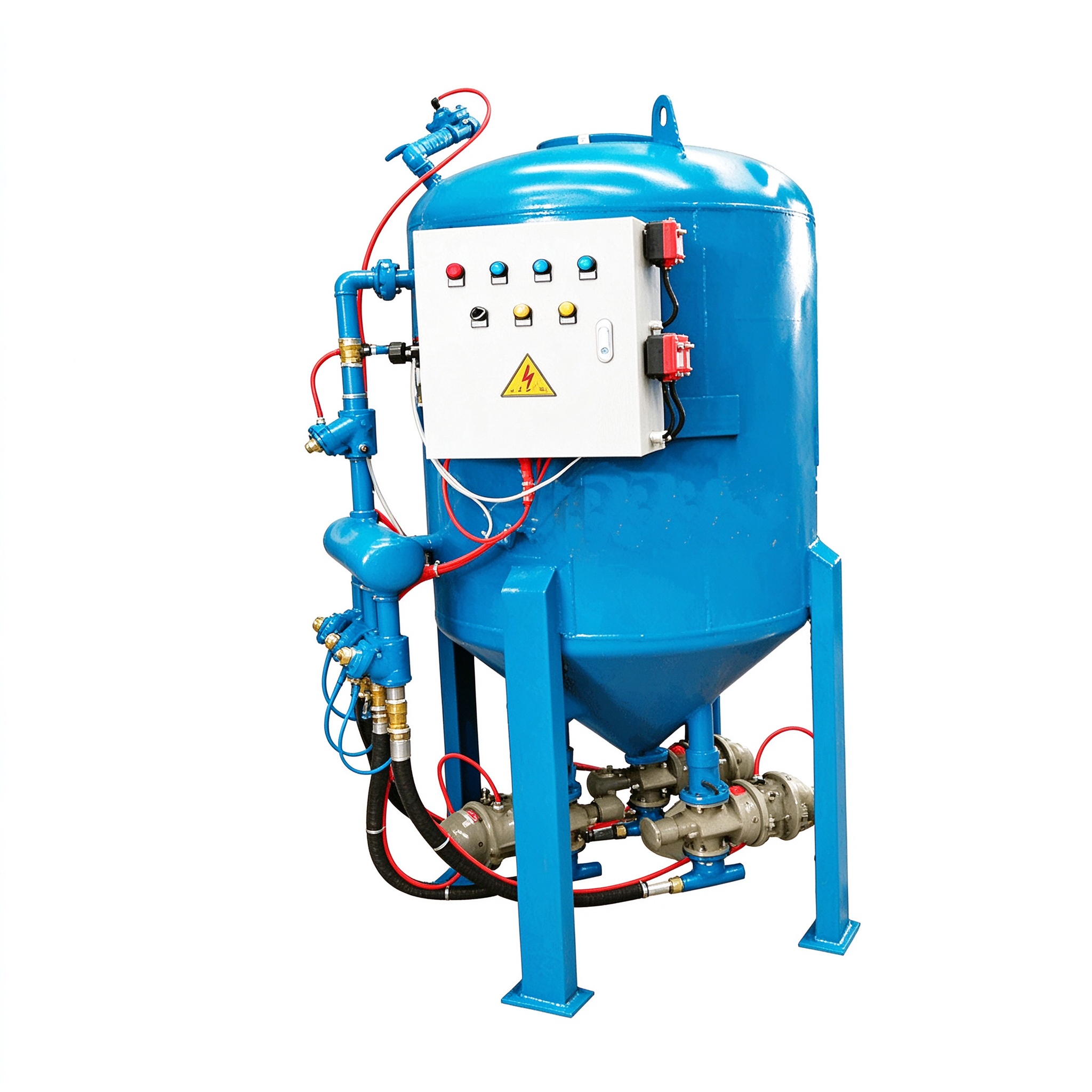
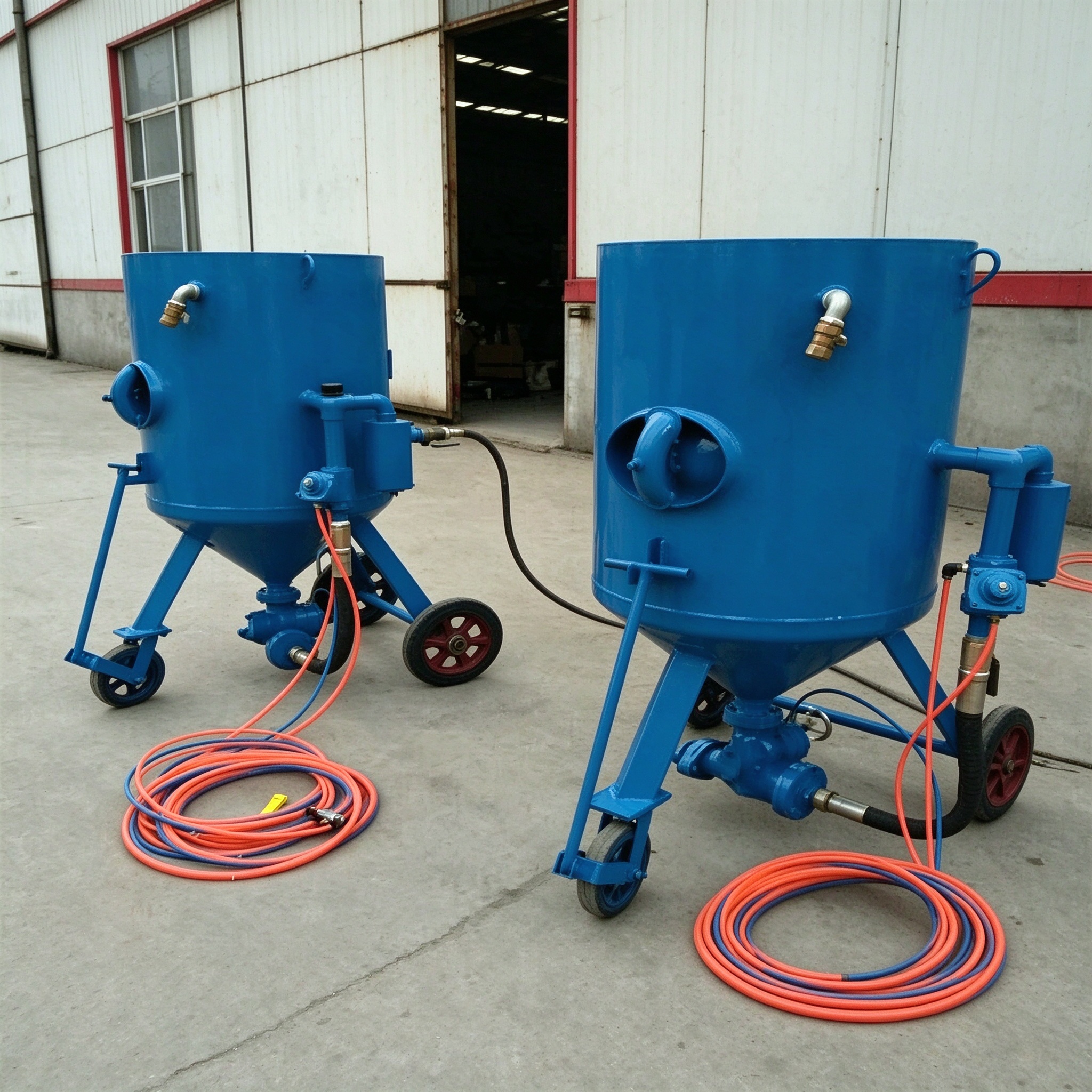
A mobile rust removal sandblasting machine is a field-deployable surface treatment system built around a pressurized abrasive vessel, an air supply, a control valve set and a blast hose with nozzle. The unit is mounted on a wheeled chassis or skid so it can be towed or lifted to different work areas, which makes it ideal for large, immovable structures such as bridge girders, storage tanks, ship hulls, transmission towers, pipe spools and heavy construction equipment.
Air from a dedicated compressor is regulated to a working pressure, mixed with abrasive in the pressure vessel, and accelerated through the nozzle onto the workpiece surface. The kinetic energy of the abrasive breaks down rust, scale and coating, while the airstream carries the debris away. Because the blast stream is directed manually, the operator controls the cleaning pattern, the angle and the dwell time — which is why operator training has a direct effect on blasting quality and abrasive consumption.
Core Working Principle and Main Components
The pressure-vessel design is what separates a productive field machine from an entry-level unit. In a pressure system, abrasive is stored in a vessel that is pressurized during blasting, so the abrasive is pushed rather than siphoned. The result is higher impact velocity, a wider effective blast pattern and significantly better productivity on hard rust and thick mill scale.
- Pressure vessel (blast pot): the reservoir that holds abrasive under pressure; sizing determines how long the operator can work between refills.
- Control valve assembly: regulates abrasive flow and allows the operator to start and stop blasting from the nozzle end.
- Blast hose and nozzle: the consumable path for abrasive; nozzle bore size and material strongly affect productivity and running cost.
- Air supply: a compressor sized for the required free air delivery at the nozzle pressure, connected through a moisture trap and filter.
- Dust collection or suppression: recovery and filtration equipment that keeps emissions within site limits and protects operators.
- Chassis and lifting points: the frame, wheels and lifting lugs that make the unit genuinely portable between work fronts.
Why Mobile Sandblasting Equipment Matters on Real Projects
The economic argument for mobile blasting is simple: moving the workpiece to a fixed blasting room is often impossible or prohibitively expensive. A 40-metre bridge girder, a section of penstock pipe or a hull block cannot be carried into a workshop. Bringing the blasting capability to the asset removes logistics cost, reduces handling risk and shortens the maintenance window.
Mobile units also support staged project execution. On a large site, several work fronts may need surface preparation at the same time — a tank farm here, a pipe rack there. A fleet of towable machines can be redistributed as priorities change, whereas a fixed chamber locks capacity into one location.
Productivity and Cost Advantages
- No transport bottleneck: blasting happens where the asset stands, eliminating crane time and haulage for large components.
- Scalable capacity: add machines to add throughput without building a new facility.
- Lower rework risk: prepared surfaces can be primed immediately, reducing the window for flash rust to form.
- Consistent surface profile: controlled pressure and abrasive flow deliver a repeatable anchor pattern for coating adhesion.
- Reduced abrasive waste: a properly tuned pressure system with correct nozzle selection consumes less abrasive per square metre than an oversized or misadjusted setup.
Key Specifications to Compare Before You Buy
Specification sheets can look similar across suppliers, so it pays to know which figures actually drive performance. The table below summarises the parameters that matter most when comparing mobile units, together with the practical consequences of each choice. Values should always be confirmed against your own blasting specification, abrasive type and site air supply.
| Parameter | What It Affects | Selection Guidance |
|---|---|---|
| Vessel capacity | Blasting time between refills and operator handling weight | Larger vessels suit long continuous passes on large steel; smaller vessels suit scattered touch-up work |
| Working pressure range | Cleaning speed, surface profile depth, abrasive consumption | Match nozzle pressure to the coating specification; adjustable regulation allows switching between heavy descaling and gentle cleaning |
| Nozzle bore and material | Productivity, air demand, wear life and running cost | Wear-resistant ceramic nozzles last far longer than standard alloy types and hold their bore size, keeping blast performance stable |
| Air consumption vs compressor output | Whether the machine can hold pressure continuously | Size the compressor above nozzle demand, accounting for hose losses and filter restrictions |
| Dust collection capacity | Site compliance, visibility and operator exposure | For enclosed or indoor work, specify recovery and filtration sized to the blast nozzle, not to the vessel |
| Mobility and handling | How quickly the unit can move between work fronts | Wheels for yard movement, lifting lugs for crane placement, skid base for confined areas |
| Controls (pneumatic or electric) | Ease of operation, safety interlock options, maintenance complexity | Electric control suits automated dosing and remote operation; pneumatic control suits remote sites without reliable power |
How to Select the Right Machine for Your Workload
Selection should start from the workpiece, not from the catalogue. Two projects with the same tonnage can need very different machines if one involves thin sheet metal and the other involves 25 mm plate with heavy mill scale. A structured selection process reduces the risk of buying a machine that is either underpowered for daily production or oversized for occasional touch-up work.
Step 1: Define the Workpiece and Cleanliness Standard
Note the largest and smallest parts you will process, the substrate material, the type of contamination and the required cleanliness grade. Heavy rust and mill scale on thick plate call for a pressure-fed mobile machine with a larger nozzle; precision components, moulds and small castings are better served by a cabinet sandblasting machine where the abrasive is contained and recovered inside an enclosure.
Step 2: Assess Site Conditions and Power Availability
Outdoor sites, remote pipeline spreads and shipyards often have limited electrical infrastructure. Pneumatic or electric-pneumatic control versions avoid dependence on site power, while fully electric control versions support process automation such as timed blasting cycles and pressure feedback. Access width, ground surface and crane availability decide whether the unit should be towed, lifted or skid-mounted.
Step 3: Plan the Abrasive and Dust Strategy
Abrasive choice affects both finish and operating cost. Dry abrasives are common in open blasting, while water-sand mixed sandblasting suppresses dust at the source and is often requested where airborne dust is unacceptable. For enclosed work, an integrated blasting room with abrasive recovery and pulse-jet filtration converts what would be a consumable loss into a reusable loop and keeps emissions inside regulatory limits.
Step 4: Match Ancillary Equipment
No blasting machine performs at its rated level with an undersized compressor or a wet air line. Moisture in the air supply causes abrasive clumping and clogged valves, so a properly sized moisture separator and filter are essential. Blast hose length, nozzle bore and hose diameter must be treated as a system: every metre of hose and every restriction reduces pressure at the nozzle.
Mobile Versus Cabinet Sandblasting Machine: Matching Equipment to Workflow
Many buyers operate both types of equipment, because they solve different problems. A cabinet sandblasting machine is intended for smaller workpieces that can be loaded into an enclosure, offering abrasive recovery, controlled dust and a consistent operator environment. A mobile pressure machine is intended for large or immovable assets, where reach and mobility outweigh containment.
| Criterion | Mobile Rust Removal Sandblasting Machine | Cabinet Sandblasting Machine |
|---|---|---|
| Typical workpiece | Bridges, tanks, hulls, pipe spools, heavy structures | Moulds, castings, fasteners, small fabricated parts |
| Dust containment | Requires recovery equipment, screens or wet suppression | Built-in enclosure and filtration |
| Abrasive use | Usually consumable; recovery possible with accessory systems | Recirculated inside the cabinet |
| Throughput model | Area per hour on large surfaces; multiple units can be parallelised | Batch processing of many small parts |
| Best fit | Field maintenance, construction sites, shipyards, pipelines | Workshops with repeatable small-part finishing |
Water-Sand Mixed Sandblasting and Pipeline Applications
Two application families deserve particular attention because they place specific demands on equipment design. The first is wet blasting, where water is introduced into the abrasive stream. The second is internal and external work on pipelines, where access is restricted and the surface geometry is curved.
Water-Sand Mixed Sandblasting Machines
A water-sand mixed sandblasting machine blends water with abrasive before or at the nozzle. The water envelope captures airborne dust, improves visibility for the operator and reduces the risk of dust migration beyond the work area. It is frequently selected for maintenance work in populated or environmentally sensitive locations, and for surfaces where a dust plume would disrupt other trades on site. The trade-off is that slurry must be managed and the surface may need additional drying before priming, so the specification should state the wet-to-dry transition in the coating procedure.
Pipeline Rust Removal Sandblasting
A pipeline rust removal sandblasting machine configuration focuses on reach and control. External pipe surfaces need uniform coverage around the circumference, which is achieved with rotating workpiece supports or by systematic operator passes. Internal cleaning of pipe bores requires specialised tooling and dust extraction that fits the internal diameter, and the selected system should be matched to pipe length, diameter and the required internal cleanliness. For high-volume pipeline work, abrasive recovery and dust collection are usually justified because they reduce consumable cost per metre and keep the right-of-way clean.
Maintenance and Operating Practices That Extend Machine Life
Most field failures are not structural — they are consumable and air-quality issues that develop slowly. A short daily routine and a defined weekly check will keep a blasting system operating close to its rated performance for years.
- Drain moisture traps daily. Water carryover is the leading cause of clogged valves and uneven abrasive flow.
- Inspect nozzle bore weekly. A worn nozzle grows in diameter, raising air demand and dropping blast pressure; ceramic nozzles hold their size far better than standard alloy types.
- Check hose for soft spots and inner wear. A hose that fails under pressure is a safety event, not just a nuisance.
- Verify vessel sealing surfaces and valve seats. Small leaks reduce pressure and waste abrasive.
- Clean dust collector filters on schedule. Blocked filters reduce extraction, raise dust levels in the work area and can overheat the system.
- Log pressure and consumption per shift. Trend data identifies wear before it becomes downtime.
Vessels manufactured to pressure vessel standards should be inspected in line with local regulatory requirements. Reputable manufacturers hydrostatically test each vessel before dispatch — a documented test at a multiple of the rated pressure is a basic expectation, not a premium feature.
How to Choose a Reliable Sandblasting Machine Manufacturer
Equipment quality in this sector tracks manufacturing discipline. Two suppliers may offer the same nominal model, but the one that controls steel grade, weld quality, pressure testing and assembly tolerance will deliver far lower lifetime cost. When shortlisting a sandblasting machine manufacturer, evaluate the following.
Manufacturing Capability and Quality Control
Ask whether the factory manufactures vessels in-house or assembles from purchased components. In-house fabrication allows control over plate grade and welding, and it enables non-standard pressure ratings and dimensions. Ask for the pressure test protocol, the inspection records issued with each unit and the standard the vessel is built to. A manufacturer that hydrostatically tests every vessel and documents it is a manufacturer that takes pressure safety seriously.
Engineering and Customisation Depth
Field conditions rarely match a catalogue. A capable manufacturer can adapt vessel size, control type, chassis configuration and dust collection to the customer’s layout, and can supply a complete blasting room with recovery and filtration designed around the building dimensions and workpiece envelope. Experience with integrated systems — machine, air supply, dust control and abrasive handling — reduces interface risk for the buyer.
Service Network and Spare Parts Availability
Blasting machines consume nozzles, hoses and valve parts continuously. Local spare parts stock, remote technical guidance and on-site commissioning support determine how quickly a fault becomes a production stoppage. Ask how installation, operator training and troubleshooting are handled, and confirm which wearing parts are held in stock.
FAQ
How do I choose between a mobile rust removal sandblasting machine and a cabinet sandblasting machine?
Start with the workpiece. If the parts are small enough to be loaded into an enclosure and you need contained dust and abrasive recovery, a cabinet sandblasting machine is the efficient choice. If the asset is large or cannot be moved — bridge girders, storage tanks, hull sections, pipe spools — a mobile pressure-fed machine is the practical option. Many operations use both: cabinets for repeatable small-part finishing and mobile units for field work.
What abrasive can be used in a mobile sandblasting system?
Most dry blast abrasives are suitable, including mineral slags, garnet, aluminium oxide, glass bead media and steel grit or shot depending on the required profile and whether recovery is used. The choice should match the specified surface profile and cleanliness grade, and the machine must be configured for the abrasive’s density and particle size. Always confirm compatibility with the manufacturer and check local regulations on silica-based materials.
How is dust controlled during outdoor sandblasting?
Outdoor dust control typically combines containment screens or tarpaulins, water-sand mixed blasting to suppress dust at the nozzle, and recovery or vacuum extraction where the work area allows. For indoor or enclosed work, an integrated blasting room with abrasive recovery and pulse-jet dust collection is the standard solution, and emissions should be checked against the local environmental limits before the system is specified.
What maintenance does a pressure vessel sandblasting pot require?
Daily tasks include draining moisture traps and checking hose and nozzle condition. Weekly checks cover valve seats, sealing surfaces and filter cleaning. Periodic inspection of the vessel, including its pressure test history and any local statutory requirement, should be planned and recorded. Consumables such as nozzles, hoses and valve components should be replaced before performance degrades, not after a breakdown.
Can a sandblasting system be customised for a specific workshop layout?
Yes. For workshop installations, the practical approach is a complete system package: blasting equipment, abrasive recovery, dust collection and air supply designed around the building dimensions, the workpiece envelope and the required throughput. Supplying layout drawings and workpiece dimensions early in the project allows the manufacturer to propose a configuration that fits the space and the production flow.
What delivery capability should I look for in a large order?
Look at production capacity, standardised assembly lines and evidence of repeat bulk supply. A manufacturer able to deliver dozens of units in a single batch while maintaining individual pressure testing and inspection records is a safer partner for project schedules than one that assembles to order without documented quality control.
Summary
A well-specified mobile rust removal sandblasting machine pays for itself through faster surface preparation, lower handling cost and repeatable coating adhesion. The keys are to select from the workpiece and site conditions rather than from a catalogue page, to size the air supply and dust control as part of one system, and to buy from a manufacturer that can document pressure testing, control weld quality and support the machine after delivery. Whether the requirement is a towable field unit, a cabinet machine for small parts, a water-sand mixed system for dust-sensitive locations, a pipeline-specific configuration or a complete blasting room with recovery and filtration, the right configuration is the one matched to the real production task — and backed by a supplier with the engineering depth to prove it.