
Surface preparation is one of the most underestimated cost drivers in heavy fabrication, shipbuilding, steel structure construction and anti-corrosion coating work. Coatings fail far more often because of poor substrate preparation than because of the paint itself. That is why the mobile sandblasting rust removal tank has become one of the most requested pieces of equipment in industrial maintenance yards, fabrication shops and on-site coating projects worldwide.
This guide explains how a sandblast pot actually works, how the main configurations differ, how to select the right pressure blasting pot for your workload, and what to check before you place an order with a mobile sandblast pot manufacturer. It is written for procurement engineers, coating contractors, workshop owners and maintenance managers who need equipment that runs reliably under continuous production conditions — not for hobby use.
What Is a Mobile Sandblasting Rust Removal Tank?
A mobile sandblasting rust removal tank — often called a mobile sandblast pot or portable abrasive blasting pot — is a pressure vessel that stores dry abrasive and delivers it through a metering valve into a compressed air stream. The air/abrasive mixture travels through a blast hose to a nozzle, where it is accelerated to high velocity and directed at the workpiece to strip rust, mill scale, old paint, oxide layers and contaminants.
The word “mobile” refers to the mounting arrangement. Mobile units are fitted with wheels, a trolley frame or lifting lugs so the pot can be moved around a fabrication yard, moved between workshop bays, or loaded onto a truck for site work. Capacity typically ranges from small workshop pots to larger units used with multiple operators.
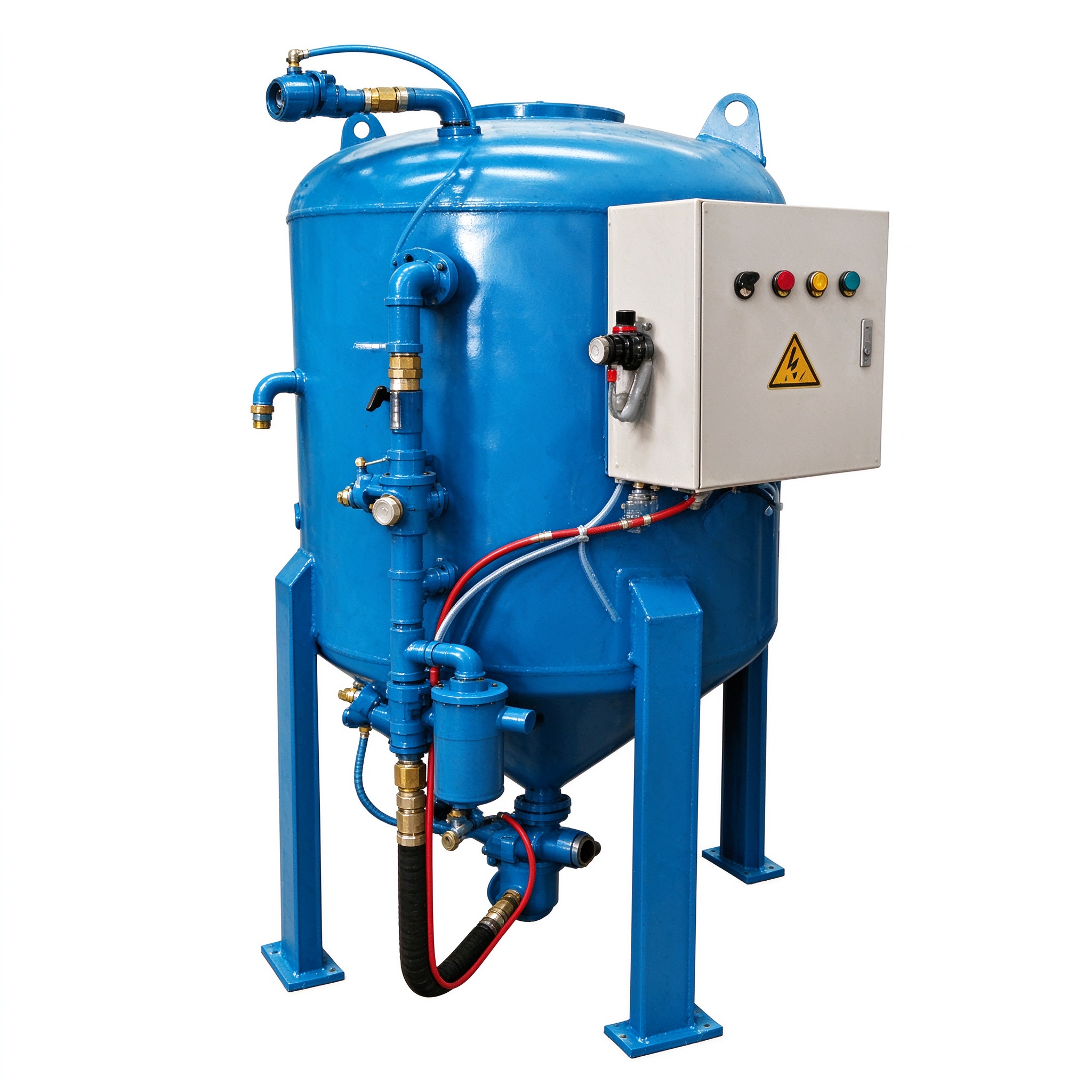
A well-designed unit is more than a steel cylinder. The performance of the whole system depends on the abrasive metering valve, the pop-up or push-pull sealing arrangement, the moisture separator, the blast hose internal diameter, the nozzle type and the air supply. A pot with excellent welding quality but a poor metering valve will give an inconsistent blast pattern, high abrasive consumption and slow production rates.
In practical terms, a properly matched sandblast pot system should deliver three things: a stable and repeatable blast profile, low abrasive waste per square meter, and predictable uptime across a full shift. Everything in this guide relates back to those three outcomes.
Main Types of Sandblasting Pots and Where Each One Fits
Buyers searching for a high pressure sandblasting tank or a small sandblasting pot for sale are often comparing configurations that serve very different jobs. The table below summarises the main categories and typical use cases.
| Pot type | Typical configuration | Best suited to | Key selection point |
|---|---|---|---|
| Small sandblasting pot | Compact vessel, single operator, light trolley | Repair shops, molds, small batches, touch-up work | Refill frequency and nozzle/air matching |
| Mobile sandblasting rust removal tank | Wheel or skid mounted, single or dual outlet | Yard work, on-site coating projects, bridge and pipeline maintenance | Mobility, hose length and air supply capacity |
| High pressure sandblasting tank | Heavier wall thickness, higher working pressure, wear-resistant internals | Hard scale removal, heavy rust, high-throughput blasting | Pressure vessel certification and weld quality |
| Open top sandblasting pot | Top loading without removing a pressure-tight lid assembly | Rapid abrasive refilling, mixed media trials, maintenance crews | Sealing reliability and dust control during filling |
| Anti-corrosion sandblasting tank | Coating-ready interiors, abrasive-compatible surface finish | Coating plants, anti-corrosion contractors, long-life pot ownership | Internal wear resistance and clean abrasive flow |
Small sandblasting pot
A small pot is the right answer when the job is intermittent. Typical applications include mold cleaning, small casting finishing, weld discoloration removal and manual touch-up. Because the vessel holds a limited abrasive volume, the operator refills more often; the benefit is low air demand, easier handling and a lower entry cost. When buyers ask for a small sandblasting pot for sale with reliable performance, the practical question is not capacity but whether the metering valve can hold a steady abrasive flow at low pressure settings.
High pressure sandblasting tank
High pressure units are specified where the surface condition is severe: thick mill scale, laminated rust, multiple layers of aged epoxy, or cast surfaces that need aggressive profiling. A high pressure sandblasting tank places greater demands on the vessel itself — plate thickness, weld procedure, nozzle wear resistance and hose quality all matter more. Pressure vessel fabrication discipline is not optional at this level.
Open top and anti-corrosion configurations
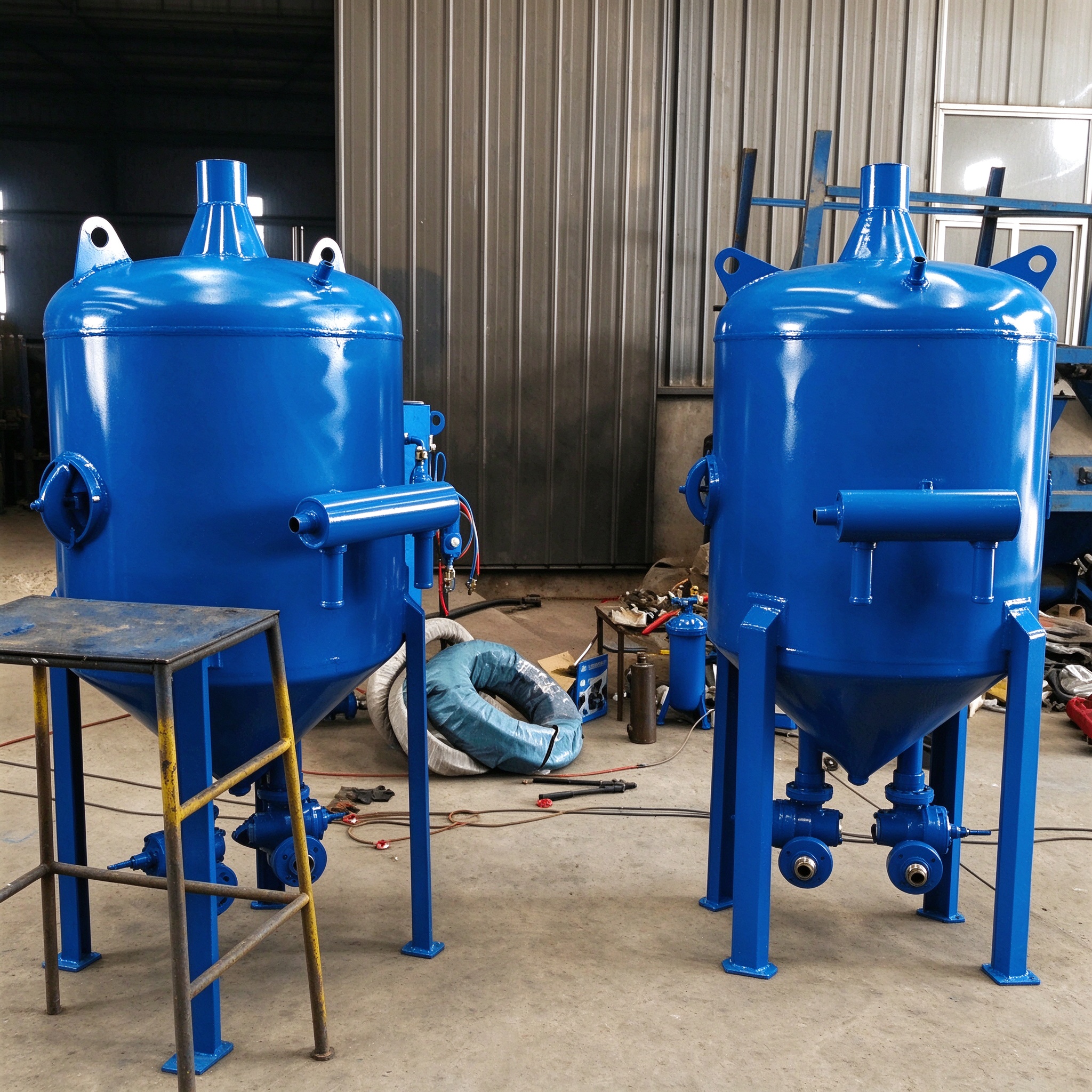
An open top sandblasting pot speeds up refilling and is convenient for contractors who change abrasive grade frequently. An anti-corrosion sandblasting tank is specified by coating plants that want a durable pot body and clean abrasive delivery over many years of continuous use. Both configurations should be selected with dust control and operator exposure in mind, not only with productivity in mind.
Applications: Where Sandblast Pots Deliver the Most Value
The same piece of equipment serves a very wide range of industries. In shipbuilding and ship repair, sandblast pots are used for hull rust removal, weld seam cleaning and preparation before anti-fouling coating. In steel structure fabrication, they prepare beams, columns and trusses for primer application. In bridge and pipeline maintenance, mobile units are essential because the work moves along the asset rather than staying inside a fixed booth.
Other common applications include automotive and motorcycle parts (deburring, paint stripping, matte finishing), hardware and die molds (surface texturing, release-agent removal), glass and stone processing (matte and carving effects), aerospace component suppliers working to controlled surface profiles, and general anti-corrosion contractors who need consistent SA-grade preparation before coating.
For indoor production, a sandblast pot is normally combined with a blasting room or cabinet and a dust collection system. For outdoor work, the pot is combined with a properly sized compressor, a moisture separator and appropriate personal protective equipment. In both cases, the pot is one component of a system — and system balance determines real output per shift.
How to Select the Right Sandblasting Pot: A Practical Checklist
Selection should start from the workpiece, not from the pot. Work through the following points in order, and the correct configuration usually becomes obvious.
- Workpiece size and access. Small, complex parts suit a small pot and a cabinet; large structural members suit a mobile unit with long hose runs.
- Required surface profile and cleanliness grade. Heavier rust and thicker scale point toward a high pressure sandblasting tank.
- Production hours per day. Continuous shifts require larger abrasive capacity, better wear parts and a dust collection plan.
- Available compressed air. Nozzle diameter and pot outlet must match actual free air delivery, not compressor nameplate rating.
- Site mobility. On-site coating projects need wheels, lifting points and a robust frame.
- Compliance requirements. Pressure vessel safety, dust emission limits and operator protection must be satisfied in the destination market.
When requesting a quotation, provide the workpiece description, target cleanliness grade, required profile, daily operating hours, available compressor output and site conditions. A capable supplier will then propose a pot size, nozzle size, hose length and dust control arrangement together, rather than quoting a vessel in isolation.
Manufacturing Quality: What Separates a Reliable Pot from a Risky One
A sandblast pot is a pressure vessel. Failures are rare but serious, and most of them trace back to material substitution, poor weld quality or missing testing. Buyers should confirm the steel grade, the welding procedure and the pressure test record before shipment.
At Wuqiao Anxing Sandblasting Machinery Co., Ltd., pot bodies are fabricated from compliant 16MnR pressure vessel steel plate, and every vessel is subjected to a hydrostatic test at 2.5 times the rated working pressure before leaving the factory. The company has been building blasting equipment since 1991, operates standardised production sites in Wuqiao County, Hebei Province, and was recognised as a national-level technology-based SME in 2025 after receiving provincial recognition in 2023. Its engineering team holds more than ten utility patents covering blasting structure, dust recovery and intelligent pressure regulation.
Practical design details also matter over a ten-year ownership cycle. Automated models are fitted with wear-resistant ceramic nozzles that last significantly longer than conventional alloy nozzles. Self-adaptive pressure regulation and abrasive recirculation reduce both energy consumption and abrasive waste, while intelligent dust collection and noise reduction bring emissions well below national limits; the company’s environmental equipment is produced under an ISO14001 environmental management system. Documented results include an approximately 30% lower failure rate than the industry average and around 15% lower energy consumption.
Maintenance Tips That Extend Pot Life
Most sandblast pot problems are predictable and cheap to prevent. Moisture is the single most common cause of poor performance: a saturated abrasive supply causes clumping, blockages and uneven blasting. Drain the moisture separator and air receiver daily, and check the desiccant or filter element on schedule.
Inspect the nozzle, blast hose and coupling seals weekly. A worn nozzle changes the blast pattern and silently increases abrasive consumption. Check the metering valve for wear, verify the pop-up seal seats correctly, and confirm that the safety valve and pressure gauge are functional. For mobile units working outdoors, clean and re-coat the frame and wheels to slow corrosion.
Keep a small spare parts stock on site — nozzle, seal kit, hose coupling and gauge. Remote troubleshooting is fast when the technician can swap a component immediately, and a small inventory prevents an entire shift from being lost to a single worn seal.
Choosing a Sandblasting Equipment Supplier
For international buyers, the supplier decision is as important as the equipment decision. Look for a manufacturer with its own production facilities, documented pressure testing, verifiable export experience and a clear spare parts policy. Capacity matters too: a factory able to build and ship in volume is usually better prepared to handle urgent replacement orders.
Wuqiao Anxing Sandblasting Machinery produces blasting machines, pressure blasting pots, integrated blasting rooms, dust collection systems and supporting compressors and consumables, with annual capacity reaching over a thousand units and sets. The company supports standardised volume orders, non-standard customisation and complete blasting-and-dust-extraction system projects, and has delivered multi-unit orders to large heavy industry customers. Its sales network covers nearly thirty provinces and regions across China, and products are exported to Europe, North America, the Middle East, Southeast Asia, Hong Kong, Macao and Taiwan, with repeat orders from buyers in Myanmar, South Korea and several Middle Eastern markets.
FAQ
What is the difference between a small sandblasting pot and a high pressure sandblasting tank?
A small sandblasting pot is a compact, low-air-demand vessel intended for intermittent work such as mold cleaning, touch-up and small batches. A high pressure sandblasting tank is built with heavier plate, stricter welding control and wear-resistant internals so it can sustain aggressive blasting on thick rust and hard mill scale at higher working pressure. Choose the small pot for flexibility and the high pressure tank for throughput and severe surface conditions.
Can an open top sandblasting pot be used for on-site coating projects?
Yes. Open top designs are popular with contractors because refilling is quick and abrasive grades can be changed easily. When used outdoors, pair the pot with a properly sized compressor, a moisture separator, dust suppression and appropriate operator protection. Also confirm that the sealing arrangement stays reliable in wind and dust, and that the frame and wheels suit the site surface.
How is pressure safety verified before shipment?
Pot bodies should be fabricated from compliant pressure vessel steel plate — 16MnR is commonly specified — and each vessel is hydrostatically tested at 2.5 times the rated working pressure before delivery. Buyers should request the test record together with material documentation and confirm that the safety valve setting matches the working pressure of the planned air supply.
What compressed air capacity does a mobile sandblasting rust removal tank require?
Air demand is driven mainly by nozzle diameter and working pressure, not by pot size. As a rule of thumb, larger nozzles require substantially more free air delivery, and the compressor must be able to hold pressure while blasting continuously. Always match the nozzle, pot outlet and compressor to the same specification, and allow margin for hose length and altitude before ordering.
How long does delivery take for bulk sandblast pot orders?
Lead time depends on configuration, quantity and whether the order is standard or custom. A manufacturer with multiple assembly lines and an annual capacity in the thousands of units can usually confirm a stable schedule and complete multi-unit deliveries in a single batch. Confirm the production plan, testing milestones and shipping documents at the quotation stage.
Do you support custom sizing and OEM branding?
Yes. Non-standard pots can be built to suit specific pressure ratings, abrasive capacity, outlet configurations and site mobility requirements, and OEM branding is available for distributors and contractors. Provide the workpiece details, target surface grade, daily operating hours and available air supply so the proposal matches actual production conditions.
Summary
Selecting a mobile sandblasting rust removal tank is fundamentally an exercise in matching the vessel and its accessories to the real workload: the workpiece, the required surface profile, the daily operating hours and the available compressed air. A small sandblasting pot suits flexible, intermittent work; a high pressure sandblasting tank suits aggressive, high-throughput blasting; an open top sandblasting pot speeds up refilling for contractors; and an anti-corrosion sandblasting tank supports long-life, coating-oriented operations.
Beyond the specification sheet, verify the things that determine ten-year ownership cost — pressure vessel steel grade, hydrostatic testing at 2.5 times rated pressure, weld quality, nozzle wear resistance, dust emission compliance and spare parts availability. A supplier with in-house fabrication, documented testing, volume capacity and a responsive after-sales structure will protect your production schedule far more effectively than a lower initial price.
With more than three decades of specialised blasting equipment manufacturing, in-house R&D, complete system integration and export experience across Europe, North America, the Middle East and Southeast Asia, Wuqiao Anxing Sandblasting Machinery is positioned to supply standardised or fully customised sandblast pot solutions — and to keep them running with practical selection advice, installation support and a stocked spare parts policy.