
Industrial surface preparation is only as reliable as the abrasive delivery system behind it. Whether a workshop is removing mill scale from steel plates, restoring a bridge structure, or preparing automotive components for coating, the pressure sandblasting tank sits at the center of the process. It stores abrasive, maintains pressure, and controls the flow that determines cleaning speed, surface consistency, and operator safety. For buyers comparing equipment, the real challenge is not simply finding a sandblasting tank for sale; it is choosing the right configuration for the workpiece, site condition, duty cycle, and environmental requirements.
Wuqiao Anxing Sandblasting Machinery Co., Ltd. is a source manufacturer based in Wuqiao County, Cangzhou, Hebei Province, China, with production operations in a standardized development-zone facility and a second site in Anling Town. The company has focused on sandblasting equipment since 1991 and now manufactures sandblasting machines, pressure sandblasting tanks, integrated sandblasting room systems, environmental dust-removal equipment, air compressors, and related consumables. This guide explains how to compare pressure sandblasting tanks, mobile sandblasting tanks, outdoor sandblasting tanks, and double-chamber sandblasting tanks so that procurement teams can make a practical decision rather than a specification-only comparison.
Why the Sandblasting Tank Determines Blasting Performance
A pressure sandblasting tank is a pressure vessel and a process-control component at the same time. The vessel must hold abrasive safely, release it at a stable rate, and resist the wear and vibration of continuous operation. When the tank design is mismatched to the job, operators often compensate by increasing pressure or stopping frequently to refill, which raises abrasive consumption, reduces finish consistency, and increases downtime. In high-volume workshops, those small interruptions become a significant operating cost.
The tank also affects environmental performance. A well-sealed pressure sandblasting tank, combined with proper dust collection and abrasive recovery, helps contain dust at the working zone. This matters for factories that need to meet local air-emission rules and for outdoor projects where wind and weather can spread dust beyond the work area. Selecting a tank with reliable sealing, stable pressure regulation, and compatible dust-removal connections is therefore both a production decision and a compliance decision.
For B2B buyers, a sandblasting tank manufacturer should be able to explain not only tank volume and pressure rating, but also how the vessel will behave with the chosen abrasive, nozzle size, hose length, and compressor output. A tank that is oversized for the available air supply may never reach its rated performance, while an undersized tank may force frequent refilling and unstable pressure. The right selection starts with the actual blasting task, not with a catalog page alone.
Core Sandblasting Tank Types from a Source Manufacturer
Wuqiao Anxing Sandblasting Machinery produces several categories of pressure sandblasting tanks to serve different site conditions and production models. The main options include mobile sandblasting tanks, outdoor sandblasting tanks, pressure sandblasting tanks for stationary or workshop use, and double-chamber sandblasting tanks for continuous operation. Each type solves a different operational problem, and the best choice depends on mobility, duty cycle, abrasive capacity, and control preferences.
Mobile Sandblasting Tanks for Flexible Site Work
Mobile sandblasting tanks are built for users who need to move blasting equipment between work areas, workshops, or maintenance sites. Wheel-mounted or portable configurations reduce handling effort and allow a single unit to support several jobs. They are commonly used for maintenance and repair work, small steel structures, machinery refurbishment, and contractor projects where the blasting location changes frequently. The key selection points are wheel and frame durability, stable pressure control during movement, and easy access for refilling and inspection.
Outdoor Sandblasting Tanks for Harsh Site Conditions
Outdoor sandblasting tanks are intended for bridges, shipyards, construction sites, pipelines, and other open-air projects where equipment is exposed to weather, dust, and rough handling. Buyers should look for durable vessel construction, protected controls, moisture-management features, and reliable sealing. Outdoor work also places more emphasis on hose routing, remote control accessibility, and operator protection. A tank that performs well in a clean workshop may need additional protection and heavier site hardware before it is suitable for outdoor blasting.
Pressure Sandblasting Tanks for High-Productivity Cleaning
Pressure sandblasting tanks use pressurized abrasive delivery to achieve strong cleaning action on rust, mill scale, old coatings, and surface contamination. They are widely used in steel structure fabrication, shipbuilding, foundry work, and heavy equipment maintenance. Compared with lower-pressure or suction-based systems, a well-matched pressure tank can deliver more consistent abrasive velocity and reduce time spent on tough surfaces. The important variables are working pressure, vessel certification, abrasive metering, and compatibility with the nozzle and compressor package.
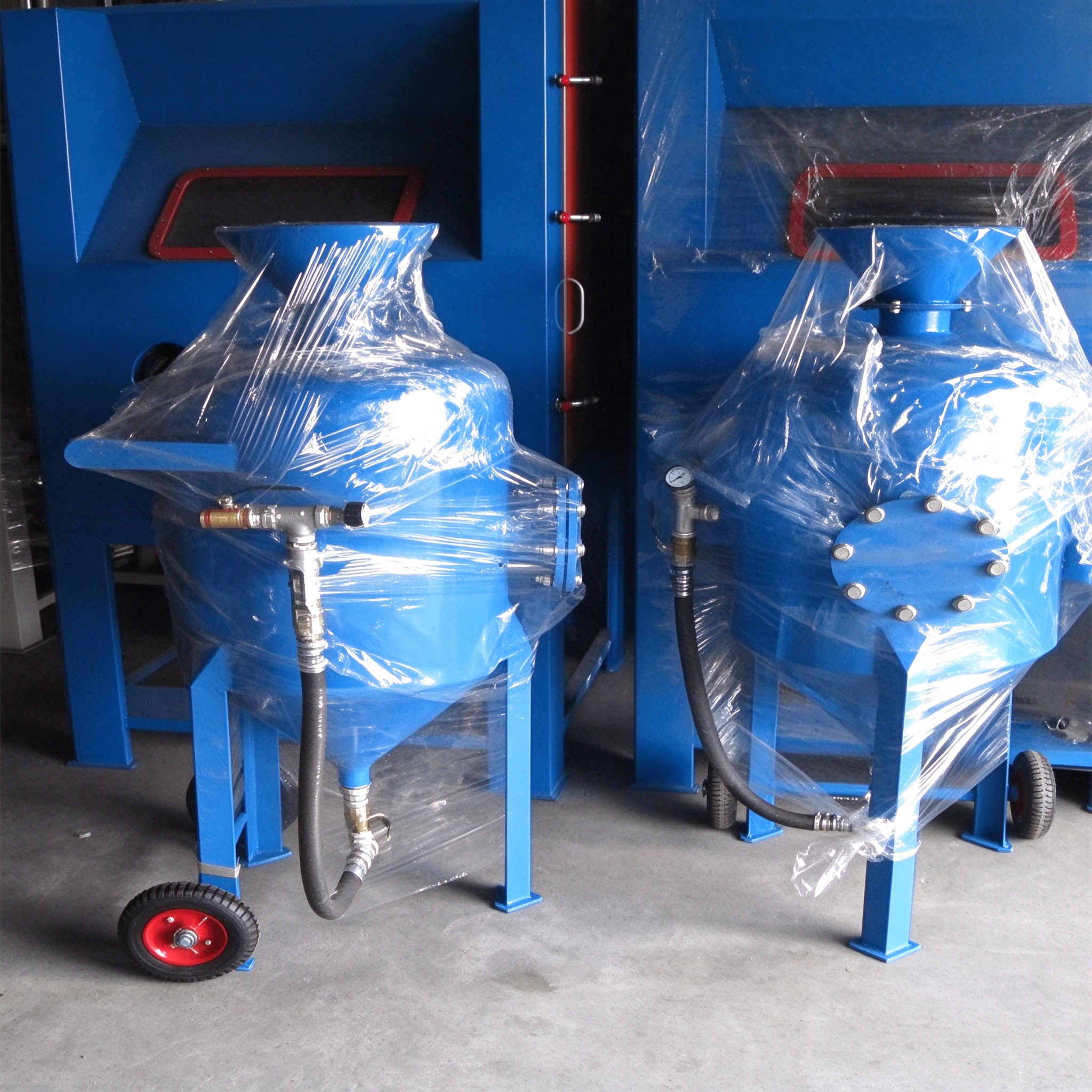
Double-Chamber Sandblasting Tanks for Continuous Blasting
Double-chamber sandblasting tanks are designed to reduce interruptions caused by refilling. By alternating between two chambers, the system can maintain abrasive flow while one chamber is being replenished. This design is useful for high-duty-cycle operations where consistent blasting rhythm matters, such as large steel structures, repetitive component processing, and production lines that cannot afford frequent stops. For buyers comparing double-chamber sandblasting tank price, the value should be measured against labor savings, reduced idle time, and more uniform surface results.
| Tank Type | Mobility | Typical Application | Selection Focus |
|---|---|---|---|
| Mobile sandblasting tank | High | Maintenance work, small structures, changing job sites | Frame strength, wheel design, stable pressure during movement |
| Outdoor sandblasting tank | Medium to high | Bridges, shipyards, pipelines, construction sites | Weather protection, sealing, control access, hose management |
| Pressure sandblasting tank | Stationary or mobile | Rust removal, mill scale cleaning, coating preparation | Pressure rating, abrasive metering, compressor matching |
| Double-chamber sandblasting tank | Stationary or skid-mounted | High-duty-cycle production, large workpieces, continuous blasting | Chamber switching, refill strategy, control automation |
Key Specifications and Selection Criteria
Choosing a pressure sandblasting tank requires more than matching a volume number to a workpiece. Procurement teams should compare vessel construction, pressure rating, abrasive capacity, control method, and compatibility with the rest of the blasting system. A tank is part of an air-abrasive circuit: compressor output, hose diameter, nozzle size, and abrasive type all influence the result. For this reason, a reliable sandblasting tank supplier will ask about the job before recommending a model.
Pressure Rating and Vessel Safety
Pressure vessel safety is the first filter in any selection process. Wuqiao Anxing Sandblasting Machinery uses compliant 16MnR pressure-vessel steel plate for tank bodies, and each tank undergoes a hydrostatic test at 2.5 times the rated pressure before leaving the factory. Buyers should always confirm the design pressure, test method, and documentation available for the vessel. They should also verify that relief valves, gauges, and fittings are appropriate for the working pressure and that operators are trained to inspect the system before each shift.
Capacity, Duty Cycle, and Refill Strategy
Abrasive capacity affects how long an operator can blast before refilling. Small mobile sandblasting tanks are convenient but require more frequent refills; larger pressure sandblasting tanks support longer runs but need adequate site space and handling equipment. For high-duty-cycle work, a double-chamber sandblasting tank can reduce refill interruptions by allowing continuous abrasive delivery. The right capacity is a balance between production rhythm, abrasive consumption, and the practical ability to replenish the tank safely.
Controls, Automation, and Operator Efficiency
Control configuration has a direct effect on labor and consistency. Manual, pneumatic, and electric control options are available for different operating preferences. Automated pressure regulation and abrasive flow control can help maintain a stable blasting pattern, while remote controls allow the operator to stop and start the system without walking back to the tank. For factories investing in production efficiency, PLC-based automation and integrated dust collection should be evaluated as part of the total system rather than as isolated add-ons.
Matching Tanks to Real Application Scenarios
Shipbuilding and heavy steel fabrication often require aggressive cleaning of large surfaces. Pressure sandblasting tanks with stable abrasive delivery and durable nozzles are suitable for removing rust and mill scale before protective coating. In these environments, outdoor sandblasting tanks or skid-mounted systems with protected controls are often preferred because the equipment may operate near the hull, yard, or construction pad rather than inside a clean workshop.
Steel structure plants, bridge contractors, and pipeline coating facilities need repeatable surface preparation. A mobile sandblasting tank can serve multiple work bays, while a stationary pressure sandblasting tank with a recovery and dust-removal system may better support continuous production. For automotive parts, hardware, molds, and precision components, smaller enclosure-based blasting equipment or carefully controlled pressure tanks can be used for deburring, matte finishing, coating removal, and surface strengthening.
Foundries, stone and glass processors, and maintenance workshops have different priorities. Some need flexibility and quick relocation; others need high abrasive capacity and dust containment. A double-chamber sandblasting tank is valuable when blasting cannot stop frequently, while an outdoor sandblasting tank is more appropriate when the work site is exposed to weather and rough handling. The most effective selection process links the tank type to the actual workpiece, site, and production target.
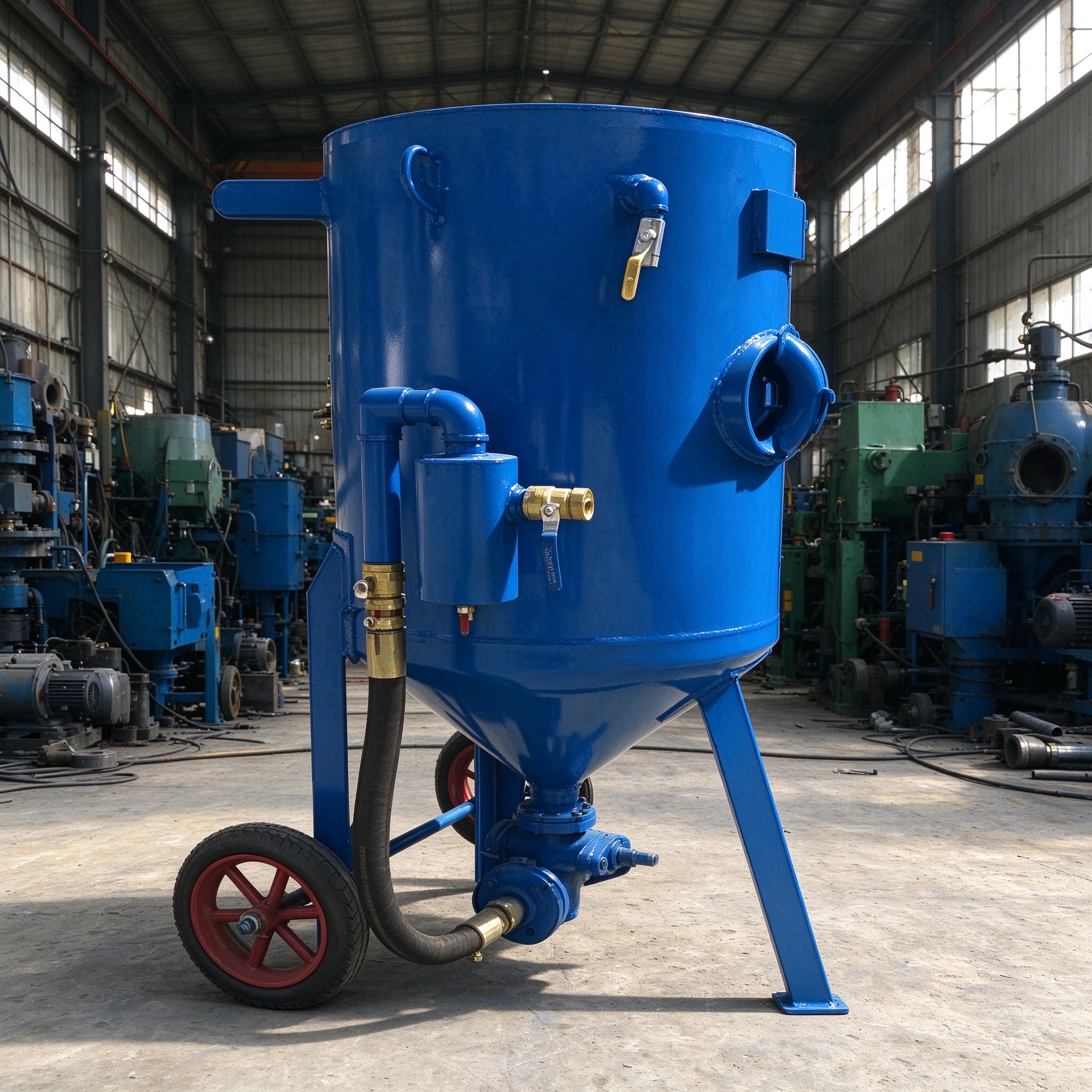
Manufacturing Quality and Environmental Compliance
Wuqiao Anxing Sandblasting Machinery operates as a manufacturer with mechanical design, fluid pressure, and environmental dust-removal engineering capabilities. The company has accumulated multiple utility model patents related to sandblasting structure, dust recovery, and intelligent pressure regulation. Its production process includes full-flow quality control, and finished machines are checked for blasting uniformity, sealing performance, and continuous no-load operation. These checks matter because a pressure sandblasting tank is used under vibration, abrasive wear, and cyclic pressure.
Environmental compliance is also part of the equipment design. The company’s environmental equipment has ISO14001 environmental management certification, and dust emissions are designed to remain below applicable limits. Integrated dust collection, abrasive recovery, and sealed blasting systems help reduce visible dust and improve workplace conditions. For buyers in markets with strict environmental requirements, the tank should be specified together with the dust-removal and recovery system rather than purchased as a standalone vessel.
Durability details also affect total cost of ownership. The company uses wear-resistant ceramic nozzles on automatic models, with a service life reported to be three times that of ordinary alloy nozzles. Its adaptive pressure regulation, automatic abrasive circulation, and intelligent dust-reduction technologies are designed to lower故障率 and energy consumption compared with typical industry averages. These are practical considerations for buyers who evaluate sandblasting tank price against years of operating cost rather than purchase price alone.
How to Choose a Reliable Sandblasting Tank Supplier
A reliable sandblasting tank manufacturer should be able to review the workpiece, blasting standard, site layout, compressor capacity, and dust-control requirements before quoting. Wuqiao Anxing Sandblasting Machinery provides pre-sales engineering surveys, free equipment selection proposals, and plant layout drawings. This level of support is important because a pressure sandblasting tank that looks suitable on paper may need different fittings, controls, or mobility features once the actual work area is reviewed.
Buyers should also ask about production capacity, customization experience, export documentation, and spare-parts availability. The company operates standardized assembly lines with annual capacity reaching over one thousand units and sets, and it supports both batch orders and non-standard customization. Its products have been exported to Europe, the Middle East, Southeast Asia, and other regions, with repeat business in several overseas markets. For international buyers, confirming voltage, control language, shipping configuration, and local service arrangements early helps avoid delays.
After-sales support is another decisive factor. A sandblasting tank is a long-term production asset, so remote troubleshooting, spare-parts stock, and on-site installation support can reduce downtime. The company provides installation, commissioning, operator training, and maintenance guidance, with a rapid response mechanism and common spare parts kept in stock. When comparing quotations, buyers should evaluate the complete package, including commissioning and training, rather than the tank alone.
Maintenance, Safety, and Uptime Best Practices
Daily maintenance starts with moisture control. Compressed air should be dry and clean, and drain valves, filters, and separators should be checked regularly. Moisture in the abrasive can cause clogging, uneven flow, and accelerated wear. Operators should also inspect seals, hoses, couplings, and nozzle condition before each shift. Worn nozzles and damaged hoses reduce efficiency and can create safety risks, so replacement parts should be kept available.
Pressure safety deserves strict attention. Relief valves, gauges, and vessel fittings should be inspected at defined intervals, and the tank should never be modified without engineering approval. Operators must wear appropriate personal protective equipment and follow lockout procedures during maintenance. Abrasive should be stored dry and screened where required to prevent foreign material from entering the metering system.
For double-chamber sandblasting tanks and automated pressure sandblasting tanks, control settings should be reviewed when the abrasive type, nozzle size, or workpiece changes. A setting that works well for heavy rust removal may be too aggressive for surface finishing. Keeping a simple log of pressure, abrasive consumption, and maintenance actions helps identify drift and supports predictable production planning.
FAQ
What is the difference between a mobile sandblasting tank and an outdoor sandblasting tank?
A mobile sandblasting tank is designed mainly for movement between work areas, with a wheeled or portable frame. An outdoor sandblasting tank is designed for exposure to weather, rough site handling, and field conditions. Some models combine both features, but buyers should confirm frame strength, sealing, control protection, and hose arrangement for the actual site.
How do I choose the right pressure sandblasting tank for my project?
Start with the workpiece, required surface cleanliness, abrasive type, compressor output, nozzle size, and duty cycle. Then compare pressure rating, capacity, control method, and mobility. A manufacturer should review the site layout and blasting target before recommending a model, especially for outdoor or high-volume operations.
Can double-chamber sandblasting tanks improve productivity?
Yes, in suitable applications. A double-chamber design allows abrasive delivery to continue while one chamber is replenished, reducing refill interruptions. The benefit is greatest in high-duty-cycle blasting where consistent rhythm and reduced downtime matter. The cost should be compared with labor savings and production gains.
What maintenance does a sandblasting tank require?
Regular maintenance includes checking air moisture, seals, hoses, nozzles, pressure gauges, and relief valves. The vessel should be inspected for wear and the abrasive should be kept dry and free of debris. Operators should follow a written inspection schedule and replace worn parts before they affect safety or blasting quality.
How can I verify a sandblasting tank manufacturer’s quality control?
Ask about vessel material, hydrostatic testing, welding inspection, finished-machine testing, and documentation. A credible manufacturer can explain how each tank is tested for pressure safety, sealing, and blasting performance. It should also provide installation, commissioning, training, and spare-parts support for long-term operation.
Summary
Selecting a pressure sandblasting tank is a production decision, a safety decision, and a cost decision. Mobile sandblasting tanks support flexible site work, outdoor sandblasting tanks handle harsh field conditions, pressure sandblasting tanks deliver strong cleaning performance, and double-chamber sandblasting tanks reduce refill interruptions in high-duty-cycle operations. The best result comes from matching the tank to the workpiece, compressor, abrasive, dust-control system, and maintenance plan.
Wuqiao Anxing Sandblasting Machinery Co., Ltd. brings more than three decades of sandblasting equipment experience to the selection process, with standardized manufacturing, non-standard customization, pressure-vessel testing, environmental dust-removal design, and after-sales service. For buyers seeking a reliable sandblasting tank manufacturer and a practical industrial surface preparation solution, a detailed technical review before purchase is the most effective way to protect uptime, safety, and long-term operating cost.