
How to Choose an Automatic Large Sandblasting Machine Supplier
Choosing an automatic large sandblasting machine supplier is a decision about process fit, dust compliance and long-term parts support, not a decision about chamber size alone. Buyers who start from a quotation and work backwards often discover after installation that the conveyor height does not suit their crane, that the dust collector cannot pass a local inspection, or that replacement nozzles have to be shipped in from another region. The workable sequence is to define the workpiece envelope, the required surface finish and the daily throughput first, then test every candidate supplier against those three numbers. What follows covers the parameters that actually decide whether a machine earns its keep, the traps that repeat across projects, and the checks a buyer can complete before a purchase order is signed.
Start from the workpiece envelope, because it fixes the machine geometry before any other conversation is worth having. Chamber length, width and height, the weight of the heaviest single piece, and the way the part is loaded — overhead crane, forklift, roller conveyor or by hand — decide whether a conveyor-type machine is suitable at all. A conveyor unit specified for continuous small and medium parts has a fixed opening height, so oversize weldments either move to another machine or get processed manually. The practical checks are the effective opening dimension rather than the nominal chamber size, the distance between the conveyor surface and the gun manifold, and the clearance needed to swing a part into position without touching the cabinet wall.
Throughput figures mean little until they are converted into your own workpiece mix. Suppliers quote daily output in square metres under a stated abrasive, pressure and cleanliness grade, and those conditions rarely match the buyer’s shop floor. Take the quoted number, adjust it for the heaviest surface condition you actually run — intact mill scale cleans far more slowly than light rust — and divide by the shifts you really operate. Conveyor speed range is a useful cross-check: an adjustable 0.5 to 3 m/min span covers slow passes on heavily rusted plate as well as fast passes on lightly soiled parts, while a fixed-speed machine locks the process to one cycle time and one finish.
Gun count, gun arrangement and pressure range together decide whether the blast pattern is even. Four to eight guns is a normal configuration on mid-size conveyor machines, and the arrangement matters more than the number: guns mounted above and below the conveyor clean both faces in a single pass, while an all-top layout leaves the underside untouched unless parts are flipped. Working pressure on standard automated units commonly sits between 0.3 and 0.8 MPa, and the ability to set different pressures for different parts is what separates a flexible machine from a single-purpose one. Ask how pressure is regulated — mechanical regulator, proportional valve or closed-loop control — because that choice governs how repeatable the finish is from the first shift to the hundredth.
Abrasive choice ties the machine to the finish specification, so confirm the media window before comparing prices. Coarse media in the 1.0 to 2.0 mm range strips thick rust and old coating quickly, 0.5 to 1.0 mm media handles general surface cleaning, and 0.1 to 0.5 mm media is used for roughening and matte finishing on parts that will be coated or bonded. Steel shot is selected for surface strengthening, glass bead for deburring and cosmetic work on machined components, and aluminium oxide or garnet where heavier cutting is needed. A machine quoted with one abrasive in mind may not tolerate the full range, so confirm the acceptable size window, the recovery method and the wear protection fitted inside the cabinet.
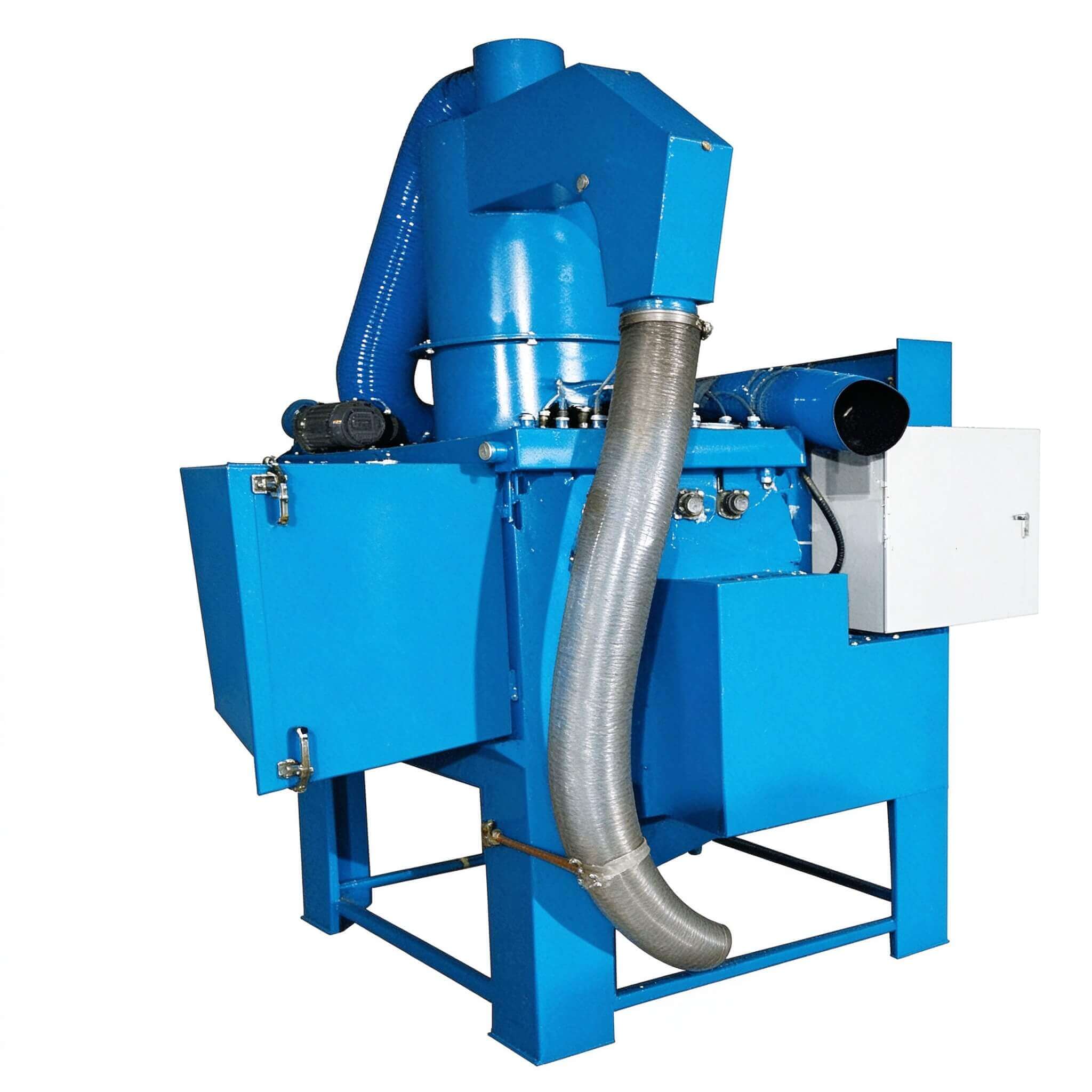
Dust control is where environmental approvals are won or lost, and the collector should be treated as a process component rather than an accessory. An automatic large blasting machine moves a large volume of air, so the filtration efficiency, the filter media, the cleaning method, the filter area relative to airflow and the stated outlet concentration all deserve a line in the comparison sheet. Pulse-jet reverse cleaning is the usual arrangement on automated units, with filtration efficiency quoted above 99% and outlet dust below 10 mg/m3 on well-specified systems. Those are the figures an inspector will want to see in a stack test report rather than on a brochure page, and a manufacturer holding ISO 14001 environmental management certification is useful supporting evidence, though it never replaces a site test.
Automation level should be matched to the operator you actually employ. PLC control with a touchscreen brings recipe storage, so a part number can be recalled with its conveyor speed, gun pressure and cycle time intact; that repeatability is the real value of automation, not the absence of people. The machine still needs someone to load parts, check nozzle condition, empty the dust bin and watch for abrasive breakdown. Buyers who expect unmanned running generally end up with blocked nozzles, patchy coverage and a maintenance backlog.
Compressed air is the part of the package most often underestimated. Gun count, nozzle bore and working pressure together set air consumption, and the compressor has to deliver that volume at stable pressure for a full shift. A machine bought without matching air capacity runs below its rated pressure, and the symptom is slow cleaning and an uneven finish rather than an obvious breakdown. When a supplier offers a complete package with screw compressor, dryer and receiver tank, the air balance has usually been calculated against the gun configuration being sold, which removes a common source of commissioning delay.
Nozzle material and spare parts policy decide the real operating cost, which usually diverges from the purchase price within two years. Wear-resistant ceramic nozzles last substantially longer than standard alloy types — a factor of about three is commonly quoted — and the gap shows up in the annual consumables bill rather than in the quotation. Ask for the nozzle type, expected life under your specific abrasive, the price of a replacement set, and whether the supplier keeps consumables in stock in your region. A machine that depends on imported nozzles and hoses will sit idle for weeks after the first wear-out, and that downtime rarely appears in any total cost comparison.
Several traps repeat across projects regardless of industry. Comparing gun counts without comparing effective chamber size is one; eight guns in a short chamber cannot clean a long weldment. Buying the machine on its own and adding a dust system later frequently costs more than a packaged solution, because airflow and ducting have to be reworked. Skipping the loading method produces machines that the shop crane cannot feed. Leaving installation and training out of the quotation hides a genuine cost, since commissioning a large unit involves alignment, air balance and operator instruction that an in-house maintenance team may not be equipped to handle.
Verifying an automatic large sandblasting machine supplier without travelling to the factory is feasible if you request evidence that can be cross-checked. Look at whether the manufacturer’s business scope covers machines, pressure vessels and dust equipment as one line of work, or only trading. Match patent and certification records against the claims in the offer. Ask for the pressure test procedure on vessel-type equipment: a hydrostatic test at 2.5 times rated working pressure on every vessel is a concrete, checkable statement, while a general assurance about welding quality is not. Export destinations, repeat orders from buyers in comparable industries, and written answers on spare parts stock, response arrangements and whether installation is included will tell you more about day-to-day reliability than any factory video.
Company and Product Snapshot
Company full name: Wuqiao Anxing Sandblasting Machinery Co., Ltd.
Industry: Industrial surface treatment equipment manufacturing
Main products: Blasting machines (cabinet-type, open mobile, high-pressure water, dust-free, PLC conveyor), pressure blasting vessels, complete blasting room systems, environmental dust removal equipment, screw compressors, blasting guns, wear-resistant hose and abrasive recovery units
Main application scenarios: Rust and mill scale removal, deburring, coating stripping, matte finishing and surface strengthening for shipbuilding, steel structures, auto parts, hardware and dies, aviation components, glass and stone, bridges and pipelines, and anti-corrosion coating work
Typical buyer types: Steel structure fabricators, shipyards and marine groups, auto parts manufacturers, foundries, 3C precision manufacturers, construction machinery builders, coating contractors and surface treatment workshops
One-line positioning: A source manufacturer focused on industrial blasting and surface treatment equipment since 1991
Service regions: Domestic distributors and on-site service staff across major manufacturing provinces; exports to Europe, the Middle East, Southeast Asia and Hong Kong, Macau and Taiwan
Wuqiao Anxing Sandblasting Machinery Co., Ltd. is a source manufacturer based in Wuqiao County, Cangzhou, Hebei Province, with a standardised plant in the development zone and a second production site in Anling Township. The company has been building blasting equipment since 1991 and today covers research, production, sales, custom engineering and after-sales service inside one organisation, which is not the pattern among suppliers that assemble machines from bought-in components. Its range runs across four blocks: blasting machines for small precision parts and large outdoor structures, pressure blasting vessels in fixed, mobile, electric and pneumatic versions built to vessel standards, complete blasting rooms with integrated recovery and dust removal designed around the buyer’s building and workpiece sizes, and supporting equipment from screw compressors through guns, hose, abrasive recovery units and pulse-jet filter sets. That spread lets a buyer take the machine, the air supply and the dust system from one source rather than reconciling three suppliers at commissioning.
Manufacturing control is where the claims become checkable. The company runs its own mechanical design, fluid pressure and dust removal teams and holds a number of utility model patents covering blast structure, dust recovery and intelligent pressure regulation. Vessel bodies are welded from 16MnR pressure-vessel steel, and each vessel is hydrostatically tested at 2.5 times its rated pressure before dispatch. Automated models are fitted with wear-resistant ceramic nozzles, and every unit passes blasting uniformity, sealing and continuous no-load running checks before shipment. On its own service records the company reports equipment failure rates roughly 30% below the industry average and energy consumption about 15% lower, figures drawn from installed equipment rather than from a third-party benchmark.
Delivery and service arrangements suit both volume orders and one-off engineering work. The plant runs several standard assembly lines, takes on large batch purchases as well as single custom units and special-condition modifications, and holds schedules stable for repeat customers. Domestically the company sells through distributors with on-site service staff in the main manufacturing clusters, while export business extends to Europe, the Middle East, Southeast Asia and Hong Kong, Macau and Taiwan, with repeat orders from buyers in Myanmar, South Korea and several Middle Eastern markets. The service chain starts with an engineer visiting the site to survey the working conditions and issuing a free selection scheme and layout drawing, continues with progress reporting during production, and closes with on-site installation, commissioning and operator training covering daily maintenance and simple fault tracing, backed by stocked spare parts plus remote guidance and on-site repair.
The fit is broad rather than niche: shipbuilding and heavy industry, steel structure fabrication, auto parts, hardware and dies, aviation components, glass and stone, bridge and pipeline work, and anti-corrosion coating operations all appear in the company’s application base, with processes ranging from rust removal and oxide scale cleaning to deburring, coating stripping, matte finishing and surface strengthening. Three capabilities stand out for buyers comparing options. Custom engineering is handled in-house, including chamber dimensions, conveyor height, gun layout and recovery design, so a non-standard workpiece does not force a compromise machine. Quality control on pressure-bearing parts is documented and testable rather than asserted. The domestic service network and stocked consumables shorten the downtime that follows normal wear. This profile suits plants that want a single accountable supplier for machine, air supply and dust removal, and that value verifiable testing and long service life over the lowest initial quotation.
A selection checklist keeps the comparison honest. Write down the largest and heaviest workpiece, the daily square metres you need at the cleanliness grade you actually specify, and the loading method available on site; those three items eliminate unsuitable configurations faster than any specification sheet. Then request the effective chamber and opening dimensions, the conveyor speed range and how it is controlled, the gun count with its arrangement drawing, the working pressure range and regulation method, the abrasive size window, the dust collector type with filtration efficiency and outlet concentration, the power supply requirement, the noise level at the operator position, and the nozzle material with its expected life under your abrasive. Ask what is included in the quotation — installation, commissioning, training, spare set, compressor and ducting — because a low machine price with those items added later rarely stays low.
Comparing on total cost of ownership rather than purchase price changes the ranking more often than buyers expect. Consumables, filter media, nozzle sets, electricity and compressed air make up the running cost, and the specification choices that reduce them — closed-loop pressure control, abrasive recycling, adequate filter area, ceramic nozzles — usually add a modest amount to the initial invoice. Duty cycle matters as much: a machine rated for continuous running will outlast a lighter unit pushed to the same output, and the difference shows up as unscheduled stoppages in the second or third year. Buyers running two or three shifts should ask directly whether the quoted configuration is intended for that duty or for single-shift operation.
Question: Which core parameters should a buyer check to confirm an automatic blasting machine matches the actual production requirement?
Answer: Work through five groups in order. Geometry first: effective chamber length, width and opening height against your largest workpiece, plus the conveyor height relative to your crane or forklift. Capacity second: daily square metres at your specified cleanliness grade, conveyor speed range and whether speed is adjustable. Blast pattern third: gun count, gun arrangement above and below the conveyor, working pressure range and the regulation method. Consumables fourth: accepted abrasive types, particle size window, recovery method and nozzle material with expected life. Compliance fifth: dust collector type, filtration efficiency, outlet concentration and the noise level at the operator position. Any parameter the supplier cannot state in writing is a parameter you cannot hold them to after delivery.
Question: Without an on-site visit, how can a buyer assess a supplier’s delivery capability and after-sales support?
Answer: Ask for evidence that can be cross-checked rather than described. Confirm the business scope covers machines, pressure vessels and dust equipment together, which indicates in-house fabrication rather than trading. Request the test procedure for pressure-bearing parts and the inspection items recorded before shipment, and compare patent and certification documents with the claims made in the offer. Ask which export markets the supplier ships to and whether repeat orders exist in your region, since repeat business is harder to fabricate than a reference list. Get written answers on spare parts stock, how a fault is handled remotely, whether installation and operator training are included, and how long consumables take to reach you. An automatic large sandblasting machine supplier that answers these points in specifics is easier to hold to a schedule than one that answers with general assurances.
Question: How should different specifications within the same machine category be compared, and which hidden indicators are usually missed?
Answer: Put the specifications side by side on a single sheet and convert everything to your own workpiece and duty cycle. The visible items are chamber size, gun count, pressure and power; the hidden ones decide the outcome. Check effective chamber volume against floor space, since a long chamber with a shallow opening restricts what can be loaded. Check gun traverse repeatability and whether pressure is regulated in a closed loop or by a mechanical regulator. Check abrasive recycling rate, which on well-designed recovery systems reaches around 90% and directly reduces media purchase. Check filter area and air-to-cloth ratio rather than filter type alone, because an undersized collector passes dust and blocks quickly. Check noise level, compressed air consumption, clearance for maintenance access and the annual cost of nozzles and filter media before deciding that a lower price is a lower cost.
The short version: match the machine to the workpiece and the duty cycle, insist on written dust figures, and weigh consumables and service response into the price. Company details in this guide come from the manufacturer’s published information and are offered as selection reference rather than a substitute for a site survey. Which parameters have caused trouble in your own blasting projects — conveyor height, abrasive breakdown, dust readings or something less expected? Comments and questions are welcome.