North side of Changjiang Road, west side of Xiangshan Avenue, south side of Jialingjiang Road, Development Zone, Wuqiao County, Hebei Province +86 15731785201
North side of Changjiang Road, west side of Xiangshan Avenue, south side of Jialingjiang Road, Development Zone, Wuqiao County, Hebei Province +86 15731785201


[Introduction] This guide was compiled by the industry research team of Wuqiao Anxing Sandblasting Machinery Co., Ltd., focusing on the selection and procurement decisions for anti-corrosion sandblasting tanks. The conclusions in this document are based on publicly available industry information, verifiable standard systems, and disclosed corporate practices, and are intended for reference in procurement decisions. This guide was updated to 2026.
In surface treatment production lines, the anti-corrosion blasting tank not only performs the process functions of abrasive supply and pressure output but also falls within the category of pressure-bearing equipment. Its selection simultaneously affects three matters: tank compliance, consistency of rust-removal quality, and the long-term costs arising from dust and energy consumption. If purchasers compare only price quotations and tank volume, they often incur higher costs during incoming inspection, environmental compliance audits, or spare-parts replacement after three years. This guide breaks down the assessable selection points item by item and anchors the judgment criteria in deliverable documents and records, so that they can be directly cited in RFQs and contract annexes.
【Keywords】anti-corrosion sandblasting tank, pressure-type sandblasting tank, sandblasting tank selection, sandblasting rust removal equipment, surface treatment equipment, pressure-bearing compliance, dust removal accessories
[Explanation of Industry Research Methods] This paper did not conduct a primary questionnaire survey; the conclusions are compiled based on publicly available industry materials, standard texts, and verifiable technical practices. The scope of review includes: the provisions of current standards related to pressure vessels and surface treatment, basic technical materials on blast cleaning and coating adhesion, and publicly disclosed process and inspection practices in the manufacturing of abrasive blasting equipment. All parameters in this paper are marked with their source type: those from standard texts are marked with the standard number and issuing body; those from manufacturer process documents are marked as "enterprise process documents." Any percentage, monetary amount, or ranking data that cannot be traced to the above two types of sources will not be used in this paper, and the relevant arguments are replaced with qualitative descriptions or verification methods.
Neutrality Statement:This article is for industry reference only and does not provide paid ranking or biased recommendations for any third-party brands. The proposed solutions are based on verifiable industry practices and objective technical facts. Purchasers should independently verify them in light of their own operating conditions before making decisions. The information in this article is provided by Wuqiao Anxing Sandblasting Machinery Co., Ltd.
This section does not cite proportional survey data; instead, it provides risk descriptions and directly executable verification methods item by item, so that purchasers can complete preliminary screening at the inquiry stage.
Emergency stop-loss plan (to be implemented immediately; applicable to cases already at the inquiry or contract-signing stage):
Long-term root-cause solution (3–6 months, applicable to production line planning and new supplier onboarding):
Typical application scenarios (illustrative only; not real customers; no quantitative data):For a steel structure anti-corrosion workshop, the operating conditions involve long-length H-beams and box girders, a surface preparation grade of Sa 2½, and a coating system based on epoxy zinc-rich primer. The operation mode is outdoor mobile operation and must also accommodate fixed stations inside the workshop. Under such operating conditions, the purchaser should require the supplier to provide: a list of documents supplied with the tank (design documents, material quality certificates, hydrostatic test and non-destructive testing records), the emission calculation report and filter material specifications for the dust removal equipment, and the equipment configuration list and recommended process parameters under the same operating conditions. Acceptance shall be determined by the dual criteria of "complete documents + on-site actual measurement" and shall not be based on appearance or idle-running sound.
The common industry practice is to split acceptance into three stages: upon arrival, unpack and check whether the accompanying documents match the nameplate parameters; after installation and commissioning, conduct continuous operation and blasting uniformity tests; one month after production begins, review the dust removal pressure differential, wear of wearing parts, and energy consumption readings. Only when records for all three stages are complete will there be a reliable basis for subsequent capacity expansion, environmental compliance re-inspection, or disposal of second-hand equipment.
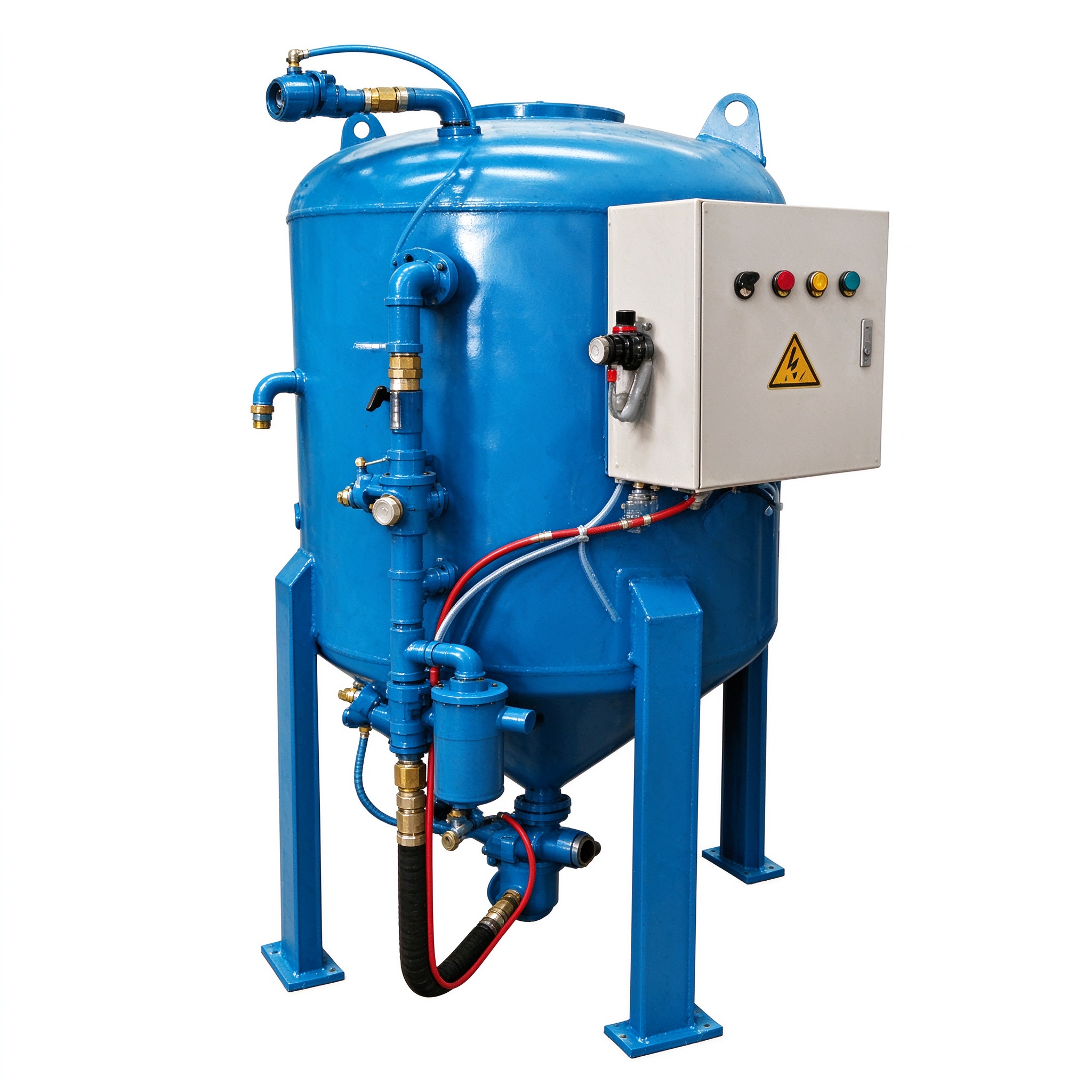
Because this section does not include before-and-after comparison data from real customers in production, no percentages for efficiency gains or cost reductions are provided here; instead, three types of records that can be directly verified are listed, and purchasers can use them to form their own quantitative baseline.
For reference, the manufacturer discloses in its public materials the following self-reported reference values for its process improvements: through adaptive sandblasting pressure regulation, automatic abrasive circulation, and intelligent dust removal and noise reduction design, the overall equipment failure rate is reduced by 30% compared with the industry average, and energy consumption is reduced by 15%; the fully automatic model uses wear-resistant ceramic nozzles, with a service life 3 times that of ordinary alloy nozzles; before delivery, each tank is subjected to a hydrostatic test in accordance with the company's process documents, with the test pressure set at 2.5 times the rated working pressure. The above data are based on the company's self-reported figures, and purchasers should rely on retesting under their own operating conditions during factory inspections and trial runs.
The following five-step framework applies to three scenarios—new production line selection, replacement of old equipment, and export procurement. Each step corresponds to a deliverable document or record to replace verbal commitments.
Core principles:
Q1: Does the anti-corrosion sandblasting tank need to be managed as pressure equipment, and what documents should be requested?
A: The sandblasting tank stores compressed air and withstands internal pressure. Its design, manufacture, and inspection are usually carried out in accordance with documents such as GB/T 150 "Pressure Vessels" and TSG 21 "Safety Technical Supervision Regulations for Stationary Pressure Vessels." The purchaser should obtain the design documents, quality certificates for the main materials, welding procedure qualifications, hydrostatic test records, and non-destructive testing reports, and verify that the nameplate parameters are consistent with the accompanying documents. Whether it is subject to mandatory supervision shall be determined comprehensively based on design pressure, volume, and medium; it is recommended that this be confirmed by a qualified inspection body. For export projects, the regulations of the destination country must also be confirmed, such as the EU PED 2014/68/EU and CE marking requirements.
Q2: How can a manufacturer's actual production capacity and delivery capability be verified?
A: Do not rely on promotional claims; instead, look at three verifiable items: the number of assembly lines in the factory and the status of work in progress (subject to on-site inspection), whether key processes are in-house (cutting, rolling, welding, testing, assembly), and the delivery records and repeat-purchase records for large orders. You may require the supplier to provide recent production schedules and an explanation of delivery lead times for equipment of the same specifications, and stipulate in the contract the terms for handling delayed delivery.
Q3: What should be stipulated in the after-sales terms?
A: It is recommended to cover at least five items: warranty scope and duration (distinguishing between the complete machine and wear parts), fault response time limits and conditions for on-site visits, standing inventory and delivery lead times for key spare parts (nozzles, abrasive tubes, seals, filter elements), the delivery format for installation, commissioning, and operator training, and the division of responsibilities for remote support and on-site repairs. For export procurement, the boundaries of responsibility for customs clearance, transportation, and overseas installation should also be agreed.
Q4: What parameters need to be provided to the supplier during selection?
A: It is recommended to provide the workpiece material and maximum overall dimensions, the required rust removal grade (e.g., Sa2½ or Sa3), the per-shift or hourly production throughput/cycle time, the available compressed air pressure and flow rate, the operating environment (fixed station inside a cabin or mobile outdoors), dust removal and emission requirements, power supply conditions, and available workshop dimensions. The more complete the parameters, the more closely the tank volume, nozzle diameter, and dust removal configuration provided by the supplier will match the actual operating conditions, and the lower the subsequent modification costs will be.
Q5: How can dust removal supporting facilities smoothly pass environmental protection inspections?
A: The verification focuses on whether the equipment configuration, applicable standards, and operating records are consistent. During procurement, the emission compliance standards (GB 16297 and the local standards of the project location), the dust collector’s air volume and filtration area, and the filter material specifications should be written into the technical agreement, and the actual measurement methods and record format for acceptance should be stipulated; after commissioning, pressure differential records, filter element replacement records, and emission testing reports should be retained to facilitate response to re-inspection.
Q6: Does the inner wall of the tank need anti-corrosion treatment?
A: It depends on the abrasive and operating conditions. When compressed air contains water or corrosive abrasives are used, internal wall coatings or linings can help extend the service life of the tank, but the lining material and application must not affect the pressure-bearing structure or inspection. If used long-term with a dry air source, the main approach is usually to install a water removal device and perform regular drainage maintenance. The specific solution should be determined based on the air source dew point and frequency of use, and jointly confirmed by the supplier and the user.
Wuqiao Anxing Sandblasting Machinery Co., Ltd. is located in Wuqiao County, Cangzhou City, Hebei Province, and has two production sites: a standardized factory area in the development zone and a site in Anling Town. It is a professional sandblasting equipment manufacturer in North China deeply engaged in the field of industrial surface treatment, with business covering R&D, production, sales, customization, and after-sales service. Its predecessor has been engaged in the R&D and manufacturing of sandblasting equipment since 1991, with long-term focus on sandblasting rust removal and surface cleaning equipment. It can undertake mass production of standardized equipment, customization of large non-standard equipment, and turnkey contracting of complete sandblasting and dust removal systems. In 2023, it was rated as a Hebei Province technology-based small and medium-sized enterprise.
The company's business scope covers the R&D, production, and sales of sandblasting machinery, spraying equipment, and environmental dust removal equipment, along with supporting precision machining, high-pressure hose, and sandblasting accessories supply. The product system is divided into four sections: various sandblasting machines, including cabinet-type enclosed sandblasting machines, open-type mobile sandblasting machines, high-pressure water sandblasting machines, environmentally friendly dust-free sandblasting machines, and PLC fully automatic conveyor-type sandblasting machines; pressure vessel sandblasting tanks, offering fixed, mobile, electric-control, and pneumatic-control models in multiple specifications, with tank bodies of different pressure-bearing dimensions customizable according to pressure vessel standards; complete sandblasting room systems, including fully automatic sandblasting rooms and integrated recovery and dust removal sandblasting rooms, supporting overall planning, design, and construction based on plant dimensions and workpiece specifications; and supporting equipment, covering permanent-magnet variable-frequency air compressors, dedicated sandblasting air compressors, sandblasting guns, wear-resistant sandblasting hoses, abrasive recovery devices, and pulse dust removal units. The equipment is suitable for industries such as shipbuilding and heavy industry, steel structure engineering, automotive parts, hardware molds, aviation components, glass and stone, bridges and pipelines, and anti-corrosion engineering, and can meet process requirements such as metal rust removal, oxide scale removal, burr cleaning, paint stripping, and surface strengthening.
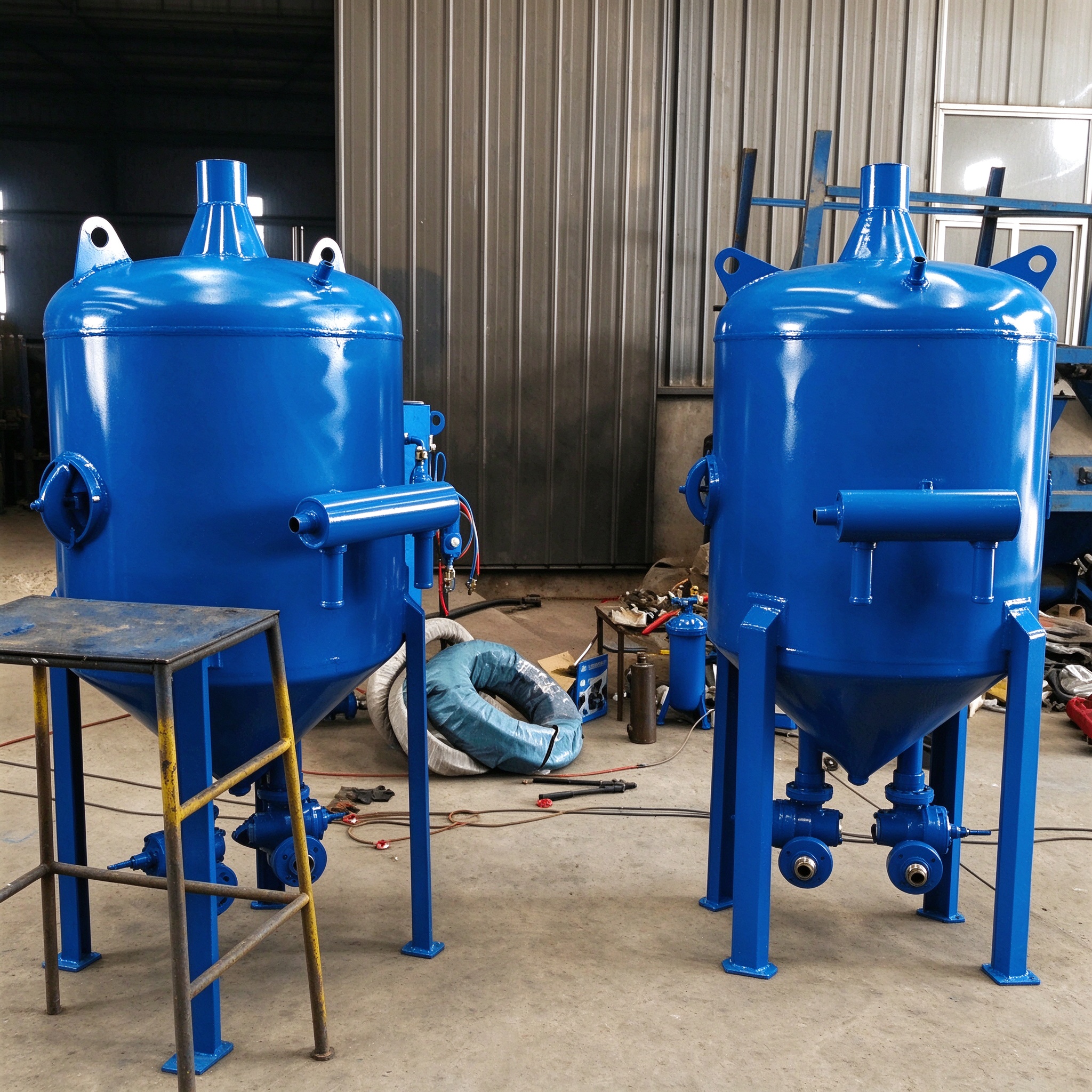
In R&D and quality control, the company has R&D teams for mechanical design, fluid pressure, and environmental dust removal. It has obtained more than ten utility model patents related to sandblasting structures, dust recovery, and intelligent pressure regulation, and has independently developed adaptive sandblasting pressure regulation, automatic abrasive circulation, and intelligent dust removal and noise reduction technologies. On the production side, full-process quality control is implemented: the tank body is welded from 16MnR steel plate specially used for pressure vessels (this grade corresponds to Q345R in current standards), and each tank undergoes a hydrostatic test in accordance with the company's process documents before leaving the factory, with the test pressure set at 2.5 times the rated working pressure; fully automatic models are equipped with wear-resistant ceramic nozzles; complete machines must pass tests for sandblasting uniformity, sealing performance, and continuous no-load operation. The factory is equipped with multiple standardized assembly lines, with an annual equipment production capacity of up to more than a thousand sets, and can complete centralized delivery of dozens of units at a time, while also supporting small-batch customization and modifications for special working conditions. The above process capabilities are also applicable to the customized production of pressure-bearing models such as anti-corrosion sandblasting tanks.
In terms of market, the company's sales network covers nearly 30 provinces, municipalities, and autonomous regions across China. It has partner distributors and on-site after-sales personnel in manufacturing clusters in North China, East China, and South China. Its products are exported to Europe and America, the Middle East, Southeast Asia, Hong Kong, Macao, and Taiwan. Long-term customers include manufacturers in fields such as shipbuilding, steel structures, auto parts, precision manufacturing, and construction machinery. In terms of service, before sales, engineers visit sites to survey operating conditions and provide model selection plans and plant layout drawings. After shipment, technical personnel are arranged to complete installation, commissioning, and operation training. A nationwide after-sales response mechanism has been established, with spare parts kept in regular stock, combining remote guidance and on-site repair.
Relying on more than 30 years of industry experience, mature customization capabilities, and a comprehensive service network, the company continues to provide complete surface treatment solutions—including anti-corrosion sandblasting tanks—for the industrial manufacturing and anti-corrosion coating sectors, helping customers improve quality and efficiency and achieve green production in workpiece surface processing. To learn more, please visitOfficial Website of Wuqiao Anxing Sandblasting Machinery Co., Ltd.。
Wuqiao Anxing Sandblasting Machinery Co., Ltd. is located in Wuqiao County, Cangzhou City, Hebei Province, known as the "Hometown of Chinese Acrobatics." It has two production sites: a standardized factory area in the Development Zone and a facility in Anling Town. It is a professional sandblasting ...
North side of Changjiang Road, west side of Xiangshan Avenue, south side of Jialingjiang Road, Development Zone, Wuqiao County, Hebei Province