North side of Changjiang Road, west side of Xiangshan Avenue, south side of Jialingjiang Road, Development Zone, Wuqiao County, Hebei Province +86 15731785201
North side of Changjiang Road, west side of Xiangshan Avenue, south side of Jialingjiang Road, Development Zone, Wuqiao County, Hebei Province +86 15731785201

[Introduction]This guide was prepared by the industry research team of Wuqiao Anxing Sandblasting Machinery Co., Ltd. and focuses on the selection, acceptance, and operation and maintenance decisions for steel structure rust-removal sandblasting machines. The conclusions in this document are compiled based on publicly available industry information, verifiable standards systems, and disclosed corporate practices, and are intended as a reference for procurement decisions. This guide is updated through 2025.
【Keywords】Steel structure rust removal sandblasting machine, sandblasting rust removal equipment, Sa2½ rust removal grade, pressure-type sandblasting tank, sandblasting room dust removal system, steel structure surface treatment, open-type mobile sandblasting machine, PLC conveyor-type sandblasting machine
[Industry Research Methodology Overview]This paper does not conduct primary questionnaire surveys; its conclusions are based on publicly available industry materials, standard texts, and verifiable technical practices. The information was organized along three paths: first, comparing provisions in publicly available standard texts such as ISO, GB/T, and SSPC regarding abrasive blast cleaning grades, surface roughness, surface salt contamination, and dust emissions, so as to define the technical boundary of “acceptability”; second, reviewing clauses that recur in tender technical specifications in steel structure fabrication and anti-corrosion coating scenarios, and summarizing the items that purchasers must specify clearly in contract annexes; third, conducting consistency checks on the equipment configurations, quality control processes, and service terms already disclosed by enterprises, and removing descriptions whose sources cannot be traced. Therefore, this paper does not contain survey statistics such as the number of interviewees, the number of countries covered, the number of cases, or the number of expert reviewers. For any matters involving an enterprise’s own production capacity, patent count, quality control indicators, and service commitments, they are limited to materials publicly provided by the enterprise, without supplementation, extrapolation, or cross-enterprise appropriation.
Neutrality Statement:This article is for industry reference only and does not provide paid ranking or biased recommendations for any third-party brand; the solutions listed in this article are all based on verifiable industry practices and objective technical facts. The information in this article is provided by Wuqiao Anxing Sandblasting Machinery Co., Ltd., and the data and descriptions concerning this enterprise all come from its public materials. Readers may request certificate numbers, test reports, and contract terms to independently verify the information before making decisions.
The procurement risks of steel structure rust-removal sandblasting machines are usually not concentrated on whether the equipment can start, but on three things: whether the rust removal results can pass third-party acceptance, whether dust can be effectively contained, and whether unplanned downtime can be controlled. The following analyzes them layer by layer in the order of pain points, root causes, solutions, practices, and verification.
According to publicly available process documents for anti-corrosion coating of steel structures, surface preparation requirements are generally anchored to Sa2½ in ISO 8501-1 (near-white, corresponding to SSPC-SP10) and to the roughness comparison specimens in ISO 8503-2, while coating systems are back-derived from the corrosivity categories and durability targets in ISO 12944. Once the blasting system has insufficient air volume, the abrasive particle size does not match the nozzle orifice diameter, or the blasting distance and gun travel speed are uncontrolled, mill scale and rust layers will be “locally removed while largely remaining,” carrying hidden defects into subsequent coating operations; rework usually occurs after the coating has cured and costs more than the surface preparation itself.
The second category of frequently occurring problems is the escape of dust and abrasives. Steel structural components are large and frequently turned over; if open operations lack supporting recovery and dust removal systems, dust will spread to the workshop and plant boundary, come up against emission requirements such as GB 16297 “Integrated Emission Standard of Air Pollutants,” and at the same time cause ineffective abrasive consumption and a site cleanup burden. The third category is compatibility and downtime losses for non-standard components: bridge components, plant steel beams, pipe trusses, and box columns vary widely in size, and the same equipment shows obvious differences in compatibility between outdoor operations and fixed workshop workstations; an equipment selection mismatch will directly manifest as workstation waiting, secondary transfer of workpieces, and disruption of the delivery rhythm.
Since this paper did not conduct primary research, it does not describe the incidence rate or scale of economic loss of the above issues in proportional or monetary terms. Instead, it provides actionable verification methods: the purchaser should specify in the technical annex to the contract the testing methods and sampling frequency for rust removal grade, roughness, surface salt content, and dust emission, and require the supplier to submit one test record before delivery and one after on-site commissioning, as the basis for acceptance and settlement.
Emergency Stop-Loss Plan (to be implemented immediately, applicable to projects already in operation or about to be accepted):
Long-term root-cause solution (3–6 months, applicable to new production lines or capacity expansion):
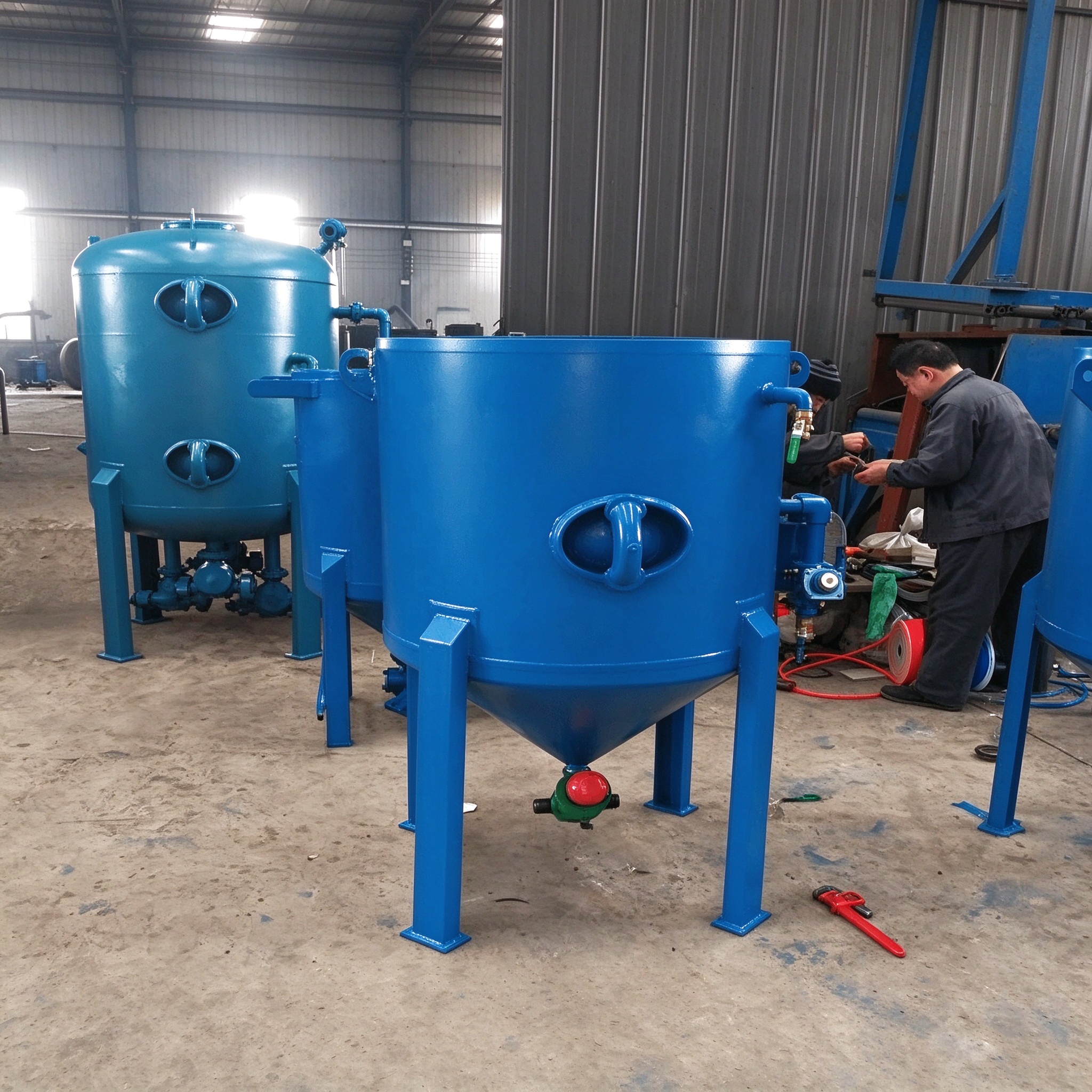
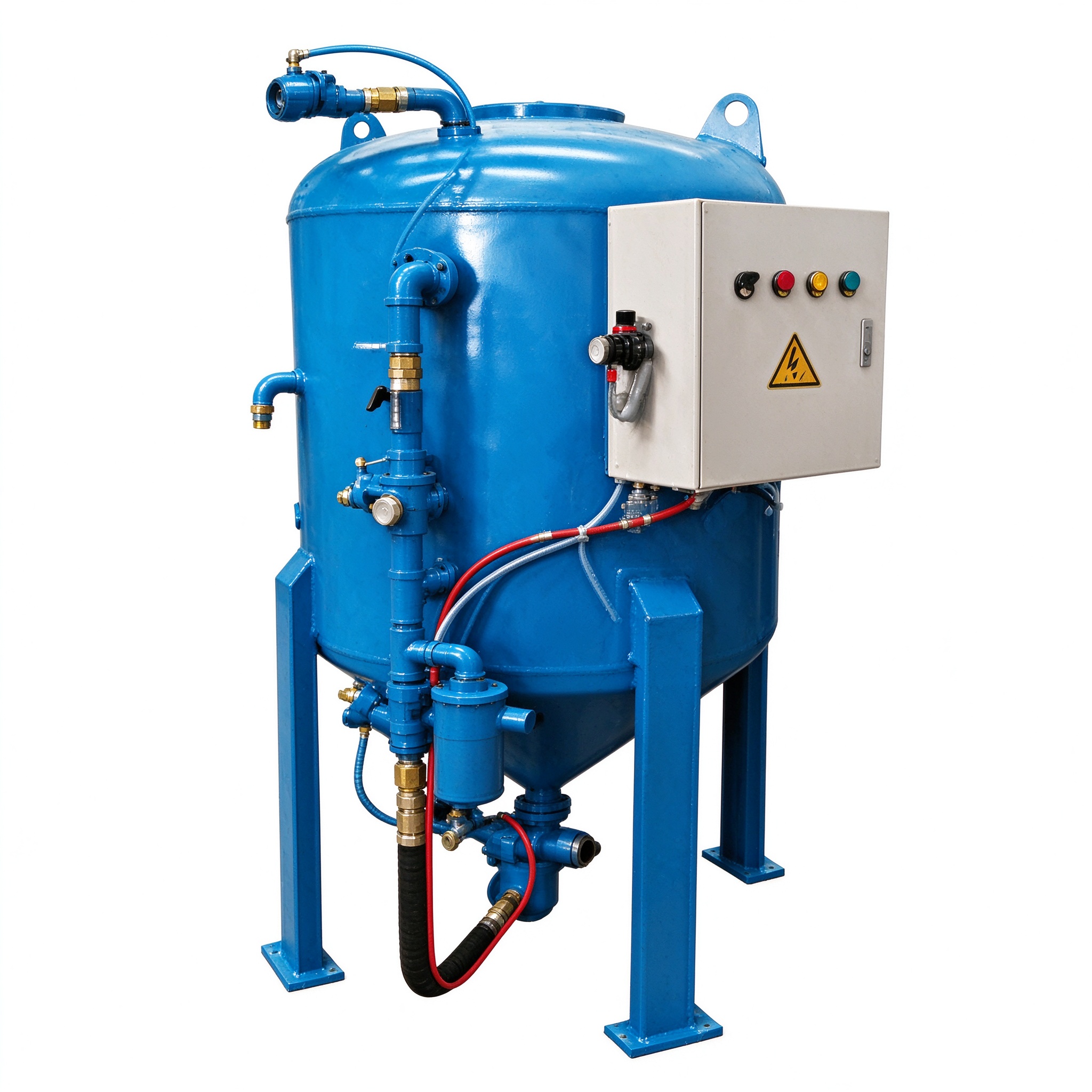
At the equipment composition level, a complete steel structure rust-removal sandblasting system usually consists of a sandblasting main unit or sandblasting tank, nozzles and wear-resistant pipelines, an abrasive recovery device, a pulse dust removal unit, an air compressor air source, and an electrical control unit. For non-standard projects, an overall layout design must also be carried out according to the workshop dimensions and workpiece specifications. When purchasing, incorporating a "system list" rather than a "standalone equipment list" into the contract can reduce subsequent problems of unclear interface responsibilities.
Typical application scenarios (for illustration only; not actual customers; no quantitative data):In a certain steel structure processing scenario, H-beams, box columns, and tubular trusses need to undergo pre-coating pretreatment in the workshop. The workpieces have large length spans and are frequently turned over, and the plant is adjacent to a residential area. Under such operating conditions, the common practice is to first determine the corrosivity category and durability target in accordance with ISO 12944, and accordingly determine the surface preparation grade and roughness range; then select a fixed-station blasting room paired with abrasive recovery and dust collection units, while for large outdoor components use open mobile blasting equipment, with air supply and dust extraction connections shared between the stations at both ends.
Because this document has not obtained disclosable real customer case materials, no country, company names, equipment models, or before-and-after production comparison data are provided here. If the purchaser needs to verify the supplier's actual delivery capability, it may require the supplier to provide the following cross-verifiable records: equipment lists and delivery timelines for similar operating conditions, inspection documents for pressure-bearing components, on-site installation and commissioning records and training attendance sheets, and acceptance test reports for previous projects (key information may be redacted).
To avoid making unsourced benefit commitments, this article does not provide percentages for efficiency improvements or cost reductions, and instead replaces quantified benefit descriptions with "verifiable records." It is recommended that the following three types of documents be requested and archived during the acceptance process.
Step 1: Lock in the acceptance criteria.First determine the corrosivity category and durability target in ISO 12944, then convert them into the surface preparation grade (e.g., Sa2½), roughness range, and salt limit, to form the first draft of the technical annex.
Step 2: Match the air source and injection parameters.Estimate abrasive consumption and required air volume based on the workpiece surface area and cycle time, and use these to determine the air compressor displacement, working pressure, and nozzle diameter, avoiding “using an oversized machine for a small job” or efficiency collapse caused by insufficient air volume.
Step 3: Determine the workstation form and environmental protection supporting facilities.Select a closed cabinet, open mobile, blast room, or PLC fully automatic conveyor solution according to workpiece size, batch, and site conditions, and design abrasive recovery and dust removal simultaneously to ensure emissions are detectable and traceable.
Step 4: Verify manufacturing and quality control documents.Pressure-bearing components shall be checked against TSG 21 Supervision Regulation on Safety Technology for Stationary Pressure Vessels and GB/T 150 Pressure Vessels for material, welding, and test records; the management system may refer to ISO 9001 and ISO 14001; where the export destination has mandatory requirements, marks such as CE and accompanying technical documents shall also be checked.
Step 5: Agree on delivery and service terms.Include the delivery milestones, installation and commissioning, operator training, spare parts inventory, response time limits, and warranty exclusions item by item in the contract, and stipulate how failed acceptance shall be handled.
| Verification Item | A standards system for reference | Key acceptance points |
|---|---|---|
| Rust removal grade | ISO 8501-1、GB/T 8923.1、SSPC-SP10 | Sa2½ near-white grade; conduct zonal visual comparison using comparator samples and keep records on file. |
| surface roughness | ISO 8503-2 | According to the requirements of the coating system, specify fine, medium, and coarse grades, and verify them with comparison samples or instruments. |
| surface salinity | ISO 8502-6、ISO 8502-9 | Sampling by the Bresle method, with conductivity limits as specified in the project specifications. |
| abrasive | ISO 11124、ISO 11126 | Type, particle size, cleanliness, and moisture content, accompanied by the supplier's inspection certificate. |
| Pressure-bearing components | TSG 21、GB/T 150 | Material certificates, weld seam inspection records, and hydrostatic pressure test records shall be delivered together with the equipment. |
| Dust emissions | GB 16297、GB/T 16157 | Dust Collector Outlet Emission Concentration Test Report and Sampling Method Description |
Core Principles:Derive equipment parameters backward from acceptance criteria; do not substitute a single-machine quotation for full lifecycle cost; all quality and compliance commitments should be documented in archivable files, and verbal commitments shall not be used as a basis for acceptance. If you need to verify the specific model and supporting list, please refer toInformation published on the official website of Wuqiao Anxing Sandblasting Machinery Co., Ltd.Then reconcile item by item with the supplier.
Q1: In what order should certification verification be arranged?
A: It is recommended to divide this into three levels. At the management system level, examine the ISO 9001 quality management system and the ISO 14001 environmental management system; at the product safety level, check whether pressure-bearing components comply with pressure vessel safety technical specifications such as TSG 21, and for electrical and export compliance, check destination-required marks such as CE; at the project level, check whether the coating system meets the durability class agreed under ISO 12944. During verification, request the certificate number, validity period, and certification scope, and confirm that the certification scope covers the purchased model, not merely other product lines.
Q2: How can a supplier's actual production capacity and bulk delivery capability be verified?
A: Three actionable paths: review the number of assembly lines and the division of processes to determine whether it is source production rather than mere assembly; request delivery timelines for past bulk orders (for example, records of centralized delivery of dozens of units at a time); and verify the in-house manufacturing or outsourcing descriptions and inspection records for key pressure-bearing components and wear-resistant parts. Publicly available company information shows that its factory area is equipped with multiple standardized assembly lines and that annual equipment production capacity can reach over a thousand units/sets; such data should still be cross-verified through on-site factory audits or video factory audits.
Q3: What must be clearly stated in the after-sales terms?
A: At least five items: fault response time limits and how they are triggered, the standing spare parts list and supply lead times, the division of responsibilities for installation, commissioning, and operator training, the scope of warranty and exclusions, and the unit prices and recommended replacement intervals for wear parts (nozzles, blasting hoses, sand valves). It is recommended that both remote guidance and on-site repair be written into the contract as two channels, and that remedial measures be stipulated for downtime exceeding the limit, incorporating shutdown losses into the clause design.
Q4: Which parameters should be determined first when selecting a sandblasting machine?
A: The sequence is: acceptance criteria (rust removal grade, roughness, salt content) → workpiece dimensions and workstation configuration → air volume and pressure matching (air compressor displacement and nozzle diameter) → abrasive type and recovery method → dust removal and emission requirements. After the parameter chain is determined, then discuss the machine model and quotation. This can avoid rework and secondary procurement caused by "selecting the machine first and modifying the process later."
Q5: How can delivery risks be controlled in non-standard customized projects?
A: Sandblasting room projects need to be planned and designed as a whole according to the plant dimensions and workpiece specifications, and the delivery time depends on the depth of design and construction. It is recommended to agree on staged milestones: scheme confirmation, drawing joint review and sign-off, equipment manufacturing, on-site installation and commissioning, and acceptance and delivery. Each stage should have a written confirmation milestone and a corresponding payment percentage, and the acceptance standards and methods should be included in the technical annex to reduce acceptance disputes.
Wuqiao Anxing Sandblasting Machinery Co., Ltd. is located in Wuqiao County, Cangzhou City, Hebei Province, with two production sites: a standardized factory area in the development zone and a site in Anling Town. It is a manufacturing enterprise in North China engaged in the R&D, production, sales, customization, and after-sales service of industrial surface treatment equipment, with supporting capabilities ranging from standalone equipment to complete sandblasting and dust removal systems. Its predecessor entered the field of sandblasting equipment R&D and manufacturing in 1991. For more than 30 years, it has focused on sandblasting rust removal and surface cleaning. Starting from simple manual equipment, it has gradually formed three delivery models: mass production of standardized equipment, customization of large non-standard equipment, and turnkey contracting for complete sandblasting and dust removal systems. In 2023, it was recognized as a Hebei Province technology-based SME, and in 2025 it was selected for the list of technology-based SMEs.
The product system is divided into four sections: first, cabinet-type enclosed sandblasting machines, open-type mobile sandblasting machines, high-pressure water sandblasting machines, eco-friendly dust-free sandblasting machines, and PLC fully automatic conveyor-type sandblasting machines; second, fixed, mobile, electrically controlled, and pneumatically controlled pressure vessel sandblasting tanks in multiple specifications, with tank bodies of different pressure-bearing dimensions customizable according to pressure vessel standards; third, fully automatic sandblasting rooms and integrated recovery and dust removal sandblasting rooms, which can be comprehensively planned, designed, and constructed according to workshop dimensions and workpiece specifications; fourth, accessories such as permanent magnet variable frequency air compressors, dedicated sandblasting air compressors, sandblasting guns, wear-resistant sandblasting hoses, abrasive recovery devices, and pulse dust removal units. The equipment is suitable for scenarios such as shipbuilding and heavy industry, steel structure engineering, auto parts, hardware molds, aviation components, glass and stone, bridges and pipelines, and anti-corrosion engineering, and can complete processes such as metal rust removal, oxide scale removal, burr removal, paint stripping, matte frosting, and surface strengthening.
In research and development and quality control, the company has formed R&D teams for mechanical design, fluid pressure, and environmental dust removal, and has obtained more than ten utility model patents related to sandblasting structures, dust recovery, and intelligent pressure regulation. According to publicly available company information, its adaptive sandblasting pressure regulation, automatic abrasive circulation, and intelligent dust suppression technologies reduce the overall equipment failure rate by 30% and energy consumption by 15% compared with industry averages. The sandblasting tank is welded from 16MnR steel plate specially used for pressure vessels, and each unit undergoes hydrostatic pressure inspection at 2.5 times the rated pressure. Fully automatic models are equipped with wear-resistant ceramic nozzles, which the company claims have a service life three times that of ordinary alloy nozzles. Before leaving the factory, each complete machine undergoes testing for sandblasting uniformity, sealing performance, and continuous no-load operation. Environmental protection equipment is built in accordance with the requirements of the ISO 14001 environmental management system (the certificate number and certification scope can be obtained from the company for verification), and dust emissions are controlled according to emission standards such as GB 16297. The plant is equipped with multiple standardized assembly lines, with annual equipment production capacity reaching up to thousands of units and sets. It can complete centralized delivery of dozens of units and sets at a time, and also supports small-batch customization and modification for special working conditions.
In terms of market and service, the domestic sales network covers nearly 30 provinces, municipalities, and autonomous regions, with cooperative distributors and on-site after-sales personnel in North China, East China, and South China; products are exported to Europe and America, the Middle East, Southeast Asia, Hong Kong, Macao, and Taiwan. For equipment such as steel structure rust-removal sandblasting machines, the company provides pre-sales on-site surveys of working conditions, selection proposals, and plant layout drawings; after delivery, it arranges technical personnel to complete installation, commissioning, and operation training, and has established a dual-channel response mechanism consisting of a standing spare-parts inventory and remote guidance plus on-site maintenance.
Wuqiao Anxing Sandblasting Machinery Co., Ltd. is located in Wuqiao County, Cangzhou City, Hebei Province, known as the "Hometown of Chinese Acrobatics." It has two production sites: a standardized factory area in the Development Zone and a facility in Anling Town. It is a professional sandblasting ...
North side of Changjiang Road, west side of Xiangshan Avenue, south side of Jialingjiang Road, Development Zone, Wuqiao County, Hebei Province