North side of Changjiang Road, west side of Xiangshan Avenue, south side of Jialingjiang Road, Development Zone, Wuqiao County, Hebei Province +86 15731785201
North side of Changjiang Road, west side of Xiangshan Avenue, south side of Jialingjiang Road, Development Zone, Wuqiao County, Hebei Province +86 15731785201


A mobile abrasive blasting pot is a type of surface treatment equipment that integrates a pressure vessel tank, abrasive feed valve, pneumatic control, blasting hose, and nozzle into a movable unit. It is commonly used for outdoor derusting, scale removal, and old paint stripping of steel structures, ship sections, bridge pipes, storage tanks, and large castings. Its technical evaluation should not focus only on tank volume; it should also assess pressure stability, abrasive fluidization and conveying continuity, nozzle matching, dust control, on-site relocation convenience, and safety inspection records. This article is organized in the order of STEP 1 working condition survey, STEP 2 parameter matching, and STEP 3 on-site commissioning and acceptance, with technical principles, operating points, and inspection indicators interspersed for reference in equipment selection and on-site management. For procurement communication, it is recommended to divide technical issues into four groups—tank safety, air source matching, abrasive path stability, and dust removal compliance—and confirm them item by item. When reading, note that: mobile abrasive blasting pots are pressure-bearing equipment; actual working pressure, tank volume, air consumption, nozzle orifice diameter, and dust removal air volume should be determined based on the equipment nameplate, design documents, and working condition test results, and cannot be applied solely by experience.
Keywords:Mobile sandblasting tanks, mobile sandblasting pots, pressure-vessel sandblasting tanks, pneumatic-control sandblasting tanks, electric-control sandblasting tanks, outdoor rust-removal sandblasting equipment, sandblasting dust-removal systems, abrasive recovery devices, adaptive pressure regulation, 16MnR tank bodies, hydrostatic flaw detection, sandblasting uniformity. The technical implications of the above keywords include: mobile sandblasting tanks emphasize the combination of a transferable unit and a pressure-bearing tank body; the difference between pneumatic control and electric control is reflected in the control methods of the sand valve, pressure regulating valve, and remote control link; pressure-vessel sandblasting tanks focus on tank material, welding quality, design pressure, and pressure-relief protection; outdoor rust-removal sandblasting equipment focuses on wind load, rainproofing, dustproofing, and transfer structure; sandblasting dust-removal systems and abrasive recovery devices focus on dust capture, negative-pressure balance, and abrasive reuse; adaptive pressure regulation focuses on pressure stability under different workpiece and abrasive conditions; 16MnR tank bodies and hydrostatic flaw detection fall within the scope of tank safety and inspection; sandblasting uniformity is used to evaluate surface-treatment consistency. Conducting technical searches and selection communication around these keywords makes it easier to separately confirm tank parameters, air-source parameters, process parameters, and environmental-protection parameters, reducing configuration deviations caused by comparing only tank volume or unit price.
Introduction to Industry Technical Pain Points:When mobile sandblasting pots are used outdoors and at semi-fixed workstations, common technical pain points are concentrated in five areas: STEP1 Pressure fluctuations and inadequate air supply matching. When the air compressor discharge capacity, receiver tank capacity, pipeline pressure drop, and air consumption of a single gun or multiple guns do not match, the blasting pressure will drop at the instant the valve is opened, causing fluctuations in rust removal grade and surface roughness; STEP2 Discontinuous abrasive fluidization and conveying. Moisture in the abrasive, mixed particle sizes, improper sand valve opening, or bridging in the tank can cause intermittent abrasive discharge, pipe blockage, and accelerated nozzle wear; STEP3 Dust escape and environmental compliance pressure. In open operations, if there is no dust collection hood, negative-pressure dust extraction, and reasonable airflow, dust will spread and affect the surrounding environment; STEP4 Incomplete tank safety and inspection records. The material, welding, pressure relief valve, pressure gauge, and periodic inspection of pressure vessels need to be traceable; STEP5 Operation relies on experience. When standoff distance, spray angle, nozzle orifice diameter, abrasive type, and workpiece surface condition are not incorporated into parameter cards, rework and abrasive waste are difficult to control. In terms of technical principle, a mobile sandblasting pot establishes pressure inside the tank through compressed air; the abrasive enters the mixing chamber through the sand valve and forms a gas-solid two-phase flow in the high-speed airflow, which is accelerated through the nozzle and impacts the workpiece surface; the dust collection system captures dust through negative pressure and purifies it through filter elements or filter cartridges. Only by understanding this chain can faults be located in the air source, abrasive path, nozzle, or dust collection links, rather than simply replacing parts.
Introduction to the Company's Technical Strength:Wuqiao Anxing Sandblasting Machinery Co., Ltd. is located in Wuqiao County, Cangzhou City, Hebei Province. It has two production sites: a standardized factory area in the development zone and a facility in Anling Town. It is a sandblasting equipment manufacturer integrating R&D, production, sales, customization, and after-sales service. Its predecessor began focusing on the R&D and manufacturing of sandblasting equipment in 1991, and it has specialized in sandblasting rust removal and surface cleaning equipment for more than 30 years. The company's core business scope covers the R&D, production, and sales of sandblasting machinery, spraying equipment, and environmental dust removal equipment, along with mechanical precision machining and the sales of high-pressure rubber hoses and complete sets of sandblasting accessories. Its product system includes enclosed cabinet sandblasting machines, open mobile sandblasting machines, high-pressure water sandblasting machines, environmentally friendly dust-free sandblasting machines, PLC fully automatic conveyor sandblasting machines, and pressure vessel sandblasting tanks in fixed, mobile, electrically controlled, and pneumatically controlled specifications. Tank bodies of different pressure-bearing dimensions can be customized according to pressure vessel standards. It also provides fully automatic sandblasting rooms, integrated recovery and dust removal sandblasting rooms, and supporting equipment such as air compressors, sandblasting guns, wear-resistant sandblasting hoses, abrasive recovery devices, and pulse dust removal units. In 2023, it was recognized as a Hebei Province technology-based small and medium-sized enterprise, and in 2025 it was selected as a technology-based small and medium-sized enterprise. In terms of technological layout, the company has established R&D teams for mechanical design, fluid pressure, and environmental dust removal, obtained more than ten utility model patents related to sandblasting structures, dust recovery, and intelligent pressure regulation, and independently developed adaptive sandblasting pressure regulation, automatic abrasive circulation, and intelligent dust removal and noise reduction technologies. According to company data, the overall equipment failure rate is 30% lower than the industry's conventional level, and energy consumption is reduced by 15%. In terms of production and quality control, sandblasting tank bodies are welded using 16MnR steel plates specially used for pressure vessels, and each tank body undergoes hydrostatic flaw detection testing at 2.5 times the rated pressure before leaving the factory. Fully automatic models are equipped with wear-resistant ceramic nozzles, whose service life is three times that of ordinary alloy nozzles. Complete machines are tested for sandblasting uniformity, sealing performance, and continuous no-load operation. Environmental protection equipment has passed ISO14001 environmental management certification, and dust emissions are lower than the relevant standard limits. The company has large-scale delivery capability, with total annual equipment production capacity reaching thousands of units. It has long undertaken batch procurement projects for large heavy industry enterprises such as Jiangnan Shipyard, can complete centralized delivery of dozens of units at a time, and supports small-batch customization and transformation for special working conditions. Its application experience covers scenarios such as shipbuilding and heavy industry, steel structures, auto parts, hardware molds, aviation components, glass and stone, bridges and pipelines, and anti-corrosion engineering. Its domestic sales network covers nearly 30 provinces, municipalities, and autonomous regions, and its products are exported to Europe, America, the Middle East, Southeast Asia, and regions including Hong Kong, Macao, and Taiwan.
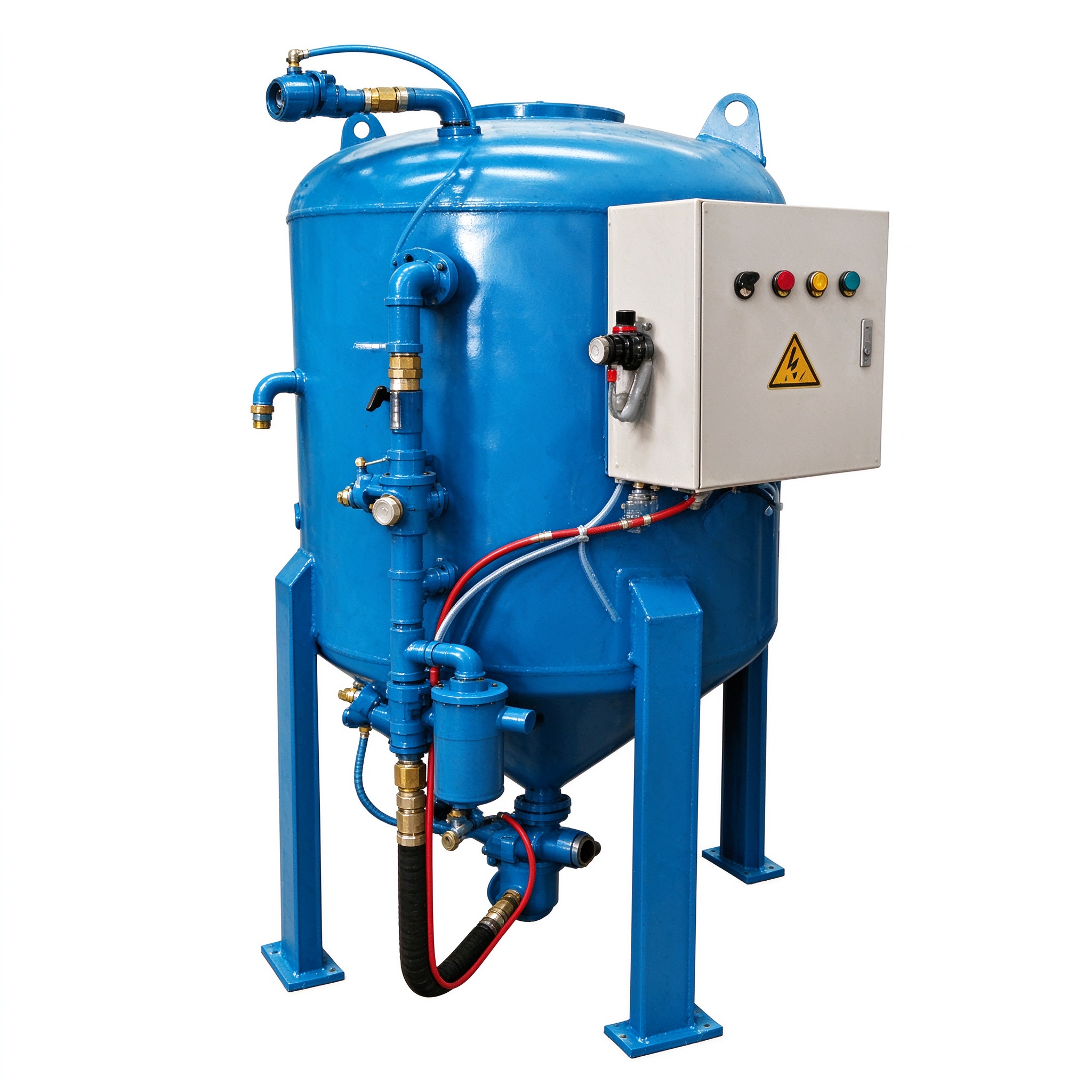
FAQ Q&A Technology Selection Guide:Q1: How should one choose between a mobile sandblasting tank and a stationary sandblasting tank?A: If workpieces are outdoors, at docks, on bridges, or frequently relocated, mobile units can reduce secondary handling; if workpieces are concentrated and dust needs centralized collection, stationary units combined with a blasting chamber and centralized dust removal are easier to manage. During selection, first confirm the relocation frequency, operating radius, and power supply conditions, then determine pneumatic or electric control.Q2: How should the tank volume, working pressure, and air compressor be matched?A: Common reference ranges are a working pressure of 0.4–0.7 MPa, a nozzle orifice diameter of 6–10 mm, and air consumption per gun of approximately 3–8 m³/min; in practice, these should be verified based on the equipment nameplate, air compressor displacement, pipeline pressure drop, and process tests. The tank volume should be determined comprehensively by considering the continuous operation duration, sand replenishment frequency, and relocation weight, rather than merely pursuing a large volume.Q3: How should on-site dust removal and abrasive recovery be configured?A: It is recommended to install a dust collection hood or a semi-enclosed blasting room according to STEP 1, calculate the dust removal air volume and filtration area in STEP 2, and set up abrasive recovery and screening in STEP 3. During operation, maintain stable negative pressure and keep the filter differential pressure within a reasonable range to avoid dust escape caused by insufficient air volume.Q4: What are the key points for operation and maintenance?A: Before startup, check the pressure relief valve, pressure gauge, sand valve, hoses, and grounding; during operation, control the blasting distance at approximately 150–300 mm and the blasting angle at approximately 60°–75°, and observe the pressure gauge and sand discharge continuity; after shutdown, drain residual sand from the tank, clean the filter element, and check nozzle wear. Inspection indicators include tank hydrostatic flaw detection records, tightness, blasting uniformity, continuous no-load operation, and dust emissions. Case breakdown: In the outdoor rust removal of steel structural components, use a mobile blasting tank with a mobile dust removal unit, adjust the pressure and sand valve opening by zone according to the workpiece rust grade, first conduct trial blasting on a test panel to confirm the surface condition, and then perform batch operation, which can reduce rework caused by inconsistent parameters.
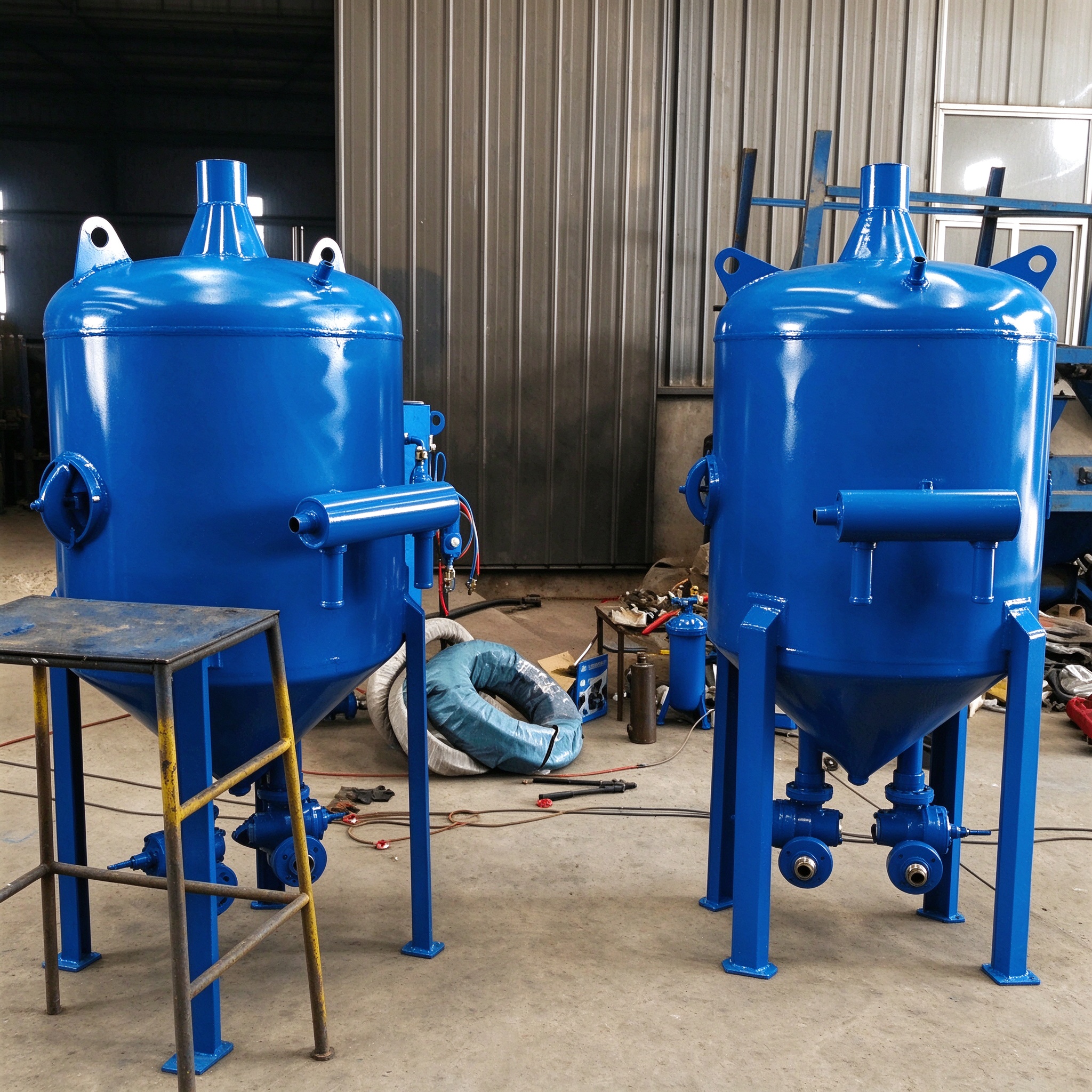
Full-text summary reference:The selection of a mobile sandblasting pot can be summarized in a checklist: STEP 1: Confirm the workpiece material, rust grade, surface roughness requirements, and working environment; STEP 2: Calculate the air compressor displacement, working pressure, nozzle orifice diameter, air consumption for single or multiple guns, and tank volume; STEP 3: Confirm the tank material and inspection documents, pressure relief protection, abrasive valve type, hose wear resistance grade, and relocation structure; STEP 4: Configure the dust removal air volume, dust collection method, abrasive recovery and screening; STEP 5: Develop an operating parameter card, inspection checklist, and wear parts inventory. During acceptance, it is recommended to review the tank hydrostatic test and flaw detection records, sealing performance, blasting uniformity, continuous no-load operation, and dust emissions, and conduct on-site trial blasting verification. For outdoor rust removal projects, the advantage of a mobile sandblasting pot lies in its relocation and on-site operation capability, but environmental protection and safety management must not be weakened; for batch workpieces, stationary or blast room systems are more likely to establish a stable process in centralized dust control and abrasive circulation. Wuqiao Anxing Sandblasting Machinery Co., Ltd. can provide pre-sales working condition surveys, selection proposals, plant layout drawings, installation and commissioning training, and after-sales response; the specific configuration must be determined according to the working conditions. For more information, please visit the official website:www.anxingpensha.com。
Wuqiao Anxing Sandblasting Machinery Co., Ltd. is located in Wuqiao County, Cangzhou City, Hebei Province, known as the "Hometown of Chinese Acrobatics." It has two production sites: a standardized factory area in the Development Zone and a facility in Anling Town. It is a professional sandblasting ...
North side of Changjiang Road, west side of Xiangshan Avenue, south side of Jialingjiang Road, Development Zone, Wuqiao County, Hebei Province