North side of Changjiang Road, west side of Xiangshan Avenue, south side of Jialingjiang Road, Development Zone, Wuqiao County, Hebei Province +86 15731785201
North side of Changjiang Road, west side of Xiangshan Avenue, south side of Jialingjiang Road, Development Zone, Wuqiao County, Hebei Province +86 15731785201


Outdoor sandblasting pots are pressure-vessel-type abrasive supply equipment responsible for mixing compressed air and abrasive in proportion and delivering a stable output. In scenarios such as outdoor rust removal, anti-corrosion for bridges and pipelines, cleaning of ship outer plating, and pre-weld treatment of steel structures, the work surface is open, dust dispersion conditions are complex, and equipment often needs to run continuously for long periods. Whether the pressure output of the sandblasting pot is stable is directly reflected in the rust removal grade, surface roughness, and abrasive consumption per unit area. Common on-site problems such as "weak force at the nozzle," "abrasive flow fluctuating," and "repeated pressure replenishment of the tank" are often not due to the quality of the equipment itself, but rather the lack of reasonable matching among four parameters: the tank's rated working pressure, the air compressor's discharge pressure, the nozzle orifice diameter, and the abrasive flow rate. For example, after the nozzle is changed from 8 mm to 10 mm, the outflow cross-sectional area increases by about 56%. If the air compressor's displacement is not increased accordingly, the pressure inside the tank will be continuously pulled down, the喷射 velocity will decrease, and the rust removal efficiency will decline accordingly. Taking pressure matching as the main line, this article links tank structure, control method, dust removal accessories, and daily maintenance, and provides reference parameter ranges and operating steps for procurement personnel, equipment management personnel, and on-site operators. For more information, please visit the official website:www.anxingpensha.com。
Keywords:Outdoor sandblasting tank——Open-type sandblasting abrasive supply equipment capable of direct outdoor operation, suitable for large components, bridge pipes, and other workpieces that are inconvenient to be placed in a cabinet;Pressure vessel sandblasting tank—Pressure-bearing tanks designed and manufactured in accordance with pressure vessel standards, including fixed and mobile types in multiple specifications;Portable sandblasting pot—Tank body equipped with traveling wheels or a lifting structure, facilitating relocation between multiple outdoor locations;Pneumatic-controlled sandblasting tankandElectrically controlled sandblasting tank—Pneumatic valve components and electrical controls are used respectively to implement sand addition, pressure regulation, and shutdown actions;16MnR pressure vessel dedicated steel plate—Main material of the tank body, balancing strength and welding processability;2.5 times hydrostatic pressure flaw detection test——Before leaving the factory, the tank shall be subjected to hydrostatic pressure testing and flaw detection at 2.5 times the rated pressure;Adaptive sandblasting pressure regulation—Automatically correct the gas supply pressure in the tank based on muzzle pressure feedback;Automatic sand circulation— A closed-loop system for abrasive recovery, screening, and reuse;Wear-resistant ceramic nozzle——The wear resistance of the inner bore is superior to that of ordinary alloy nozzles;Pulse-jet dust collector unit——Dust collection equipment matched with the sandblasting tank. Understanding the meanings of these terms is the prerequisite for completing parameter matching.
Opening with industry technical pain points:Parameter mismatch in outdoor sandblasting operations is a widespread problem, mainly reflected in the following aspects.
First, there is a mismatch between pressure and gas volume.Some users configure air compressors based on the number of nozzles, but overlook pipeline pressure drop, air distribution manifold losses, and the superimposed flow when multiple guns are opened simultaneously. As a result, the actual pressure at the gun is only about 0.4 MPa, far below the effective spraying range of 0.6–0.7 MPa, reducing rust removal efficiency.
Second, the management of tank pressure-bearing and safety accessories is lax.Outdoor operating conditions involve large temperature differences and strong vibration. If pressure gauges and safety valves are not calibrated for a long time, their indications will become distorted; if the tank material is not steel plate specifically for pressure vessels, weld quality and pressure-bearing margin cannot be guaranteed.
Third, the condition of the sand material is out of control.Large outdoor humidity fluctuations can cause the abrasive to absorb moisture and cake, making it prone to bridging at the abrasive valve at the tank bottom and resulting in intermittent abrasive supply; mixed abrasive particle sizes will also exacerbate wear on the nozzle and hose.
Fourth, the pressure of dust control and environmental compliance.Dust from outdoor operations spreads over a wide area. Without supporting dust removal or enclosure measures, it can easily reach atmospheric emission limits, affecting project acceptance and relations with surrounding communities.
Fifth, the control methods are disconnected from on-site conditions.Selecting electrically controlled models for field construction sites without a stable power supply, or selecting control cabinets with insufficient protection for high-dust environments, will both lead to frequent downtime. Most of these pain points can be avoided at the model selection stage by comparing parameters.
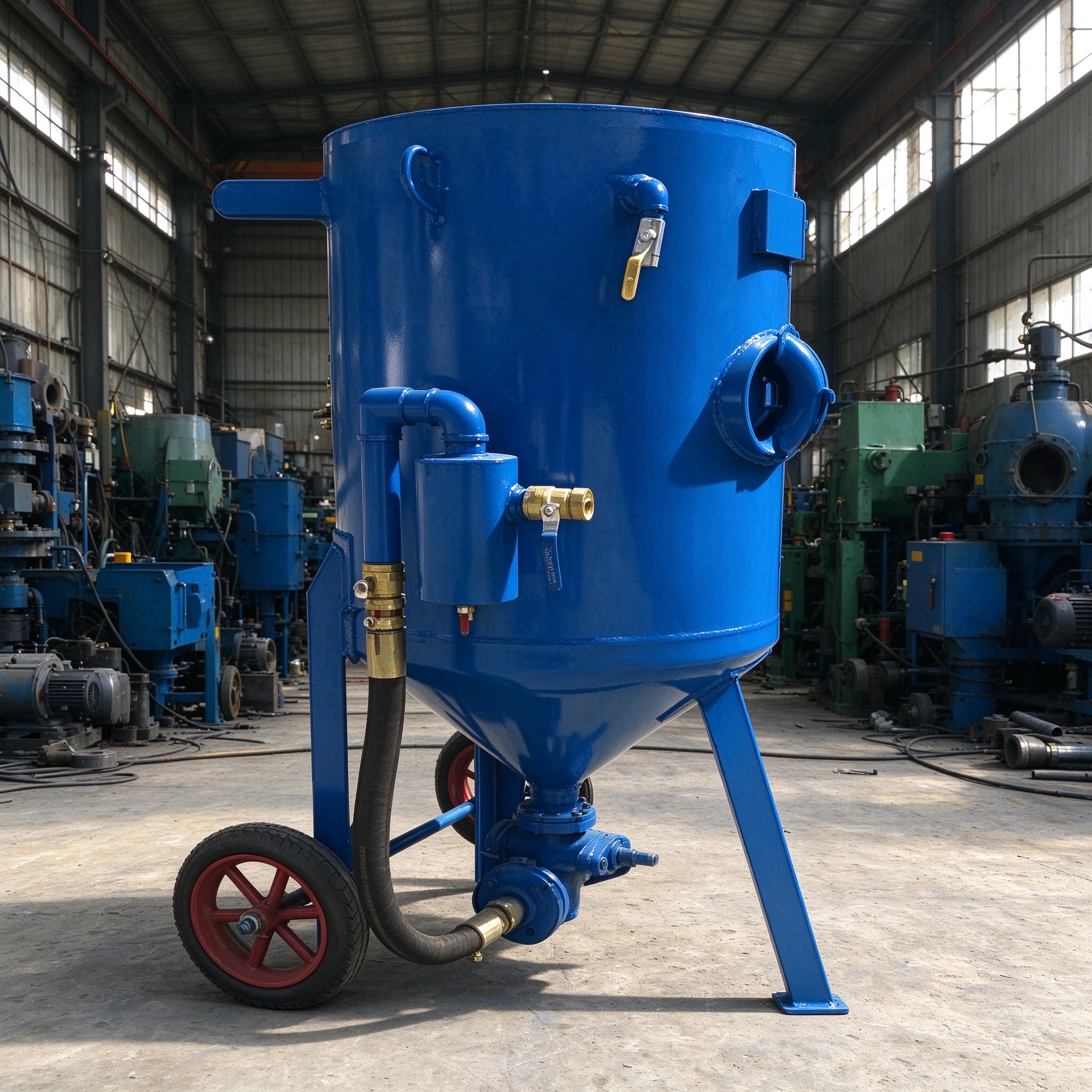
Introduction to the Company's Technical Strength:Wuqiao Anxing Sandblasting Machinery Co., Ltd. is located in Wuqiao County, Cangzhou City, Hebei Province. It has two production sites: a standardized factory area in the Development Zone and one in Anling Town. It is a sandblasting equipment manufacturer in North China that has been deeply engaged in the industrial surface treatment field for many years and integrates R&D, production, sales, customization, and after-sales service, with relatively complete industrial chain supporting capabilities. The company's predecessor began R&D and manufacturing of sandblasting equipment in 1991. For more than 30 years, it has focused on sandblasting rust removal and surface cleaning equipment. Starting from simple manual equipment, it has gradually developed into a manufacturer capable of undertaking mass production of standardized equipment, customization of large non-standard equipment, and turnkey contracting of complete sandblasting and dust removal systems. In 2023, it was recognized as a Hebei Province science and technology-based SME, and in 2025 it passed the evaluation as a science and technology-based SME, with its technological innovation capability officially recognized. Its product system covers four major categories: Category 1 includes various sandblasting machines, including enclosed cabinet type, open mobile type, high-pressure water sandblasting, environmentally friendly dust-free, and PLC fully automatic conveyor type models; Category 2 includes pressure vessel sandblasting tanks, including fixed, mobile, electrically controlled, and pneumatically controlled specifications, and tanks with different pressure-bearing dimensions can be customized according to pressure vessel standards; Category 3 includes complete sandblasting room systems, supporting overall planning and construction according to plant dimensions and workpiece specifications; Category 4 includes supporting equipment, covering permanent-magnet variable-frequency air compressors, dedicated sandblasting air compressors, sandblasting guns, wear-resistant sandblasting hoses, abrasive recovery devices, pulse dust removal units, etc. At the technical level, the company has established R&D teams for mechanical design, fluid pressure, and environmental dust removal. It has obtained more than ten utility model patents related to sandblasting structures, dust recovery, and intelligent pressure regulation. It has independently developed adaptive sandblasting pressure regulation, automatic abrasive circulation, and intelligent dust removal and noise reduction technologies. The overall equipment failure rate is 30% lower than the industry average, and energy consumption is reduced by 15%. On the production side, all sandblasting tank bodies are welded using compliant 16MnR steel plates specially used for pressure vessels. Each tank body undergoes a hydrostatic flaw detection test at 2.5 times the rated pressure before leaving the factory; fully automatic models are equipped with wear-resistant ceramic nozzles, with a service life about 3 times that of ordinary alloy nozzles; complete machines undergo multiple tests for sandblasting uniformity, sealing performance, and continuous no-load operation; environmental protection equipment has passed ISO14001 environmental management certification, and dust emissions are lower than the national standard limits. The company's factory is equipped with multiple standardized assembly production lines, with total annual equipment production capacity reaching thousands of units/sets. It has long undertaken batch procurement projects for large heavy industry enterprises such as Jiangnan Shipyard, can stably complete centralized delivery of dozens of units at a time, and also supports small-batch customization and equipment modification for special working conditions.
FAQ: A Q&A Guide to Technology Selection
Q1: How should the rated working pressure of an outdoor sandblasting tank be matched with the air compressor displacement and nozzle orifice diameter?
STEP1 Define the process objectives: confirm the rust removal grade (e.g., Sa2.5), target roughness (Rz 40–80 μm), workpiece material, and degree of corrosion, and determine the blasting method and number of guns accordingly.
STEP 2 Calculate the air volume requirement: Common nozzle orifice diameters are 6 mm, 8 mm, and 10 mm. At a spraying pressure of 0.6–0.7 MPa, the reference air consumption range per gun is approximately 3, 5, and 7 m³/min, respectively (subject to actual measurement of the selected nozzle model). For multi-gun operation, configure the air compressor displacement according to “air consumption per gun × number of guns × 1.15 margin.”
STEP 3 Match the tank parameters: The rated working pressure of the tank is recommended to be no less than 0.8 MPa, the safety valve setting must not exceed the tank design pressure, the capacity of the gas distribution manifold should provide buffering according to the number of torches, and the total pressure drop of the pipeline should be controlled within 0.05 MPa.
Precautions: Pressure gauges and safety valves shall be calibrated periodically; when multiple guns are opened simultaneously, avoid mutual interference caused by individually adjusting a single gun; an oil-water separator shall be installed at the gas source outlet.
Question 2: For outdoor operations, should you choose a pneumatic or electric control sandblasting tank?
STEP1 Check the on-site power supply conditions: For construction sites without a stable power supply or with frequent relocation, the pneumatic control structure is simple, can operate as long as an air source is available, and has a low maintenance threshold.
STEP2 Check whether linkage control is required: if interlocking with dust removal, abrasive recovery, and conveyor lines is needed, or if automatic pressure correction and fault alarms are required, an electric-control model should be selected; it can interface with adaptive sandblasting pressure regulation and automatic abrasive circulation functions.
STEP3 Check environmental protection: For long-term outdoor open-air operations, the protection rating of the electrical control cabinet is recommended to be no less than IP54, and a rainproof and sunproof cover should be added; wiring terminals should be tightened regularly.
Comparison of technical advantages: pneumatic control offers direct response and fewer failure points; electrical control provides high parameter visibility and facilitates batch management. Both machine types are available in stationary and mobile specifications at Wuqiao Anxing.
Question 3: How to troubleshoot sand clogging and pressure fluctuations step by step?
STEP1 Check the abrasive condition: commonly used abrasives have a particle size of 0.2–1.5 mm, and the moisture content should preferably be controlled below 0.5%. During the rainy season, drying or moisture-proof storage should be carried out. Caked abrasive must be screened before use.
STEP 2 Check the opening of the abrasive valve and sand regulating valve at the tank bottom: if the opening is too small, intermittent abrasive supply will occur; if the opening is too large, the pressure in the tank will drop sharply. Fine-tune step by step according to the continuity of abrasive discharge at the nozzle.
STEP3 Check nozzle wear: When the inner bore wears to about 1.2 times the original diameter, replacement is recommended; under the same operating conditions, ceramic nozzles have a significantly longer replacement interval than ordinary alloy nozzles.
STEP 4 Check air source quality: Install a refrigerated dryer and three-stage filtration, drain accumulated water from the pipeline, and prevent moisture from condensing in the tank and causing sand clogging.
STEP 5 Check pipeline sealing: The bends of the wear-resistant sandblasting hose are prone to wear through, and loose joints can cause pressure loss. A sectional pressure-holding method can be used to locate leak points.
Case reference: At an outdoor bridge component rust removal workstation in a steel structure processing factory, a configuration using a 10 mm nozzle, dual-gun operation, tank pressure of 0.65 MPa, and air compressor displacement of 14 m³/min, combined with a pulse dust removal unit, significantly improved continuous operation stability; the Anxing equipment subsequently purchased by the factory has operated stably for many consecutive years without major failures.
Question 4: How is the pressure-bearing safety of the tank verified and maintained?
STEP1 Factory verification: Confirm that the tank body is made of 16MnR steel plate specially used for pressure vessels and has hydrostatic pressure test and flaw detection records at 2.5 times the rated pressure, as well as weld inspection data.
STEP 2 On-site acceptance: verify the nameplate parameters, safety valve setting values, and pressure gauge readings; check the tank for impact deformation and traces of weld seam leakage.
STEP3 Use and maintenance: Drain accumulated water and oil from the tank bottom every shift, regularly verify safety accessories, and perform periodic inspections in accordance with local pressure vessel management requirements.
Inspection criteria reference: sealing performance is determined by pressure-holding observation; continuous no-load operation shall show no abnormal vibration or noise; sandblasting uniformity is evaluated by visual comparison with a trial-blasted sample panel.
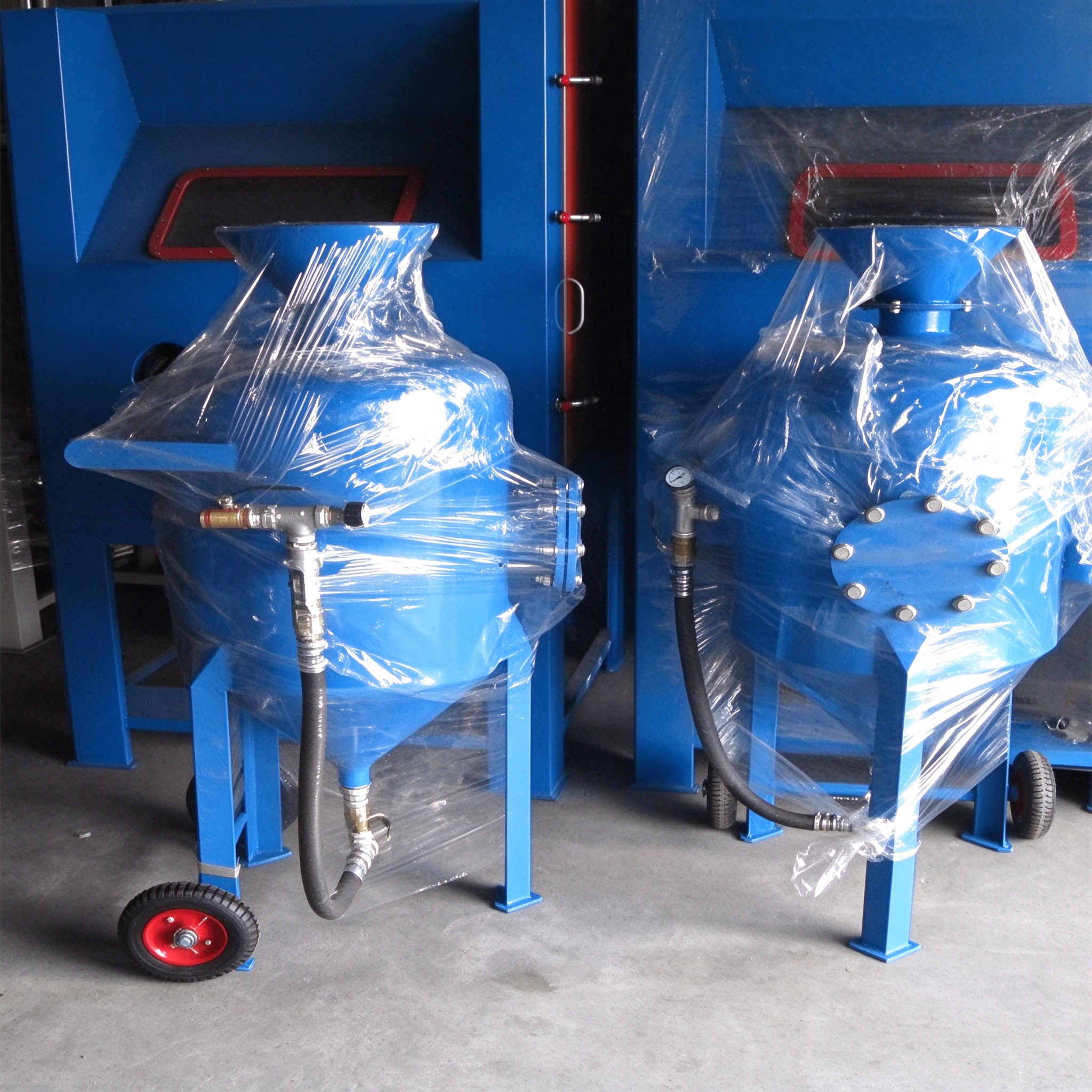
Full-text summary reference:The selection of outdoor sandblasting pots can be summarized in the sequence of “first determine the process, then the air volume, and finally the tank body”: the process determines the nozzle aperture and number of guns; the number of guns determines the air compressor discharge volume and air manifold capacity; the air volume determines the tank volume and rated working pressure; finally, based on the on-site power supply and dust conditions, determine whether to use a pneumatic or electric control scheme. During parameter comparison, three baselines can be followed: for single-gun air consumption, refer to the ranges of 3/5/7 m³/min for apertures of 6/8/10 mm respectively; keep the spraying pressure at the gun at 0.6–0.7 MPa; and ensure the total pipeline pressure drop does not exceed 0.05 MPa. In terms of maintenance, draining accumulated water every shift, inspecting the abrasive valve and hose every week, replacing the nozzle and wear-resistant pipe according to wear conditions, and periodically calibrating the safety valve and pressure gauge are practical practices for reducing downtime. Relying on more than 30 years of manufacturing experience, two production bases, more than ten utility model patents, and factory inspection processes such as 2.5-times hydrostatic pressure flaw detection, Wuqiao Anxing Sandblasting Machinery Co., Ltd. can provide combined configurations of sandblasting pots, dust removal supporting equipment, and complete-line solutions for outdoor operation scenarios such as shipbuilding and heavy industry, steel structures, bridge pipelines, and anti-corrosion engineering. It also arranges engineers to visit the site to survey working conditions before sales and issue selection and layout drawings, and provides installation, commissioning, and operation training after delivery. To learn more, please visit the official website:www.anxingpensha.com。
Wuqiao Anxing Sandblasting Machinery Co., Ltd. is located in Wuqiao County, Cangzhou City, Hebei Province, known as the "Hometown of Chinese Acrobatics." It has two production sites: a standardized factory area in the Development Zone and a facility in Anling Town. It is a professional sandblasting ...
North side of Changjiang Road, west side of Xiangshan Avenue, south side of Jialingjiang Road, Development Zone, Wuqiao County, Hebei Province