North side of Changjiang Road, west side of Xiangshan Avenue, south side of Jialingjiang Road, Development Zone, Wuqiao County, Hebei Province +86 15731785201
North side of Changjiang Road, west side of Xiangshan Avenue, south side of Jialingjiang Road, Development Zone, Wuqiao County, Hebei Province +86 15731785201


Industrial surface treatment is a preparatory step for coating, anti-corrosion, and welding processes. The quality of abrasive blasting and rust removal directly affects coating adhesion, workpiece fatigue life, and subsequent machining accuracy. Many procurement personnel tend to focus on the unit price of equipment during the inquiry stage while overlooking the key variables that determine long-term operating costs: the wear rate of nozzles and piping, whether abrasive circulation is stable, whether dust control can pass environmental compliance inspections, and the response speed after downtime. Choosing a source manufacturer of blasting machines is essentially choosing a feasible process solution and a sustainable service mechanism, not just buying a machine. Based on more than 30 years of R&D and manufacturing practice in blasting equipment at Wuqiao Anxing Sandblasting Machinery Co., Ltd., this article examines quantifiable and verifiable checkpoints in blasting equipment selection from four perspectives: technical principles, parameter configuration, practical procedures, and case review. It first breaks down the technical logic of jet formation and abrasive circulation, then provides model matching methods for different scenarios, followed by a step-by-step process explaining the key verification points for dust removal systems and pressure tanks, and concludes with a Q&A format addressing common selection questions. The operating parameters mentioned in this article are reference ranges for common working conditions; actual values need to be calculated based on workpiece material, target surface roughness, and on-site air supply conditions. To learn more, please visit the official website:www.anxingpensha.com
Keywords:Source manufacturer of sandblasting machines, sandblasting rust removal equipment, cabinet-type enclosed sandblasting machines, mobile sandblasting machines, high-pressure water sandblasting machines, environmentally friendly dust-free sandblasting machines, PLC fully automatic conveyor-type sandblasting machines, pressure-vessel sandblasting tanks, sandblasting room dust extraction systems, abrasive recovery units, pulse dust collector units, wear-resistant ceramic nozzles, 16MnR pressure-vessel steel plates, adaptive sandblasting pressure regulation, automatic abrasive circulation, dust emission control, surface roughness, Sa2.5-grade rust removal, blasting uniformity, sealing tests, continuous no-load operation tests. These keywords are not a simple list; they correspond to different stages in the sandblasting process chain: abrasive and compressed air mix in the nozzle to form a high-speed jet that impacts the workpiece surface to complete rust removal and roughening; the abrasive recovery and dust extraction system separates dust from reusable abrasive; the pressure-vessel sandblasting tank and pressure-regulating device determine jet stability and repeatability; the PLC fully automatic conveyor-type model connects loading, blasting, unloading, and dust extraction into a continuous cycle. Only by understanding the coupling relationships among these stages can one compare parameters, structure, environmental performance, and delivery in the same table during model selection, rather than examining a single indicator in isolation. For process personnel, behind the keywords is a verifiable evidence chain: nozzle material and measured service life, tank material and inspection records, certification and emission data of dust extraction equipment, and whole-machine factory inspection items—all of which can be requested from the manufacturer in writing.
On-site problems in the sandblasting process are often not caused by a single factor, but are the result of the interplay of three lines: parameters, structure, and dust removal. According to the troubleshooting sequence, they can be divided into three levels.
STEP1: Do the parameters match the process?Compressed air pressure, nozzle diameter, abrasive type and particle size, and spray angle and distance jointly determine surface roughness and cleaning efficiency. Excessively high pressure intensifies wear on the nozzle and pipelines, while excessively low pressure results in incomplete rust removal and a higher rework rate; although a larger abrasive particle size can increase cutting force, it easily causes deformation of thin-walled parts and roughness exceeding the standard; after the nozzle diameter wears and enlarges, the jet velocity at the same air pressure decreases, and operators often continue to increase the pressure to compensate, creating a vicious cycle. Under common working conditions, the working pressure for rust removal on steel structures is mostly in the 0.6–0.8 MPa range, matte treatment of precision parts is mostly in the 0.3–0.5 MPa range, the abrasive particle size is selected from 0.1 mm to 1.5 mm according to the target roughness, and the spray angle is generally controlled at 70–90 degrees. If the parameters are not calibrated, all subsequent improvements will be difficult to make effective.
STEP 2: Whether dust and noise control meets the standards.Dust generated by sandblasting is a key focus of environmental compliance inspections. Insufficient air volume can cause dust to escape from cabin doors and gaps around observation windows; improper filter element selection can cause the equipment pressure differential to rise rapidly, leading to frequent shutdowns for cleaning; and unreasonable recovery system design can cause reusable abrasive to be discharged as waste, driving up operating costs. Noise also affects workstation setup and work scheduling. Such problems are often obscured by low-cost proposals during the procurement stage and only become fully exposed during random environmental inspections.
STEP3: Are stability and total lifecycle costs controllable?Nozzles, blasting hoses, and sand valves are continuous consumables; their replacement frequency directly determines downtime and spare-parts expenditure. The stability, sealing performance, and blasting uniformity of the equipment during continuous no-load operation determine yield fluctuations in batch processing. Delivery lead time and spare-parts inventory determine whether production can be quickly resumed after a failure. Only by checking these three layers one by one can equipment selection have a comparable basis.
Wuqiao Anxing Sandblasting Machinery Co., Ltd. is located in Wuqiao County, Cangzhou City, Hebei Province. It has two production sites: a standardized factory area in the development zone and one in Anling Town. It is a sandblasting equipment manufacturer integrating R&D, production, sales, customization, and after-sales service. Its predecessor began R&D and manufacturing of sandblasting equipment in 1991; for more than 30 years, it has focused on the field of sandblasting rust removal and surface cleaning equipment. In 2023, it was recognized as a Hebei Province technology-based small and medium-sized enterprise, and in 2025 it was included in the list of technology-based small and medium-sized enterprises. Regarding the three levels of pain points mentioned above, the company's technology layout can be examined in three steps.
STEP1 R&D and Structural Design.The company has established three R&D teams in mechanical design, fluid pressure, and environmental dust removal, and has accumulated more than ten utility model patents related to blasting structures, dust recovery, and intelligent pressure regulation. It has independently developed technologies such as adaptive blasting pressure regulation, automatic abrasive circulation, and intelligent dust removal and noise reduction. According to comparative test data provided by the company, the overall equipment failure rate is about 30% lower than the industry average, and energy consumption per unit of processing is about 15% lower. These technologies directly address the parameter drift problem in STEP1: the pressure regulating device stabilizes the jet, the circulation system reduces abrasive waste, and the dust removal and noise reduction structure improves the working environment.
STEP2 Manufacturing and Quality Control.The sandblasting tank body is welded using compliant 16MnR steel plate specially designed for pressure vessels. Before delivery, each tank body undergoes a hydrostatic flaw-detection test at 2.5 times the rated pressure. Fully automatic models are equipped with wear-resistant ceramic nozzles; according to the manufacturer's actual measurements, their service life is approximately 3 times that of ordinary alloy nozzles. The complete machine must undergo multiple inspections, including sandblasting uniformity, sealing performance, and continuous no-load operation, and must comply with national atmospheric emission and pressure vessel safety standards. The environmental protection equipment has passed ISO14001 environmental management certification, and dust emissions are below the limits required by national standards. For purchasers, these processes allow them to directly request welding procedure records, hydrostatic test reports, and complete-machine inspection sheets for verification.
STEP3 Delivery and Service.The factory is equipped with multiple standardized assembly production lines, with an annual total equipment production capacity of up to thousands of units/sets. It has consistently completed centralized deliveries of dozens of pieces of equipment at a time, has long undertaken batch procurement projects for large heavy-industry enterprises, and also supports small-batch customization and modifications for special working conditions. Before sales, engineers visit the site to survey working conditions and provide selection plans and factory layout drawings; after shipment, technical personnel are arranged to provide on-site installation, commissioning, and operation training, covering equipment use, routine maintenance, and simple troubleshooting; a rapid response mechanism has been established nationwide, with spare parts kept in stock and remote guidance and on-site repair carried out in parallel. The product line covers five types of sandblasting machines—enclosed cabinet type, open mobile type, high-pressure water type, environmentally friendly dust-free type, and PLC fully automatic conveyor type—pressure vessel sandblasting tanks, fully automatic sandblasting rooms with integrated recovery and dust removal, as well as permanent-magnet variable-frequency air compressors, sandblasting guns, wear-resistant sandblasting hoses, abrasive recovery devices, pulse dust removal units, and other accessories. They are suitable for shipbuilding and heavy industry, steel structures, automotive parts, hardware molds, aviation parts, glass and stone, bridges and pipelines, anti-corrosion engineering, and other industries, and can meet process requirements such as metal rust removal, oxide scale removal, deburring, paint stripping, matte sanding, texture engraving, and surface strengthening.
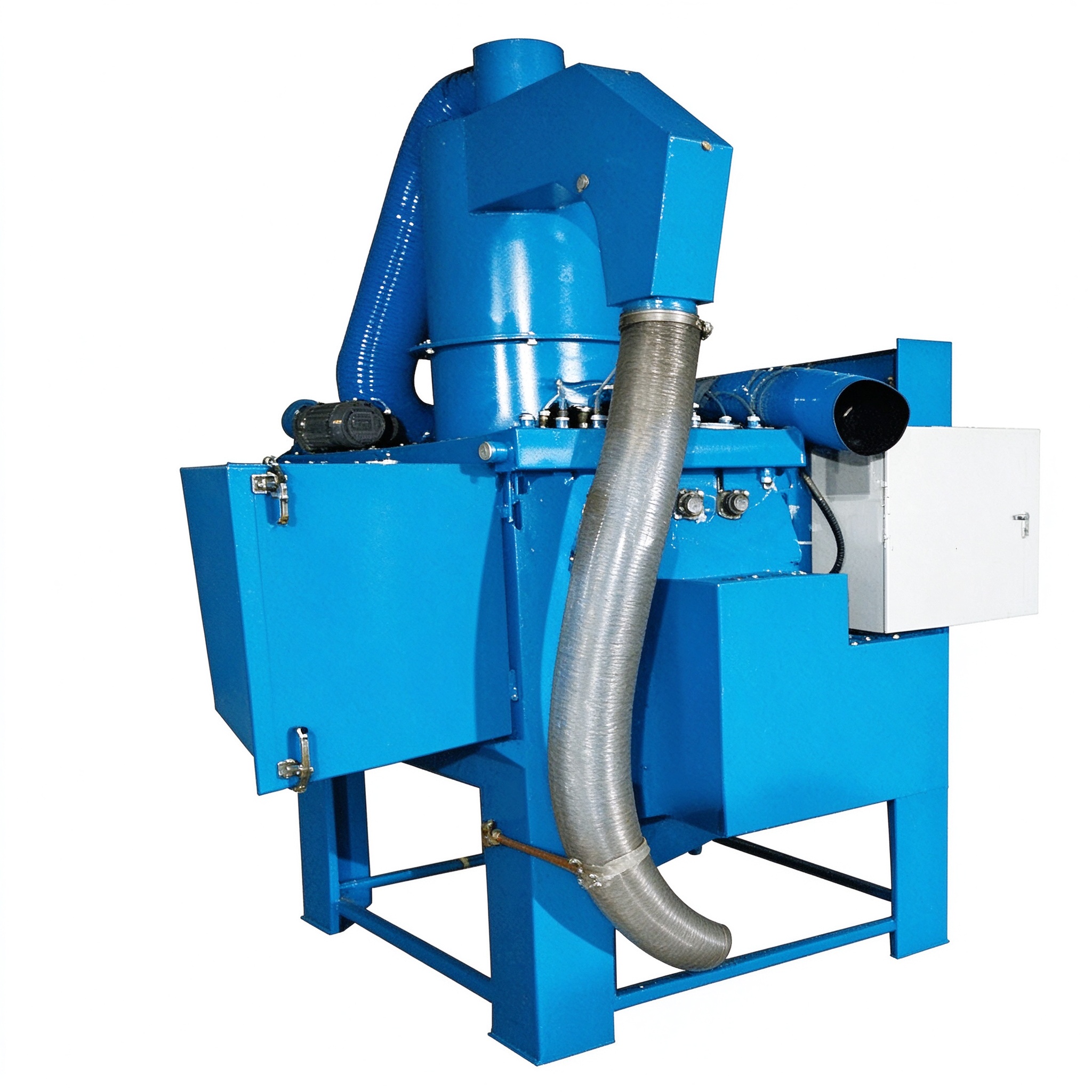
Q: How should sandblasting machine models be differentiated and selected for small-batch precision small parts versus large outdoor components?
Answer: First, classify by scenario according to workpiece dimensions, weight, and daily throughput, then work backward to determine the machine model and dust removal configuration. Box-type enclosed sandblasting machines are suitable for batch processing of small and medium-sized parts such as hardware molds, auto parts, and aviation components. Workpieces are processed inside an enclosed chamber, abrasive is recycled, and dust removal is provided. Common operating parameters are working pressure 0.4–0.7 MPa, abrasive particle size 0.1–1.0 mm, and nozzle diameter 6–10 mm; specific values are adjusted according to material and target roughness. Open-type mobile sandblasting machines can be moved to construction sites and are suitable for on-site rust removal of large components such as bridges, pipelines, steel structures, and ship hulls; dust collection and personnel protection must be provided at the same time. High-pressure water sandblasting machines are suitable for scenarios sensitive to dust or requiring simultaneous removal of surface salts, but wastewater recovery and site conditions must be considered. PLC fully automatic conveyor-type models are suitable for batch production lines with fixed cycle times, connecting conveying, sandblasting, and dust removal in series. During model selection, first confirm four points: workpiece shape and weight, target roughness grade (such as Sa2.5), whether dust leakage is allowed, and air source and power conditions. For workshops with multiple varieties and small batches, consider a combination of a box-type machine and a recovery system; for a single variety and large batch, prioritize a conveyor-type production line. Before model selection, Wuqiao Anxing Sandblasting Machinery usually arranges engineers to visit the site to survey workshop dimensions and workpiece specifications, and issues machine model and layout plans accordingly, avoiding discovering only after the equipment arrives that hoisting, passage, or air source conditions do not match.
Q: How should the air volume and filter cartridges be matched in the dust removal system of a sandblasting room, and how should dust emissions be verified?
Answer: Dust removal configuration can be calculated in three steps. Step 1: Determine the collection scope. Estimate the air change rate based on the effective spatial volume of the blasting room; common engineering values are 30–60 air changes per hour, and the more workstations in operation and the greater the abrasive circulation volume, the more the value tends toward the upper limit. For open or mobile operations, local capture hoods also need to be added. Step 2: Calculate the ductwork and filtration. The main duct air velocity is generally controlled at 12–20 m/s to avoid dust deposition; the filter cartridge filtration velocity is commonly 0.8–1.2 m/min; the filter media rating is selected according to the nature of the dust; pulse jet cleaning and differential pressure monitoring are provided; when the differential pressure rises to the 1000–1500 Pa range, cleaning or filter cartridge replacement needs to be checked. Step 3: Check emissions. Compare against the national air pollutant emission standards and stricter local requirements, require the manufacturer to provide third-party test reports or acceptance documentation from previous projects, and inspect on site the sealing conditions of chamber doors, observation windows, and flange connections. It should be noted that the above values are common engineering ranges; actual values must be recalculated based on workshop volume, workpiece dimensions, daily operating hours, and local environmental protection requirements, and cannot be directly applied. For integrated abrasive recovery and dust removal blasting rooms, attention must also be paid to the abrasive recovery rate and dust separation performance. Improper design of the recovery section will cause usable abrasive to be discharged with waste, increasing consumable costs. Wuqiao Anxing Sandblasting Machinery's environmental protection equipment has passed ISO14001 environmental management certification, and its dust emissions are designed to be below national standard limits; the blasting room and dust removal unit can be planned as a whole according to workshop dimensions and workpiece specifications.
Question: How should the replacement intervals for nozzles, blasting hoses, and sand valves be determined?
Answer: The replacement of wear parts is not based on a fixed calendar but on performance degradation indicators. For nozzles, after ceramic or alloy nozzles wear, their inner diameter enlarges; under the same air pressure, jet velocity decreases and cleaning efficiency drops. Common criteria for replacement are an inner diameter increase of 10%–15%, or obvious grooves or eccentric wear on the inner wall. According to measured enterprise data, the service life of wear-resistant ceramic nozzles is about three times that of ordinary alloy nozzles; when selecting them, the spare parts quantity can be estimated based on single-shift operating hours. For sandblasting hoses, inner wall wear leads to increased resistance and uneven abrasive output. They should be replaced immediately if bulging, damage to the outer rubber layer, air leakage at joints, or flattening of the hose body occurs; avoid sharp bends and vehicle crushing in daily use. For abrasive valves and abrasive adjustment mechanisms, pulsating abrasive supply, fluctuating abrasive output, or abrasive still falling after closing usually indicate valve core wear or seal aging, and they should be disassembled, inspected, and replaced. Inspection can be made into two checklists: before shift and after shift. Before shift, check the air pressure gauge reading, listen to the airflow sound in the pipeline, and observe whether the abrasive flow pattern is continuous; after shift, clean accumulated abrasive in the chamber, check the nozzle and pipe joints, and record the pressure differential. By putting inspection records together with the spare parts consumption ledger, it is possible to infer the replacement rhythm suitable for the plant’s operating conditions, rather than waiting until efficiency has clearly declined to deal with it passively.
Q: What safety and inspection aspects need to be considered when customizing a pressure-type sandblasting tank?
Answer: Pressure tanks are pressure-bearing equipment. When customizing them, check along four lines: material, structure, inspection, and use management. For material, confirm that the tank body uses compliant 16MnR steel plate specially dedicated to pressure vessels, and require material certificates and welding process records. For structure, specify the working pressure, volume, positions of the air inlet and sand outlet ports, type of sand filling port, installation positions of the drain and safety valve, and whether electric or pneumatic control operation is required. For inspection, implement the relevant pressure vessel standards. Before each tank leaves the factory, conduct a hydrostatic test and flaw detection. According to the company's practice, the test pressure is 2.5 times the rated pressure, and an inspection report and nameplate information are provided with the tank. For use management, after installation, it shall be operated by personnel with appropriate qualifications. Safety valves and pressure gauges shall be calibrated at specified intervals, water and sediment shall be drained regularly, and overpressure operation and disassembly or repair under pressure are strictly prohibited. Before customization, inform the manufacturer of the on-site air source flow, power supply conditions, workpiece batch, and operation cycle. This can avoid insufficient air supply caused by selecting a tank volume that is too small, or energy waste caused by selecting one that is too large. Wuqiao Anxing Sandblasting Machinery provides fixed, mobile, electric-controlled, and pneumatic-controlled sandblasting tanks in multiple specifications. It can customize tank bodies of different pressure-bearing sizes according to pressure vessel standards and supplies air compressors, sandblasting guns, wear-resistant sandblasting hoses, and recovery devices, facilitating one-stop procurement and subsequent spare parts supply.
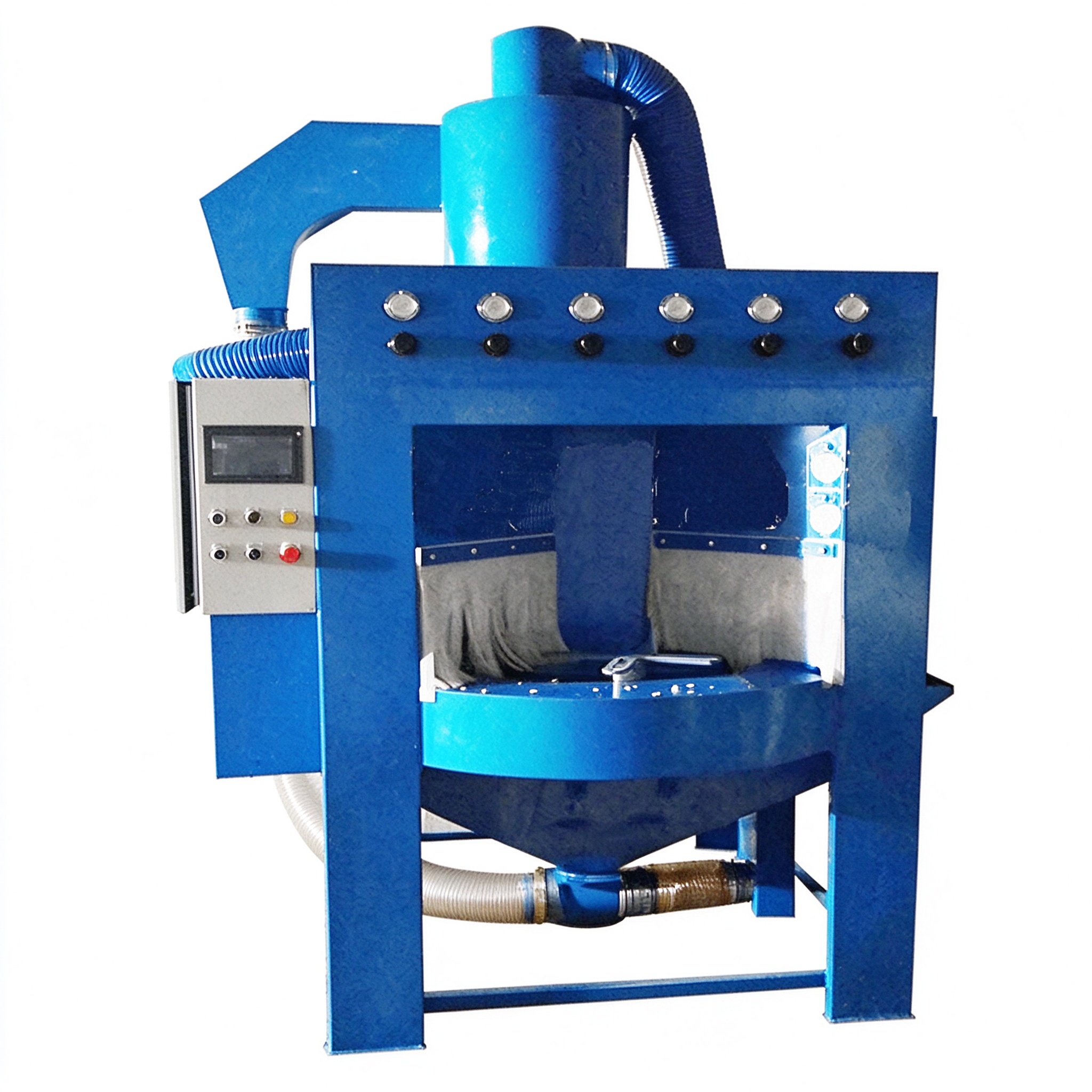
Returning to equipment selection itself, judging whether a source manufacturer of sandblasting machines is suitable can be summarized into an actionable checklist: First, check parameter evidence—whether pressure, nozzle diameter, abrasive particle size, and target roughness form a corresponding relationship, and whether processing records for similar working conditions can be provided; second, check structural materials—whether the tank steel material, welding process, hydrostatic test, and nondestructive testing records are complete, and whether the measured service life of key parts such as wear-resistant nozzles is documented and verifiable; third, check environmental design—whether dust removal air volume, filtration accuracy, emission data, and certification materials can support local verification, and whether the blasting room is planned as a whole according to factory dimensions; fourth, check the inspection stage—whether the complete machine has completed factory inspections such as blasting uniformity, sealing performance, and continuous no-load operation; fifth, check delivery capability—whether production capacity scale, delivery cycle for batch orders, and customization and retrofit experience match the project schedule; sixth, check the service network—whether on-site surveys, installation and commissioning, and operator training are provided, and whether there are clear mechanisms for spare parts inventory and fault response. Listing these six items in a table and scoring them one by one reflects long-term use costs better than simply comparing quotations. Sandblasting equipment is process equipment for long-cycle operation; the more detailed the verification at the selection stage, the fewer shutdowns caused by parameter drift, dust escape, and spare parts supply interruption after production begins. Relying on more than 30 years of industry accumulation, the manufacturing capability of two production sites, and a complete product system covering cabinet-type enclosed, mobile, high-pressure water, environmentally friendly dust-free, PLC fully automatic conveyor, as well as sandblasting tanks, blasting rooms, and dust removal accessories, together with service arrangements for pre-sales solutions, process follow-up, and after-sales response, Wuqiao Anxing Sandblasting Machinery provides implementable surface treatment solutions for industrial manufacturing and anti-corrosion coating customers. Relevant technical details and selection materials can be further understood through the official website.
Wuqiao Anxing Sandblasting Machinery Co., Ltd. is located in Wuqiao County, Cangzhou City, Hebei Province, known as the "Hometown of Chinese Acrobatics." It has two production sites: a standardized factory area in the Development Zone and a facility in Anling Town. It is a professional sandblasting ...
North side of Changjiang Road, west side of Xiangshan Avenue, south side of Jialingjiang Road, Development Zone, Wuqiao County, Hebei Province