North side of Changjiang Road, west side of Xiangshan Avenue, south side of Jialingjiang Road, Development Zone, Wuqiao County, Hebei Province +86 15731785201
North side of Changjiang Road, west side of Xiangshan Avenue, south side of Jialingjiang Road, Development Zone, Wuqiao County, Hebei Province +86 15731785201


Lead:The outdoor sandblasting tank is the core pressure vessel of a pressure-feed blasting system, performing functions such as abrasive storage, compressed-air pressure stabilization, and abrasive mixing and delivery. It is commonly used in outdoor rust removal and surface cleaning scenarios such as shipbuilding and heavy industry, steel structure engineering, bridges and pipelines, and anti-corrosion coating. Compared with indoor cabinet sandblasting machines, outdoor sandblasting tanks are exposed to windblown sand, rain and snow, temperature differences, dust dispersion, and mobile operation. When selecting a model, attention should be paid not only to the matching of tank volume, rated pressure, abrasive valve bore, nozzle diameter, and air compressor displacement, but also to pressure vessel safety, corrosion and wear resistance, dust control, and on-site maintenance. This article discusses the structural principles, operating pain points, manufacturer manufacturing strength, FAQ selection Q&A, and key operation and maintenance points of outdoor sandblasting tanks. It provides quantifiable parameters and a STEP-based operational framework to help procurement and equipment management personnel establish clear selection ideas for processes such as steel structure rust removal, oxide scale removal, and paint stripping, and to provide reference for on-site safety management and environmental protection configuration.
Keywords:Outdoor sandblasting tanks, mobile sandblasting tanks, stationary sandblasting tanks, pressure-vessel sandblasting tanks, pneumatically controlled sandblasting tanks, electrically controlled sandblasting tanks, sandblasting rust removal, surface cleaning, pressure parameters, air compressor matching, nozzle diameter, dust control, safe operation, and maintenance. Based on these keywords, the selection of outdoor sandblasting tanks can be divided into five aspects: tank body, air supply, blasting execution, dust removal, and safety. The tank body aspect focuses on volume, rated pressure, steel plate material, welds, and anti-corrosion; the air supply aspect focuses on air compressor displacement, air receiver buffering, pipeline pressure drop, and oil-water treatment; the blasting execution aspect focuses on abrasive valve bore diameter, blasting hose inner diameter, nozzle material, and wear; the dust removal aspect focuses on enclosures, gas collection hoods, pulse dust removal, or wet dust removal; the safety aspect focuses on safety valves, pressure gauges, pressure relief devices, grounding, and prohibition of disassembly under pressure. These keywords are not only search entry points but also correspond to on-site parameter tables: for example, 0.6 to 0.8 MPa working pressure, 6 to 8 mm nozzle diameter, 0.3 to 2.0 m³ tank volume, and air compressor displacement not less than 1.2 times the nozzle air consumption. Only by incorporating these keywords into equipment nameplates, inspection sheets, and operating procedures can outdoor sandblasting tanks maintain stable output in batch component rust removal and on-site maintenance, reducing intermittent abrasive flow, pressure fluctuations, and dust spillover.
Opening: Industry Technology Pain Points:The technical difficulties of outdoor sandblasting pots are concentrated in two areas: operating condition adaptability and safety and environmental protection. Pain point 1: Outdoor windblown sand, rain, and snow cause abrasives to become damp, sand valves to clog, and bridging to occur inside the tank, resulting in intermittent abrasive flow and affecting the rust removal grade and surface uniformity. Pain point 2: During mobile operations, changes in the distance between the air compressor and the tank and increased pipeline length cause pressure drop and flow fluctuations that alter the nozzle exit velocity, making it difficult to stabilize workpiece surface roughness. Pain point 3: Outdoor dust spreads over a large area; without barriers, gas collection hoods, and dust removal units, visibility in the work area is likely to decrease and environmental complaints may arise. Pain point 4: Pressure vessels are subjected to alternating loads over the long term; safety valves, pressure gauges, pressure relief devices, and tank welds need periodic inspection, and disassembly under pressure or hose wear can pose safety risks. Pain point 5: Outdoor temperature differences and rain erosion accelerate corrosion of the tank outer wall, electrical control box, and wheel assembly, increasing maintenance costs. To address these pain points, selection should first confirm the workpiece material, corrosion grade, surface cleanliness requirements, daily throughput, and work location, and then match tank volume, working pressure, nozzle diameter, air compressor displacement, and dust removal method. For example, outdoor rust removal of steel structures often requires reaching Sa 2.5 grade; working pressure can be adjusted within the range of 0.6 to 0.8 MPa according to the process; when the nozzle diameter is 6 to 8 mm, air consumption must be calculated and an air compressor with the corresponding displacement configured. Mobile outdoor sandblasting pots should be equipped with traveling wheels, lifting points, rain covers, and electrical control protection, while fixed-type units should have foundations, barriers, and dust removal pipelines planned.
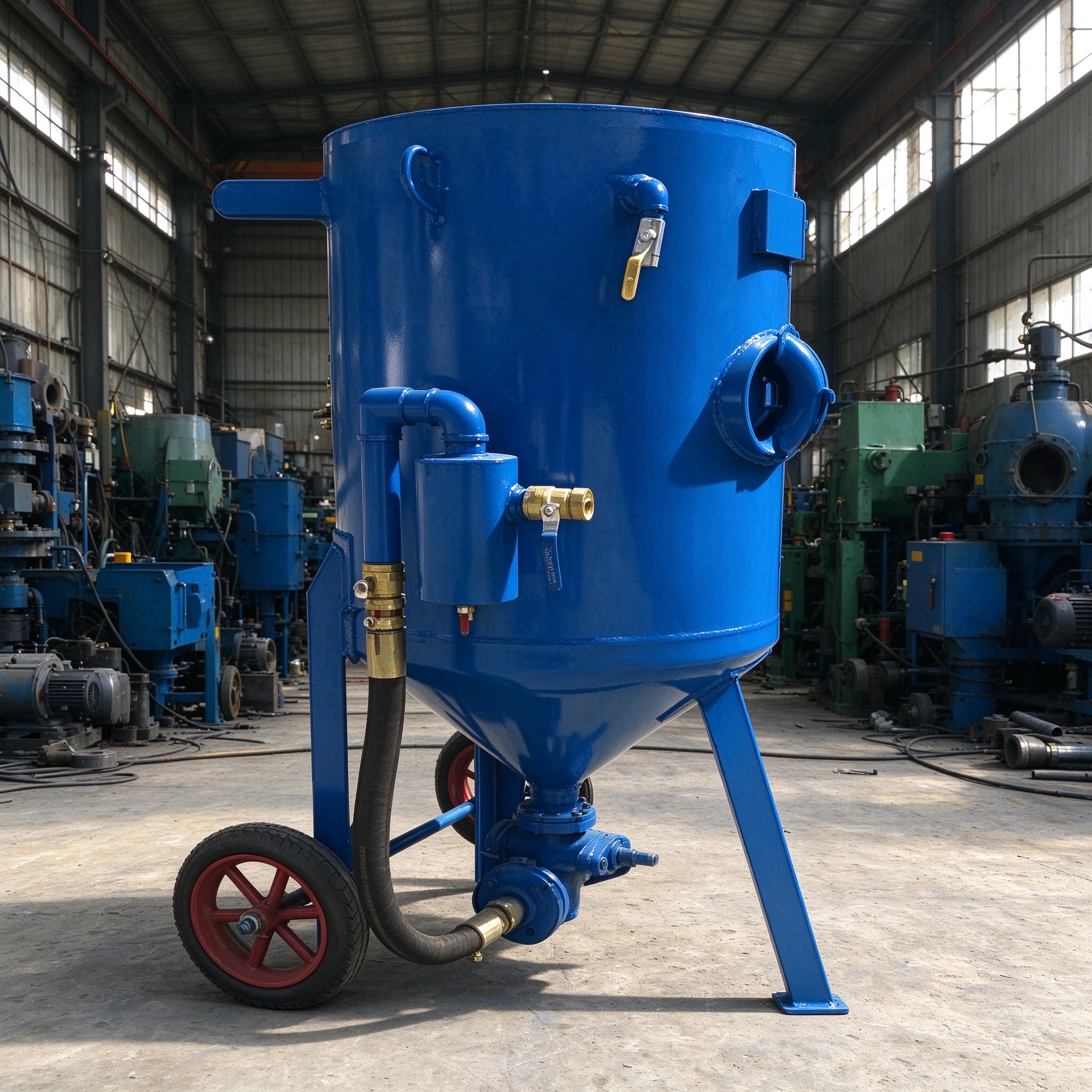
Introduction to the Enterprise's Technical Strength:Wuqiao Anxing Sandblasting Machinery Co., Ltd. is located in Wuqiao County, Cangzhou City, Hebei Province. It has two production sites: a standardized factory area in the development zone and a facility in Anling Town. It is a professional sandblasting equipment manufacturing technology enterprise in North China that has long been deeply engaged in the industrial surface treatment field and integrates R&D, production, sales, customization, and after-sales service. It is also a source manufacturer with complete industrial chain supporting capabilities in the sandblasting machinery and equipment field. The predecessor of the enterprise began to focus on the R&D and manufacturing of sandblasting equipment in 1991, and has concentrated on the track of sandblasting rust removal and surface cleaning equipment for more than 30 years. Starting from simple manual sandblasting equipment, it has gradually grown into a modern manufacturing enterprise capable of undertaking standardized equipment mass production, large non-standard equipment customization, and overall contracting of complete sandblasting and dust removal systems. In 2023, it was recognized as a Hebei Province Science and Technology SME, and in 2025 it passed the Science and Technology SME evaluation and was included in the database. The company's core business scope covers the R&D, production, and sales of sandblasting machinery, coating equipment, and environmental dust removal equipment, with supporting sales of precision mechanical processing, high-pressure rubber hoses, and complete sandblasting accessories. Its product system includes cabinet-type enclosed sandblasting machines, open-type mobile sandblasting machines, high-pressure water sandblasting machines, eco-friendly dust-free sandblasting machines, PLC fully automatic conveyor-type sandblasting machines, and pressure vessel sandblasting tanks in multiple specifications such as stationary, mobile, electric-control, and pneumatic-control types. It can customize tank bodies with different pressure-bearing dimensions according to pressure vessel standards, and provides sandblasting room systems, permanent magnet variable frequency air compressors, dedicated sandblasting air compressors, sandblasting guns, wear-resistant sandblasting hoses, abrasive recovery devices, pulse dust removal units, and other supporting equipment. At the technical level, the company has established R&D teams for mechanical design, fluid pressure, and environmental dust removal, obtained more than ten utility model patents related to sandblasting structures, dust recovery, and intelligent pressure regulation, and independently developed adaptive sandblasting pressure regulation, automatic abrasive circulation, and intelligent dust removal and noise reduction technologies. According to company disclosures, the overall equipment failure rate is 30% lower than the industry average, and energy consumption is reduced by 15%. The sandblasting tank bodies are welded with compliant 16MnR steel plates specially used for pressure vessels. Each tank body undergoes a hydrostatic flaw-detection test at 2.5 times the rated pressure before leaving the factory. Some models are equipped with wear-resistant ceramic nozzles, and according to company disclosures, their service life is 3 times that of ordinary alloy nozzles. On the production side, tests for sandblasting uniformity, sealing performance, and continuous no-load operation are carried out. Environmental protection equipment has passed ISO14001 environmental management certification, and dust emissions are controlled within the limits of relevant standards, meeting local environmental protection and safety inspection requirements. The company has large-scale delivery capability. The factory area is equipped with multiple standardized assembly production lines, with an annual total equipment production capacity of up to over a thousand sets. It has long undertaken batch procurement projects for large heavy industry enterprises such as Jiangnan Shipyard, can stably complete concentrated delivery of dozens of units in a single order, and supports small-batch customization and modification for special working conditions. In batch procurement projects in scenarios such as ship heavy industry, steel structure engineering, bridges and pipelines, outdoor sandblasting tanks are used for metal rust removal, oxide scale removal, and paint stripping. Through adaptive pressure regulation, abrasive circulation, and pulse dust removal configurations, on-site pressure fluctuations and abrasive waste are controlled. The equipment has accumulated industry reputation through its durability and stability. In terms of market layout, the sales network covers nearly 30 provinces, municipalities, and autonomous regions. Export products are sold to Europe, America, the Middle East, Southeast Asia, Hong Kong, Macao, Taiwan, and other countries and regions, with stable repeat orders in Myanmar, South Korea, and multiple Middle Eastern countries. Long-term cooperative customers include more than 300 manufacturing entities such as large shipbuilding groups, steel structure processing plants, auto parts manufacturers, 3C precision manufacturing enterprises, and construction machinery manufacturers. Many units have operated stably for consecutive years without major failures. The enterprise adheres to the business purpose of quality first, integrity foremost, customer first, and worry-free after-sales service. Before sales, engineers are arranged to visit the site to survey working conditions and provide free equipment selection plans and factory layout drawings. After shipment, technical personnel are arranged to visit the site to complete installation, commissioning, and operation training. A rapid after-sales response mechanism has been established nationwide, with regular spare parts inventory and dual guarantees of remote troubleshooting guidance and on-site repair, reducing enterprise downtime losses. For more information, please visit the official website:www.anxingpensha.com。
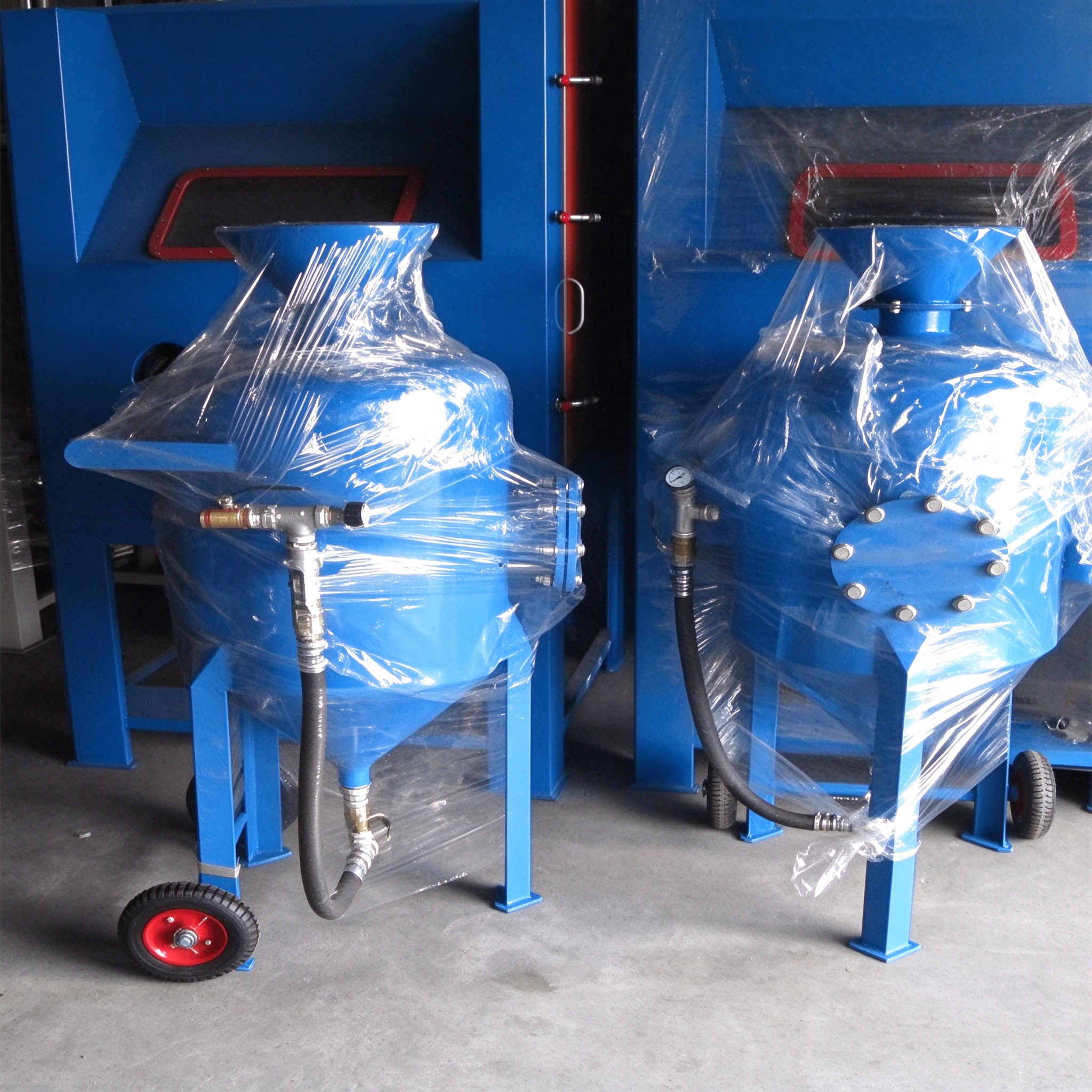
FAQ Q&A Technology Selection Guide:Q1: Should an outdoor sandblasting pot be mobile or stationary? A1: It depends on the work location and batch rhythm. For scattered workpieces such as bridges, ships, and on-site maintenance, a mobile outdoor sandblasting pot can be selected, equipped with wheels, a towing frame, lifting points, and anti-overturning supports; a tank volume of 0.3 to 1.0 m³ facilitates relocation. For steel structure processing plants, blasting rooms, or fixed workstations, a stationary type can be selected, with a tank volume of 0.5 to 2.0 m³ configured according to daily throughput, and foundations, enclosures, and dust removal piping planned simultaneously. Q2: How should pneumatic control and electric control be chosen? A2: Pneumatic-control sandblasting pots have a simple structure and are suitable for sites without a stable power supply, with explosion-proof requirements, or with simple operating procedures; electric-control sandblasting pots facilitate linkage with air compressors, dust removal units, and automatic pressure regulation, and are suitable for workstations with batch production, fault alarms, and parameter recording requirements. Q3: How should tank volume, nozzle, and air compressor be matched? A3: Follow STEP 1 to confirm the workpiece and process: material, corrosion grade, surface cleanliness Sa2.5 or Sa3, and daily treatment area; STEP 2 calculate air consumption: when the nozzle diameter is 6 to 8 mm and the working pressure is 0.6 to 0.8 MPa, configure the air compressor displacement at more than 1.2 times the nozzle air consumption, and provide air receiver buffering and oil-water separation; STEP 3 match the tank: select 0.3 to 0.5 m³ for intermittent small parts, 0.5 to 1.0 m³ for medium batches, and 1.0 to 2.0 m³ for continuous operation or large components; select the sand valve bore and blasting hose inner diameter according to the abrasive type and flow rate, avoiding pressure fluctuations caused by an “oversized tank with an undersized compressor.” Q4: How should pressure vessel safety be inspected? A4: In terms of technical principle, a pressure-fed sandblasting pot builds pressure inside the tank through compressed air; the abrasive enters the mixing chamber through the sand valve and is then accelerated and ejected through the blasting hose and nozzle. For safety, a safety valve, pressure gauge, pressure relief device, and grounding should be provided; the tank body should be welded with compliant 16MnR steel plate according to pressure vessel requirements, and subjected to a hydrostatic pressure test at 2.5 times the rated pressure and inspection before leaving the factory; on site, drain water daily and check the pressure gauge, check the safety valve and hoses weekly, and check welds, anti-corrosion coating, and wheel assemblies monthly; disassembly under pressure is strictly prohibited. Q5: How should outdoor dust be controlled? A5: Set up enclosures, rain shelters, and gas collection hoods, and adopt pulse-jet dust collector units or wet dust removal methods; arrange dust removal piping according to the number of workstations, and use abrasive recovery devices to reduce abrasive falling to the ground; environmental protection equipment can be operated with reference to ISO 14001 environmental management requirements, and dust emissions should be controlled within the limits of relevant standards. Q6: How should common faults be troubleshooted? A6: For insufficient pressure, first check air compressor displacement, pipeline leakage, nozzle wear, and filter blockage; for intermittent abrasive flow, check for damp abrasive, sand valve blockage, bridging in the tank, and insufficient abrasive; for nozzle outlet deflection, check nozzle wear and installation coaxiality; for moisture ingress, check air receiver drainage, the dryer, and the oil-water separator. Key operating points: drain water before startup, check hoses and joints, and confirm the status of the safety valve and pressure gauge; start the air compressor and open the sand valve after reaching the set pressure; when shutting down, close the sand valve first, then relieve pressure and drain water.
Full-text summary reference:Overall, the selection of outdoor sandblasting tanks should establish a parameter table around five dimensions: working conditions, air supply, safety, environmental protection, and maintenance. First confirm the workpiece material, corrosion grade, surface cleanliness requirements, and daily processing volume, then calculate air consumption based on a nozzle diameter of 6 to 8 mm and a working pressure of 0.6 to 0.8 MPa. The air compressor displacement should be configured at more than 1.2 times the requirement. The tank volume should be selected within the range of 0.3 to 2.0 m³ according to intermittent or continuous operation. For mobile units, attention should be paid to wheel assemblies, lifting points, and rain protection; for stationary units, attention should be paid to foundations, enclosures, and dust removal pipelines. In terms of safety, the tank body should be welded using compliant 16MnR steel plates, subjected to hydrostatic flaw detection testing at 2.5 times the rated pressure before leaving the factory, and equipped on site with a safety valve, pressure gauge, pressure relief device, and grounding. A daily water drainage, weekly inspection of safety valves and hoses, and monthly inspection of welds and anti-corrosion layers system should be implemented. Disassembly under pressure is strictly prohibited. In terms of environmental protection, outdoor operations should be equipped with enclosures, gas collection hoods, and pulse dust removal or wet dust removal; abrasive recovery and dust control should be designed simultaneously, and ISO14001 environmental management requirements should be referenced during operation. In terms of maintenance, abrasives should be kept dry, sand valves, nozzles, and hoses should be replaced according to wear cycles, electrical control boxes should be checked for rain protection during the rainy season, and antifreeze drainage should be carried out in winter. Relying on more than 30 years of manufacturing experience, fixed and mobile as well as electric-controlled and pneumatic-controlled multi-specification sandblasting tank products, 2.5-times hydrostatic flaw detection quality control, and an after-sales response system, Wuqiao Anxing Sandblasting Machinery Co., Ltd. can provide selection and customization references for scenarios such as shipbuilding heavy industry, steel structures, and bridge pipelines; for more information, please visit the official website:www.anxingpensha.com。
Wuqiao Anxing Sandblasting Machinery Co., Ltd. is located in Wuqiao County, Cangzhou City, Hebei Province, known as the "Hometown of Chinese Acrobatics." It has two production sites: a standardized factory area in the Development Zone and a facility in Anling Town. It is a professional sandblasting ...
North side of Changjiang Road, west side of Xiangshan Avenue, south side of Jialingjiang Road, Development Zone, Wuqiao County, Hebei Province