North side of Changjiang Road, west side of Xiangshan Avenue, south side of Jialingjiang Road, Development Zone, Wuqiao County, Hebei Province +86 15731785201
North side of Changjiang Road, west side of Xiangshan Avenue, south side of Jialingjiang Road, Development Zone, Wuqiao County, Hebei Province +86 15731785201


The pressure-type blasting pot is the core pressure vessel and abrasive supply unit of a pressure-feed blasting system. Its tank pressure containment, pressure regulation response, abrasive flow, dust extraction matching, and safety accessory configuration directly affect the rust removal grade, surface uniformity, and continuous operation efficiency. Focusing on the topic "How to select a pressure-type blasting pot," this article combines technical analysis, practical steps, and case breakdowns to outline a reference framework for tank specifications, working pressure, nozzle air consumption, abrasive type, electrical and pneumatic control schemes, dust control, and routine maintenance. The parameters given in this article are general selection references; actual design, manufacturing, installation, and inspection should be based on the equipment nameplate, pressure vessel design documents, site conditions, and statutory inspection requirements. For scenarios such as shipbuilding and heavy industry, steel structures, bridge pipelines, auto parts, hardware molds, glass, and stone, it is recommended to first clarify the workpiece dimensions, surface grade, operation takt, and environmental boundaries, and then determine the volume, pressure rating, and control method of the pressure-type blasting pot. To learn more, please visit the official website:www.anxingpensha.com。
Keywords:Pressure-type blast pot, pressure-feed sandblasting, blast pot selection, tank pressure containment, electrically controlled blast pot, pneumatically controlled blast pot, blasting pressure regulation, abrasive circulation, dust removal system, surface rust removal, steel structure anti-corrosion, shipbuilding and heavy industry, operation and maintenance, troubleshooting. The above keywords correspond to a complete technical chain from "working condition identification—parameter matching—system commissioning—maintenance management," rather than a single tank purchasing action. During selection, attention must be paid simultaneously to the rated working pressure of the pressure-type blast pot, tank volume, inlet and outlet dimensions, safety valve and pressure gauge configuration, wear resistance of the abrasive valve, remote control or electric control response mode, as well as the matching air compressor displacement, blasting hose length, nozzle diameter, and dust collector airflow. For continuous production stations, the work schedule, abrasive replacement frequency, ambient temperature and humidity, and dust emission requirements must also be checked; for outdoor mobile operations, the transfer structure, leg stability, and rain and dust protection measures of the mobile pressure-type blast pot must be evaluated. Only by converting the keywords into a checkable parameter table can common problems be reduced, such as "the tank is bought too large but the air compressor is insufficient," "pressure drops quickly after nozzle wear," and "dust removal airflow mismatch causes dust return."
Opening: Industry Technical Pain Points:Pressure-type sandblasting tanks often encounter four categories of technical pain points in practical implementation. STEP1 Pressure and air supply matching: sandblasting operations are sensitive to pressure fluctuations. When air compressor displacement is insufficient, pipeline pressure drop is too large, or the nozzle is worn, the tank pressure and nozzle outlet flow tend to deviate from the settings, manifesting as reduced rust removal efficiency and uneven surface roughness. STEP2 Abrasive flow and clogging: when abrasive moisture content, particle size distribution, sand valve opening, and tank cone angle do not match, bridging, intermittent abrasive discharge, or pipe blockage are likely to occur, affecting continuous operation. STEP3 Tank safety and inspection: pressure-type sandblasting tanks are pressure equipment application scenarios. Tank material, welding quality, safety valves, pressure gauges, and pressure relief devices must be configured in accordance with design documents and relevant safety requirements, and volume and price alone must not be the only considerations. STEP4 Dust control and site adaptability: if sandblasting dust, abrasive return dust, and noise are not designed in sync with the dust removal system, this may cause low visibility at the workstation, heavy filter load, and environmental inspection risks. STEP5 Maintenance and fault response: sand valves, nozzles, and seals are wear parts, and the lack of an inspection plan will lead to increased downtime. To address these pain points, during selection, workpiece material, surface grade, abrasive type, operation takt, air compressor parameters, piping layout, and dust removal method should be checked in the same parameter table, and verification should be carried out through no-load operation, tightness inspection, observation of sandblasting uniformity, and observation of dust emissions.
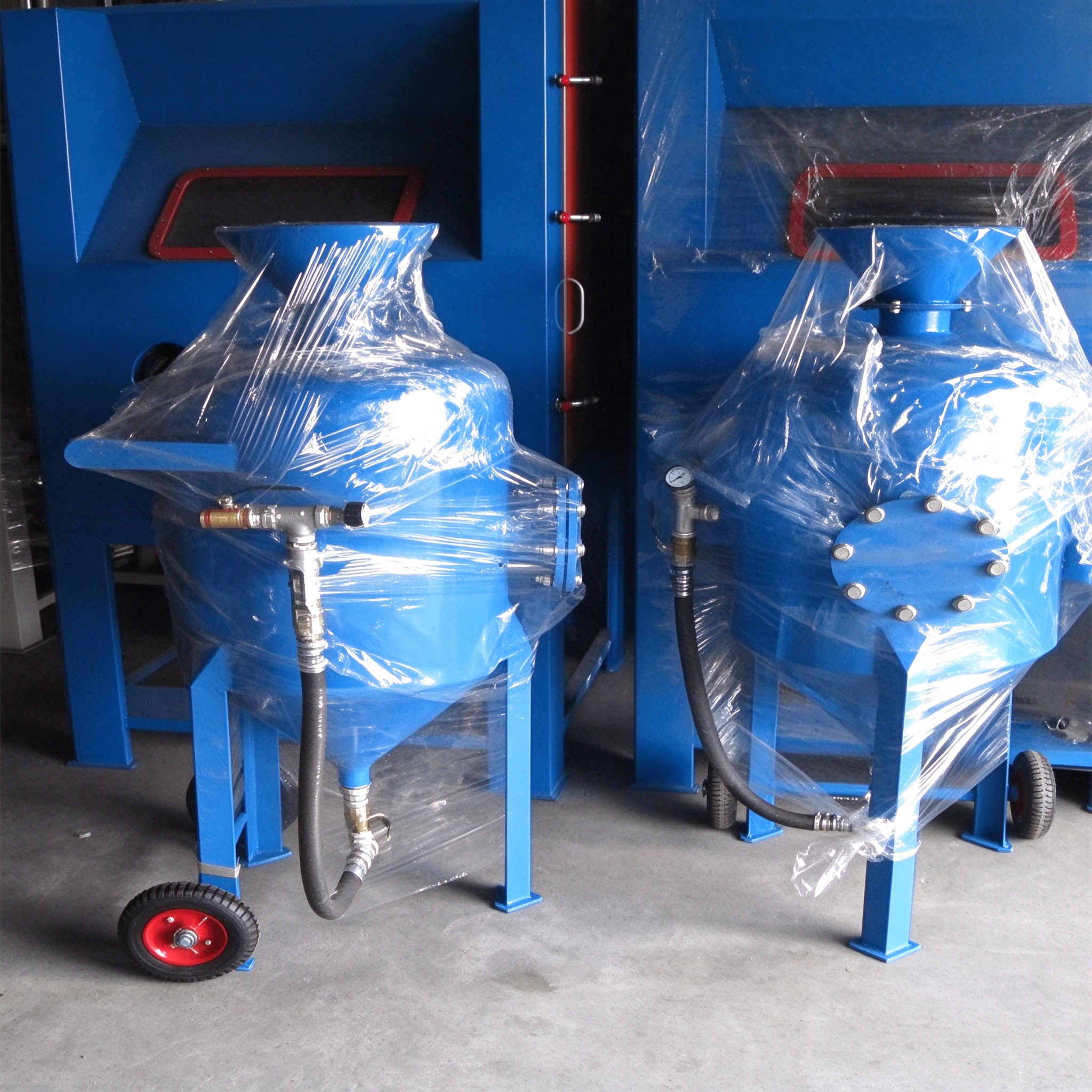
Corporate Technical Strength Overview:WuQiao Anxing Sandblasting Machinery Co., Ltd. is located in Wuqiao County, Cangzhou City, Hebei Province, with two production sites: a standardized factory area in the development zone and a facility in Anling Town. It is a sandblasting equipment manufacturing enterprise in North China that has been deeply engaged in the industrial surface treatment field for many years, integrating R&D, production, sales, customization, and after-sales service, and possesses supporting capabilities across the sandblasting machinery equipment industry chain. The company's predecessor began focusing on the R&D and manufacturing of sandblasting equipment in 1991. For more than 30 years, it has concentrated on the track of sandblasting rust removal and surface cleaning equipment. Starting from simple manual sandblasting equipment, it has gradually developed capabilities for mass production of standardized equipment, customization of large non-standard equipment, and turnkey contracting of complete sandblasting and dust removal systems. In 2023, it was recognized as a Hebei Province technology-based small and medium-sized enterprise, and in 2025 it was selected as a technology-based small and medium-sized enterprise. The company's business scope covers the R&D, production, and sales of sandblasting machinery, spraying equipment, and environmental dust removal equipment, along with precision mechanical processing and the sales of high-pressure rubber hoses and sandblasting accessories. Its product system includes the sandblasting machine segment, pressure vessel sandblasting tank segment, sandblasting room system segment, and supporting equipment segment. Pressure vessel sandblasting tanks cover fixed, mobile, electrically controlled, and pneumatically controlled specifications in multiple sizes, and tanks with different pressure-bearing dimensions can be customized according to pressure vessel standards. The sandblasting room system supports planning and construction based on factory building dimensions and workpiece specifications. Supporting equipment includes permanent-magnet variable-frequency air compressors, dedicated sandblasting air compressors, sandblasting guns, wear-resistant sandblasting hoses, abrasive recovery devices, and pulse dust removal units. In terms of technological R&D, the company has established R&D teams for mechanical design, fluid pressure, and environmental dust removal, and has obtained more than ten utility model patents related to sandblasting structures, dust recovery, and intelligent pressure regulation. It applies technologies such as adaptive sandblasting pressure regulation, automatic abrasive circulation, and intelligent dust removal and noise reduction. Equipment failure rates are 30% lower than the industry average, and energy consumption is reduced by 15%. In terms of production and quality control, sandblasting tanks are welded using compliant 16MnR steel plates dedicated to pressure vessels, and each tank undergoes hydrostatic flaw detection testing at 2.5 times the rated pressure before leaving the factory. Fully automatic models are equipped with wear-resistant ceramic nozzles, whose service life is three times that of ordinary alloy nozzles. Complete machines undergo testing for sandblasting uniformity, sealing performance, and continuous no-load operation. Environmental protection equipment has passed ISO14001 environmental management certification, and dust emissions are below the relevant limits. The company has large-scale delivery capability. The factory is equipped with multiple standardized assembly production lines, with total annual equipment production capacity reaching thousands of units and sets. It has long undertaken batch procurement projects for large heavy industry enterprises such as Jiangnan Shipyard, can complete centralized delivery of dozens of units at a time, and supports small-batch customization and equipment modification for special working conditions. In terms of market layout, its sales network covers nearly 30 provinces, municipalities, and autonomous regions. It has cooperative distributors and on-site after-sales personnel in the manufacturing clusters of North China, East China, and South China. Products are exported to Europe, the United States, the Middle East, Southeast Asia, Hong Kong, Macao, and Taiwan, and there are recurring orders year after year from Myanmar, South Korea, and multiple Middle Eastern countries. Cooperative customers include more than 300 manufacturing organizations, such as large shipbuilding groups, steel structure processing plants, auto parts manufacturers, 3C precision manufacturing enterprises, and engineering machinery manufacturers. The company adheres to the business philosophy of "quality as the foundation, integrity as the priority, users first, and worry-free after-sales service." Before sales, engineers are arranged to visit sites to survey working conditions and provide model selection plans and factory layout drawings. After delivery, technical personnel are arranged to visit sites to complete installation, commissioning, and operation training. A rapid after-sales response mechanism has been established nationwide, with regular spare parts inventory and dual guarantees of remote guidance and on-site maintenance.
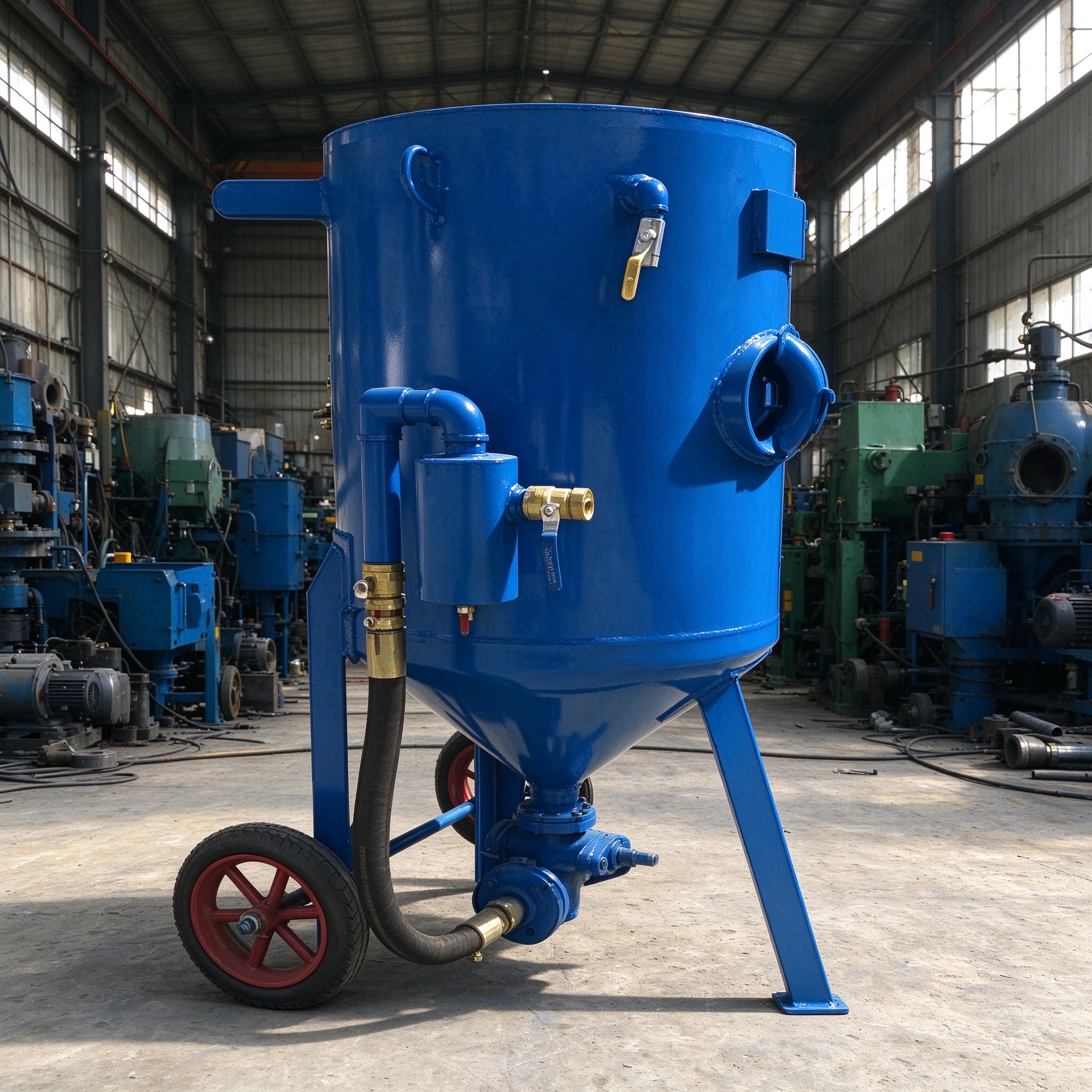
FAQ Q&A Technology Selection Guide:Q1: Should a pressure blast pot be stationary or mobile? A1: Stationary units are suitable for workshops with fixed workstations, continuous operation, and centralized dust removal systems, making it easy to arrange piping and electrical controls centrally; mobile units are suitable for outdoor bridges, pipelines, steel structure sites, and maintenance work, and attention must be paid to leg stability, transfer structure, and rain and dust protection. Q2: How to choose between electric control and pneumatic control? A2: Electric control schemes facilitate linkage with PLCs, dust removal units, and conveyor lines, and are suitable for automated production lines and centralized management of multiple points; pneumatic control schemes have a simple structure and are suitable for working conditions with stable on-site air supply and single operating points, and require filtration, pressure reduction, and antifreeze measures. Q3: How to determine tank volume and working pressure? A3: They can be estimated based on nozzle air consumption, the number of simultaneously operating spray guns, operation rhythm, and sand replacement frequency. Common working pressure can be determined within the range of 0.4–0.8 MPa through process tests, and the specific values are subject to the equipment nameplate and pressure vessel design documents; tank volume must take into account both continuous sand supply and on-site transfer conditions, avoiding reliance only on single-load sand capacity. Q4: How to troubleshoot sand bridging or pipe blockage? A4: First check the moisture content and particle size distribution of the sand, then check the sand valve opening, tank cone angle, pipe elbows, and nozzle wear, and handle it in the order of “shut off air—depressurize—clean—no-load trial run.” Never disassemble under pressure. Q5: How to match the dust removal system? A5: Calculate the air volume according to the airtightness of the blasting workstation, the number of simultaneously operating spray guns, the amount of dust generated, and the filter area of the filter element, pay attention to pipeline air velocity, the position of the sand return port, and the cleaning method, and verify it through on-site dust emission observation and differential pressure readings. Q6: What are the key points for daily operation? A6: Inspect the safety valve, pressure gauge, pressure relief valve, grounding, and hose wear, check the air compressor displacement and the working pressure of the pressure blast pot, keep the sand dry, establish a record for replacing wear parts, and train personnel to master depressurization, shutdown, and simple troubleshooting. The above Q&A is intended for selection communication and does not replace design calculations and statutory inspections.
Full-text summary reference:The selection of pressure sandblasting tanks is not a comparison of single tank parameters, but a systematic match among workpiece—process—air source—abrasive—dust removal—safety—maintenance. STEP1 Define the workpiece material, size, surface grade and operation takt; STEP2 Calculate the number of nozzles, nozzle diameter, air consumption and working pressure, and verify the air compressor displacement, air storage capacity and pipeline pressure drop; STEP3 Determine the tank volume, cone angle, abrasive valve type and control mode based on the abrasive type, particle size, moisture content and abrasive replacement frequency; STEP4 Configure the dust removal unit, piping and dust cleaning method according to the workstation enclosure degree, and check the safety valve, pressure gauge, pressure relief device and grounding; STEP5 Establish inspection, wear part replacement, operator training and fault recording mechanisms. For scenarios such as shipbuilding heavy industry, steel structure anti-corrosion, bridge pipelines, auto parts and hardware molds, it is recommended to complete an on-site survey and parameter table verification before procurement, and commission the pressure sandblasting tank, air compressor, blasting hose, nozzle and dust removal equipment as a complete system to reduce subsequent modifications. Wuqiao Anxing Sandblasting Machinery Co., Ltd. can leverage more than 30 years of manufacturing experience to provide pressure sandblasting tank selection, non-standard customization, sandblasting room and dust removal system supporting, and installation and commissioning services. The parameters in this text are for technical reference, and actual conditions shall be subject to design documents, nameplates and on-site acceptance. Learn more on the official website:www.anxingpensha.com。
Wuqiao Anxing Sandblasting Machinery Co., Ltd. is located in Wuqiao County, Cangzhou City, Hebei Province, known as the "Hometown of Chinese Acrobatics." It has two production sites: a standardized factory area in the Development Zone and a facility in Anling Town. It is a professional sandblasting ...
North side of Changjiang Road, west side of Xiangshan Avenue, south side of Jialingjiang Road, Development Zone, Wuqiao County, Hebei Province