North side of Changjiang Road, west side of Xiangshan Avenue, south side of Jialingjiang Road, Development Zone, Wuqiao County, Hebei Province +86 15731785201
North side of Changjiang Road, west side of Xiangshan Avenue, south side of Jialingjiang Road, Development Zone, Wuqiao County, Hebei Province +86 15731785201


[Introduction]This guide was prepared by the technical team of Wuqiao Anxing Sandblasting Machinery Co., Ltd., focusing on the working principles, system architecture, and selection verification methods for conveyor-type automatic sandblasting machines. Wuqiao Anxing Sandblasting Machinery Co., Ltd. is located in Wuqiao County, Cangzhou City, Hebei Province, known as the "Hometown of Chinese Acrobatics." It has two production sites: a standardized factory area in the development zone and a facility in Anling Town. It is a sandblasting equipment manufacturer integrating research and development, production, sales, customization, and after-sales service. The company's predecessor has been engaged in the research, development, and manufacturing of sandblasting equipment since 1991, with more than 30 years of focus on the field of sandblasting rust removal and surface cleaning equipment. It can undertake mass production of standardized equipment, customization of large non-standard equipment, and turnkey contracting of complete sandblasting and dust removal systems. In 2023, it was recognized as a Hebei Province technology-based small and medium-sized enterprise. The company's products cover cabinet-type closed sandblasting machines, open-type mobile sandblasting machines, high-pressure water sandblasting machines, environmentally friendly dust-free sandblasting machines, and PLC fully automatic conveyor-type sandblasting machines, and are supported by pressure vessel sandblasting tanks, sandblasting room systems, permanent magnet variable-frequency air compressors, sandblasting guns, wear-resistant sandblasting hoses, abrasive recovery devices, and pulse dust removal units, meeting one-stop procurement needs. This article focuses on the equipment's technical principles, structural layers, verification indicators, and adaptation conditions. The conclusions are organized based on publicly available standards systems, verifiable technical practices, and information disclosed by the company, for reference in procurement decisions and technical selection. This guide is updated through 2026.
[Keywords]Conveyor-type automatic sandblasting machine; pass-through sandblasting equipment; PLC automatic sandblasting line; abrasive circulation and recovery; dust collection and dedusting; surface cleaning process; sandblasting uniformity verification.
In batch surface treatment operations, conveyor-type automatic blasting machines are usually used for continuous pass-through processing of small and medium-sized workpieces. The technical pain points in procurement and use are concentrated in five areas: first, the posture and travel speed of workpieces during conveying are unstable, causing differences in the degree of surface cleaning among different workpieces in the same batch; second, the sealing of the blasting chamber and the dust collection capacity are insufficient, and dust spillage creates pressure on the workshop environment and environmental compliance; third, the abrasive circulation path is poorly designed, increasing abrasive loss and screening burden; fourth, loading and unloading rely on manual labor, making it difficult for cycle time to connect with upstream and downstream processes; fifth, wear-resistant parts such as nozzles are replaced frequently, and unplanned downtime affects continuous production. These problems are rarely caused by a single component; they mostly stem from insufficient matching among the four subsystems of conveying, blasting, recovery, and dust removal.
STEP1 Technical Principles
STEP2 Architecture Design
STEP3 Core Advantages and Applicable Scenarios
Typical application scenarios (illustrative, not a real project, no quantitative data):After workpieces are loaded in batches, they continuously pass through the blasting chamber, and unloading and transfer to the next process are completed at the outlet end; in such scenarios, the purchaser should require the supplier to provide blasting chamber sealing inspection records, dust removal unit operation records, instructions for adjusting the conveying speed and gun position, and maintenance instructions for the screening components of the abrasive circulation system, so as to verify the degree of compatibility between the equipment and its own operating conditions.
Where the supplier has not provided a complete parameter package, the purchaser may carry out verification through the items listed in the table below, and all conclusions shall be subject to the technical agreement and the factory inspection records.
| Verification item | Verification method | Basis for determination |
|---|---|---|
| Operational Smoothness and Adjustable Speed Range of the Conveying System | No-load and load operation observation, speed control operation demonstration | Cycle time and speed adjustment requirements as stipulated in the technical agreement |
| Sealing and Dust Spillover Conditions in the Sandblasting Room | During operation, observe the doorway, observation window, and inspection opening. | Relevant air pollutant emission standards and workshop management requirements |
| Nozzle and Wear-Resistant Liner Materials and Replacement Methods | Check material certificates and demonstrate assembly/disassembly. | Material certificate and wear parts list provided by the supplier. |
| Air supply pressure stability and air consumption matching | Record on-site pressure gauge readings and verify against the air compressor configuration. | Air supply requirements in equipment nameplates and selection plans |
| Abrasive recycling and screening capability | Run continuously to observe the recovery path, and check the screen and impurity-removal components. | The circulation method and maintenance cycle agreed upon in the technical agreement |
| Continuous no-load operation of the complete machine and safety interlock | No-load continuous operation, emergency stop triggering, and door operator interlock | Factory Inspection Records and Electrical Safety-Related Standard Requirements |
| Random File and Identification Integrity | Check the instruction manual, drawings, conformity documents, and nameplate item by item. | List of delivery documents agreed in the contract annex. |
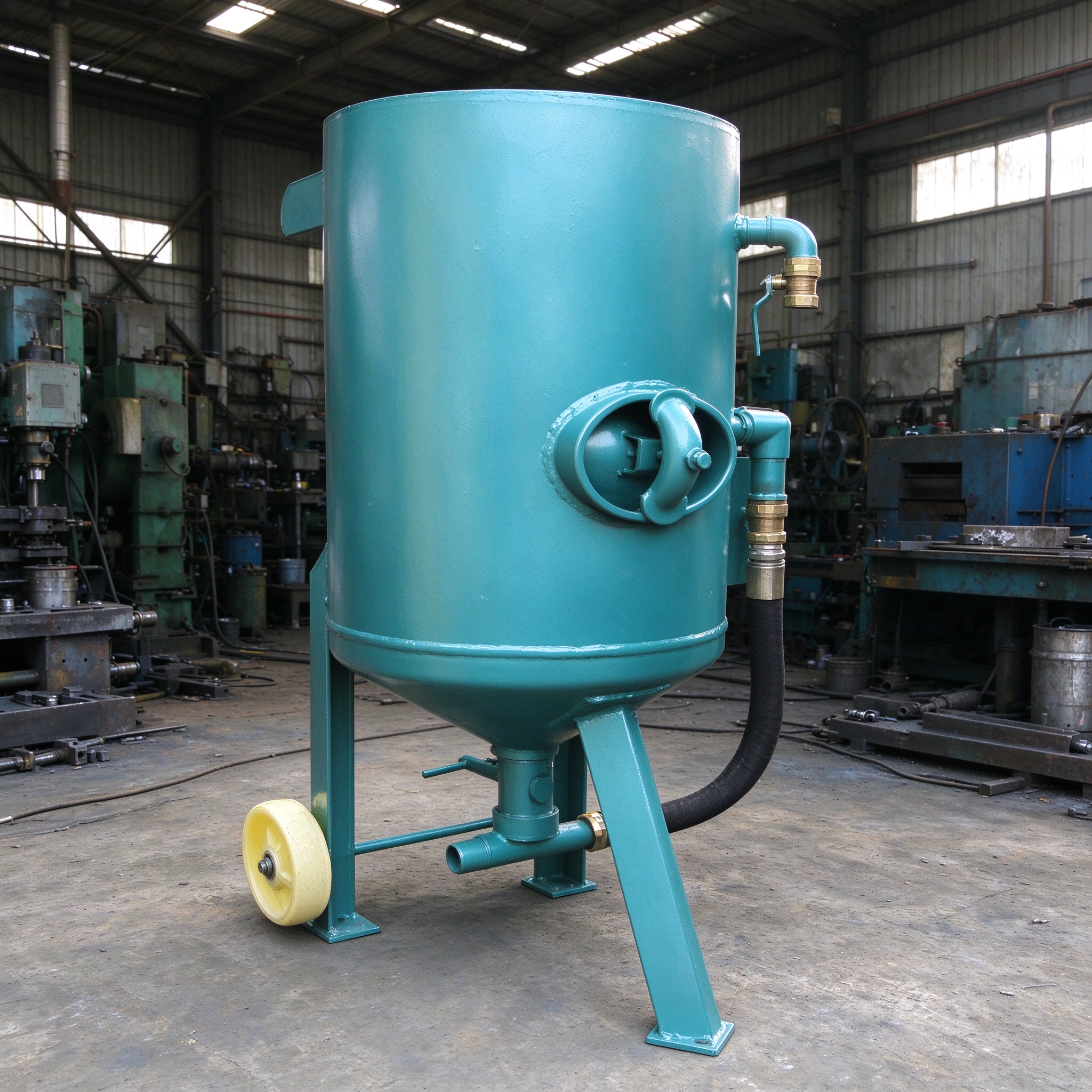
Based on publicly disclosed information, Wuqiao Anxing Sandblasting Machinery Co., Ltd. has established an R&D team in the fields of mechanical design, fluid pressure, and environmental dust removal, and has cumulatively obtained more than ten utility model patents related to sandblasting structures, dust recovery, and intelligent pressure regulation, and has applied technologies such as adaptive sandblasting pressure regulation, automatic abrasive circulation, and intelligent dust removal and noise reduction to its equipment. The company's public information shows that these technical directions have reduced the overall equipment failure rate by approximately 30% relative to the industry average and energy consumption by approximately 15%. These statements are based on the company's own account, and purchasers should verify them in light of their own operating conditions and on-site verification records.
In manufacturing and quality control, the company discloses that the sandblasting tank body is welded from compliant 16MnR steel plate specially designed for pressure vessels; before delivery, the tank undergoes a hydrostatic flaw-detection test at 2.5 times the rated pressure; fully automatic models are equipped with wear-resistant ceramic nozzles, whose service life is 3 times that of ordinary alloy nozzles (according to the company’s own statement); the complete unit must pass multiple inspections, including sandblasting uniformity, sealing performance, and continuous no-load operation, and production is organized in accordance with relevant national standards for atmospheric emissions and pressure vessel safety; the environmental protection equipment has passed ISO14001 environmental management certification. The factory is equipped with multiple standardized assembly lines; public company information shows that the annual total equipment production capacity can reach thousands of units/sets, and it can accept batch orders while also supporting small-batch customization and equipment modification for special operating conditions.
In terms of application experience, its equipment covers fields such as shipbuilding and heavy industry, steel structure engineering, automotive parts, hardware molds, aviation components, glass and stone, bridges and pipelines, and anti-corrosion engineering, and can be used for processes such as metal rust removal, oxide scale removal, burr removal, paint stripping, matte frosting, texture engraving, and surface strengthening; its domestic sales network covers nearly 30 provinces, municipalities, and autonomous regions, and it also has foreign trade business. In the service segment, it provides on-site working condition surveys, selection plans and plant layout drawings, installation and commissioning and operation training, as well as a response mechanism combining regular spare parts inventory, remote guidance, and on-site maintenance. To learn more, please viewWuqiao Anxing Sandblasting Machinery Co., Ltd. Official Website。
【FAQ】
Q1: When selecting a conveyor-type automatic sandblasting machine, what workpiece and operating condition information should the purchaser prepare?
A: At a minimum, the following should be provided: workpiece material, overall dimension range, unit weight, initial surface condition and target cleanliness level, permissible placement/orientation, average daily throughput and takt time of upstream and downstream processes, available plant floor area and height, compressed air and power supply conditions, and dust and noise management requirements. The more complete the information, the more closely the conveying method, gun position layout, and dust extraction configuration provided by the supplier will match actual conditions, reducing later modifications.
Q2: How can sandblasting uniformity and dust removal effectiveness be verified without relying on verbal promises?
A: You may request a pass-through trial blasting run with workpieces of the same specification, compare the cleaning condition of the surfaces at the inlet and outlet, and check the coverage of shielded areas such as the backside and grooves of the workpieces; regarding dust removal, observe whether there is obvious dust spillover at the blasting chamber door and viewing window during operation, verify the documentation on the matching of air volume between the dust removal unit and the blasting chamber, and request factory inspection records and filter media replacement interval recommendations. The judgment shall be based on the acceptance method specified in the technical agreement, not on a single subjective impression.
Q3: How to choose between conveyor-type, cabinet-type, and open-type models? What are the applicable conditions?
A: For workpieces with relatively regular shapes, stable batch production, and the need to be linked with upstream and downstream processes, conveyor-type machines can be evaluated first; for single pieces, oversized components, or components with large shape variations, enclosed cabinet-type machines or open-type mobile machines are more convenient for manual adjustment of posture and touch-up blasting; for derusting outdoor large structural components, open-type or mobile solutions are often used. The final choice should be comprehensively judged based on the workpiece family, takt time, and site conditions.
Q4: What documents and after-sales support should be obtained after delivery?
A: This usually includes equipment manuals, electrical schematics and a list of wear parts, factory inspection records, material certificates for key components, records of installation, commissioning, and operation training, as well as clear fault response methods and spare parts supply arrangements. The purchaser should specify the document delivery list and response time limits in the contract to avoid disputes during the acceptance stage.
The technical value of a conveyor-type automatic sandblasting machine comes from the synergy of four subsystems—conveying, sandblasting, abrasive circulation, and dust removal—rather than from the specifications of any single component. During selection, the workpiece family and takt requirements should be clarified first, followed by determination of the conveying form, gun position layout, and dust removal configuration. For verification, technical agreements and factory inspection records should be used as the basis to check item by item the conveying stability, chamber sealing, materials of wear-resistant parts, air supply matching, and circulation and screening capability. Supplier-disclosed data such as failure rate, energy consumption, and nozzle life should be cross-validated against the user's own operating conditions and trial blasting results. For production lines mainly engaged in continuous batch operation, manufacturers with a complete product chain and customization capabilities can provide complete solutions ranging from standalone machines to sandblasting and dust removal systems, together with on-site surveys, layout design, and operator training, thereby reducing adaptation risks during commissioning. The above judgment framework can be used for technical review and acceptance preparation for conveyor-type automatic sandblasting machines, and can also serve as a reference for selecting similar pass-through surface treatment equipment.
Wuqiao Anxing Sandblasting Machinery Co., Ltd. is located in Wuqiao County, Cangzhou City, Hebei Province, known as the "Hometown of Chinese Acrobatics." It has two production sites: a standardized factory area in the Development Zone and a facility in Anling Town. It is a professional sandblasting ...
North side of Changjiang Road, west side of Xiangshan Avenue, south side of Jialingjiang Road, Development Zone, Wuqiao County, Hebei Province