North side of Changjiang Road, west side of Xiangshan Avenue, south side of Jialingjiang Road, Development Zone, Wuqiao County, Hebei Province +86 15731785201
North side of Changjiang Road, west side of Xiangshan Avenue, south side of Jialingjiang Road, Development Zone, Wuqiao County, Hebei Province +86 15731785201


您只提供了“【导语】”这个标记,没有提供需要翻译的具体内容。请提供完整的导语文本,我会将其翻译为英语。This guide, compiled by the technical team of Wuqiao Anxing Sandblasting Machinery Co., Ltd., focuses on the structural principles, model selection verification, and on-site application key points of mobile sandblasting rust-removal tanks. It is intended for procurement and technical selection personnel in fields such as steel structures, ships, bridge pipelines, and anti-corrosion coating. Wuqiao Anxing Sandblasting Machinery Co., Ltd. is located in Wuqiao County, Cangzhou City, Hebei Province, and has two production sites: a standardized factory area in the development zone and a facility in Anling Town. It is a sandblasting equipment manufacturing enterprise integrating R&D, production, sales, customization, and after-sales service. The company's predecessor has been engaged in the R&D and manufacturing of sandblasting equipment since 1991, with more than 30 years of focus on sandblasting rust removal and surface cleaning equipment. Starting from simple manual equipment, it has gradually developed capabilities for mass production of standardized equipment, customization of large non-standard equipment, and turnkey contracting of complete sandblasting and dust removal systems. In 2023, it was recognized as a Hebei Province technology-based small and medium-sized enterprise. The company's products cover enclosed cabinet sandblasting machines, open mobile sandblasting machines, high-pressure water sandblasting machines, environmentally friendly dust-free sandblasting machines, PLC fully automatic conveyor sandblasting machines, and pressure vessel sandblasting tanks in multiple specifications including stationary, mobile, electrically controlled, and pneumatically controlled types. They are also equipped with air compressors, sandblasting guns, wear-resistant sandblasting hoses, abrasive recovery devices, and pulse dust removal units, which can meet process requirements such as metal rust removal, oxide scale removal, burr cleaning, paint stripping, and surface strengthening. The conclusions in this article are based on publicly available standards systems, verifiable technical practices, and information disclosed by the company. They do not contain unverified performance commitments and are provided as reference for technical selection and bid price comparison.
[Keywords]Mobile sandblasting rust-removal tank; pressure-vessel sandblasting tank; mobile sandblasting machine; surface rust-removal grade; sandblasting pressure and abrasive flow rate; sandblasting dust recovery and dedusting; sandblasting equipment selection
Bridge segments, hull sections, storage tanks, tower vessels, and large steel structural components usually do not have in-plant rust removal conditions, and the work must be completed at the construction site. This gives rise to four typical problems: first, the workpieces cannot be moved, and the operating point moves with construction progress, so the equipment must have self-propelled or whole-unit lifting and relocation capability; second, dust spreads quickly in outdoor and semi-open environments, and the capture efficiency of abrasive and dust directly affects the results of environmental acceptance; third, fluctuations in compressed air pressure and quality are directly transmitted to the spray end, causing inconsistency in rust removal grade and anchor profile depth; fourth, the tank body is a pressure-bearing component, and inadequate configuration and periodic verification of safety accessories can create safety hazards. The above problems determine that the selection of mobile equipment cannot depend only on tank volume; air path control, abrasive supply, and dust removal accessories must also be examined at the same time.
From the perspective of engineering organization, the value of the mobile sandblasting and rust removal tank lies in transforming fixed-station rust removal into mobile operation that follows the workpiece: the equipment can be transported as a whole, reducing secondary lifting and site occupation time for large components; the tank volume and number of nozzles can be configured according to the working surface; equipped with a recovery and dust removal unit, it can meet on-site environmental management requirements. Applicable scenarios include on-site rust removal and pre-painting treatment of steel structures, hull section and cabin operations, external wall treatment of bridges and pipelines, internal wall treatment of storage tanks and towers, and surface treatment of concrete and stone, etc. Before the equipment enters the site, power supply, gas supply, site load-bearing capacity, and lifting passage conditions should be confirmed to avoid insufficient supporting facilities affecting operation continuity.
The following checklist lists only verification items and verification actions; specific values shall be subject to the supplier's design documents and the provisions of the procurement contract. It is recommended to obtain written records for each item before making a decision.
| Verification Items | Verification method | Supporting documents to be requested |
|---|---|---|
| Tank material and welding quality | Check material certificates, welding procedure qualifications, and weld inspection records, and entrust a third party for re-inspection when necessary. | Design documents, material certificates, welding and inspection records |
| Withstand voltage test | Review the factory water pressure test report, and verify the test pressure, pressure holding time, and inspection conclusion. | Factory Inspection Report and Pressure Test Record |
| Safety accessories configuration | On-site inspection of the specifications, ranges, and calibration markings of safety valves, pressure gauges, and pressure relief devices. | Safety Accessories Certificate of Conformity and Calibration Records |
| Gas source compatibility | Calculate the required exhaust air volume based on the number of nozzles and the operation takt time, and measure the pressure and flow rate on site. | Equipment nameplate parameters, air compressor performance table |
| Abrasive supply consistency | Conduct continuous test spraying under the same pressure to observe whether the abrasive flow is stable and adjustable. | Trial Spray Records, Wear Parts List |
| Rust removal grade and roughness | Assess the grade by comparison with surface preparation standard reference blocks, and spot-check the anchor profile depth using a roughness meter. | ISO 8501-1, GB/T 8923.1 and other standard texts and sampling inspection records |
| Dust emissions | Review the dust removal configuration and emission testing reports, and observe visible dust at the work points. | Dust collector technical parameters; emission testing report |
| Sealing and recovery performance | Observe sand leakage, dust leakage, and pipeline wear during no-load and load operation. | Acceptance Outline and Rectification Records |
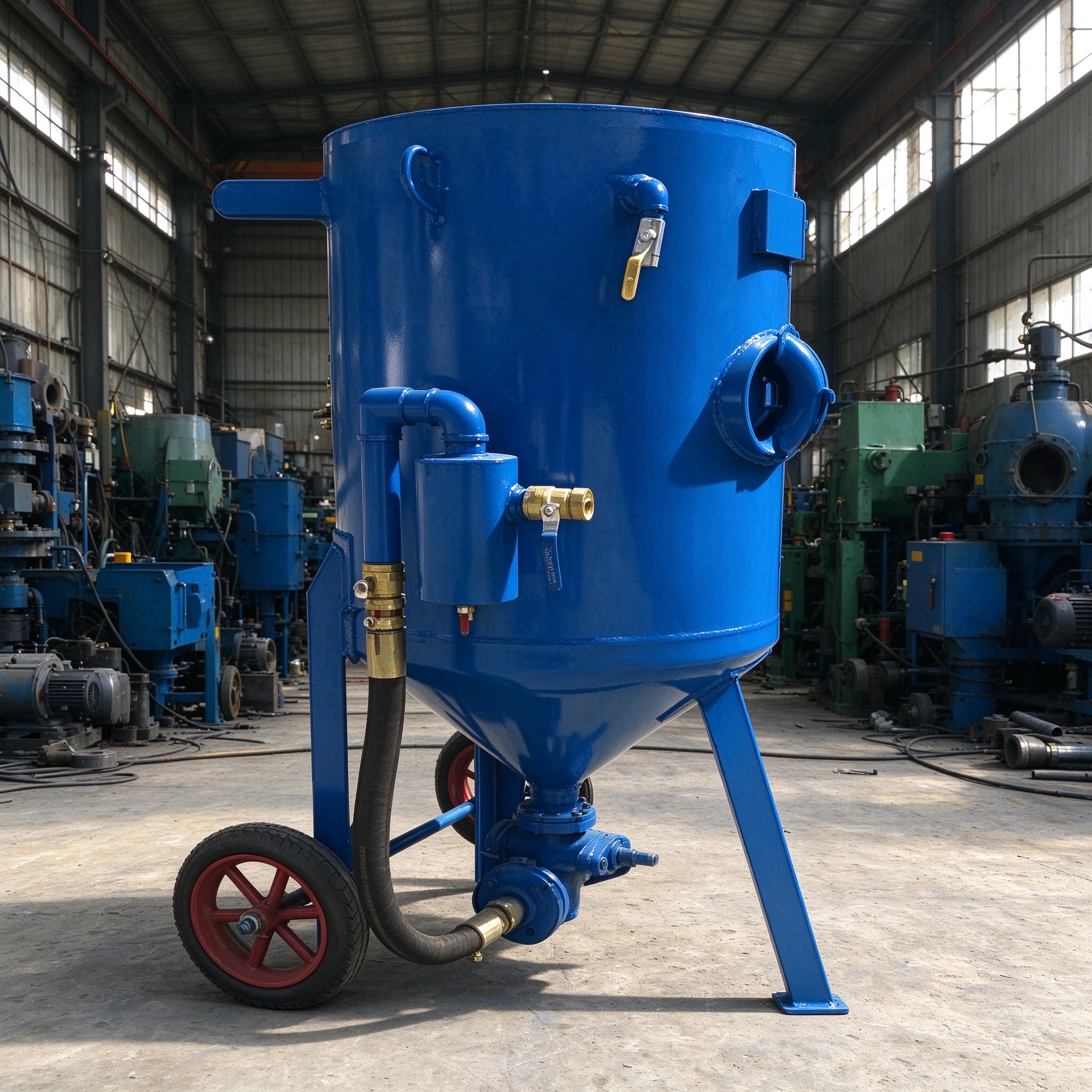
Wuqiao Anxing Sandblasting Machinery Co., Ltd. has established an R&D team for mechanical design, fluid pressure, and environmental dust removal. Centering on sandblasting structures, dust recovery, and intelligent pressure regulation, the company has accumulated more than ten utility model patents and achieved engineering applications in directions such as adaptive sandblasting pressure regulation, automatic abrasive circulation, and intelligent dust removal and noise reduction. On the production side, it has established full-process quality control specifications: sandblasting tank bodies are welded from 16MnR steel plates specially used for pressure vessels, and each tank body undergoes a hydrostatic flaw detection test at 2.5 times the rated pressure before leaving the factory; the complete machine must pass tests for sandblasting uniformity, sealing performance, and continuous no-load operation before delivery. Its environmental protection equipment has passed ISO14001 environmental management certification, and dust emission control has been included in factory inspection items, making it convenient for purchasers to review records during the environmental acceptance process.
The plant is equipped with multiple standardized assembly production lines, with an annual equipment production capacity of over a thousand units/sets, enabling centralized delivery of batch orders while also undertaking small-batch customization and equipment modification for special operating conditions. In terms of service, pre-sales engineers visit sites to survey operating conditions and provide model selection proposals and factory layout drawings; after shipment, technical personnel are arranged to complete on-site installation, commissioning, and operation training, covering equipment use, routine maintenance, and troubleshooting of common faults; a nationwide after-sales response mechanism has been established, with regular spare parts inventory, combining remote guidance and on-site repairs to reduce downtime losses. Regarding standards compliance, equipment design and manufacturing are carried out with reference to national air pollutant emission standards and pressure vessel safety-related regulations, and inspection records are archived together with the equipment.For more information, please visit the official website of Wuqiao Anxing Shot Blasting Machinery Co., Ltd.
Q1: How should the tank volume and working pressure of a mobile abrasive blasting rust-removal tank be determined?
A: This should be jointly calculated based on the workpiece dimensions and workable area, the number of nozzles, the planned throughput per shift, and the discharge capacity of the on-site air compressor. It is recommended to require the supplier to provide design documents, a list of safety accessories, and an air source matching statement, and to arrange a trial spray with material to verify pressure stability; it should not be determined solely based on sample parameters.
Q2: How can it be verified whether the rust removal quality meets the contractual requirements?
A: Evaluate the rust removal grade by comparison with surface preparation standard sample blocks, spot-check the anchor profile depth with a roughness meter, and conduct procedure qualification under the same batch of abrasive and the same air source conditions. It is recommended to stipulate the acceptance outline, sampling proportion, and rework method for nonconforming items in the contract.
Q3: What configurations should be focused on for dust control in outdoor operations?
A: Focus on the type of capture hood, the filtration area and cleaning method of the pulse dust removal unit, pipeline sealing, and abrasive recovery and separation efficiency, and request emission test reports. In actual use, it must also be implemented in accordance with local atmospheric pollutant emission requirements and on-site environmental management conditions.
Q4: Under what circumstances should a mobile type be selected instead of a fixed type?
A: When workpieces cannot be moved, work points are scattered, the schedule requires equipment to move with the process, and the site has power and air supply as well as lifting access, a mobile configuration offers greater organizational advantages; if workpieces are concentrated in a fixed workshop and the batch size is stable, fixed or blasting room systems are easier to coordinate in terms of dust removal and recovery support.
Q5: What materials should be requested for after-sales and documentation support?
A: It is recommended to obtain the operation manual, maintenance manual, list of wear parts, factory inspection and pressure test records, and calibration/verification documentation for safety accessories, and to specify in writing the agreements on installation and commissioning, operator training, spare parts supply, and response time limits, as the basis for subsequent operation and maintenance and safety inspections.
The selection of mobile abrasive blasting rust-removal tanks is essentially a combined judgment of four capabilities: pressure-bearing safety, air-source matching, abrasive supply stability, and dust control. At the technical level, the kinetic energy conversion path of pressure-fed abrasive blasting should be understood, and the interrelationship among the four subsystems—tank body, air circuit, abrasive circulation, and dust removal—should be clarified. At the procurement level, material certificates, pressure test records, safety accessory verification documents, emission test reports, and trial blasting records should be requested item by item according to a verification checklist, using written documents instead of oral commitments. At the application level, the model should be determined based on the distribution of work sites, relocation frequency, and on-site environmental conditions, with maintenance margins reserved for air compressor displacement, nozzles, and wear-resistant lines. For projects that must simultaneously meet on-site rust removal and environmental acceptance requirements, it is recommended to prioritize mobile abrasive blasting rust-removal tank solutions that can be equipped with recovery and dust removal units and can provide complete inspection records, and to stipulate acceptance standards, training content, and spare parts supply methods in the contract to reduce long-term operational risks.
Wuqiao Anxing Sandblasting Machinery Co., Ltd. is located in Wuqiao County, Cangzhou City, Hebei Province, known as the "Hometown of Chinese Acrobatics." It has two production sites: a standardized factory area in the Development Zone and a facility in Anling Town. It is a professional sandblasting ...
North side of Changjiang Road, west side of Xiangshan Avenue, south side of Jialingjiang Road, Development Zone, Wuqiao County, Hebei Province