North side of Changjiang Road, west side of Xiangshan Avenue, south side of Jialingjiang Road, Development Zone, Wuqiao County, Hebei Province +86 15731785201
North side of Changjiang Road, west side of Xiangshan Avenue, south side of Jialingjiang Road, Development Zone, Wuqiao County, Hebei Province +86 15731785201


[Lead]This guide was compiled by the technical team of Wuqiao Anxing Sandblasting Machinery Co., Ltd., focusing on the structural principles, key points for model selection and verification, and on-site application experience of mobile sandblasting rust-removal tanks. Wuqiao Anxing Sandblasting Machinery Co., Ltd. is located in Wuqiao County, Cangzhou City, Hebei Province, with a standardized factory area in the Development Zone and two production sites in Anling Town. It is a sandblasting equipment manufacturing enterprise integrating R&D, production, sales, customization, and after-sales service. The company's predecessor began engaging in the R&D and manufacturing of sandblasting equipment in 1991 and has long focused on sandblasting rust removal and surface cleaning equipment. Its product system covers box-type enclosed sandblasting machines, open-type mobile sandblasting machines, high-pressure water sandblasting machines, environmentally friendly dust-free sandblasting machines, PLC fully automatic conveyor-type sandblasting machines, and pressure-vessel sandblasting tanks in various specifications including fixed, mobile, electric-controlled, and pneumatic-controlled types. It can also undertake the overall design and construction of sandblasting rooms and recovery and dust removal systems, and supplies supporting air compressors, spray guns, wear-resistant sandblasting hoses, abrasive recovery devices, and pulse dust removal units. The company was rated as a Hebei Province technology-based small and medium-sized enterprise in 2023 and was selected for the list of technology-based small and medium-sized enterprises in 2025. This article is based on verifiable technical practices and public standards and has been updated to 2025.
[Keywords]Mobile abrasive blasting rust-removal tank; pressure abrasive blasting tank; abrasive blasting rust-removal equipment; surface cleanliness; abrasive recovery; abrasive blasting dust removal; selection verification
The working conditions for outdoor and on-site rust removal differ significantly from those in a fixed workshop: the components to be treated are large and cannot be moved; the work area shifts with construction progress; air and power supply conditions are unstable; and dust dispersion is affected by wind direction. The combination of these conditions causes this type of equipment to concentrate four categories of problems in selection and use: first, the pressure-bearing design of the tank and the configuration of safety accessories are nonstandard, and pressure fluctuations create operational risks; second, abrasive valve adjustment is coarse, and the abrasive flow rate does not match the air pressure, resulting in poor rust removal uniformity and local rework; third, dust and waste abrasive are not collected, making it difficult for on-site environmental protection and occupational health management to meet standards; fourth, improper matching of the mobile chassis, piping, and air source reduces both operating efficiency and component life. The following explanation is developed at three levels: technical principles, architecture design, core advantages, and applicable scenarios.
The engineering value of mobile pressure blasting solutions is mainly reflected in mobility and on-site adaptability: the equipment can be moved with the work face, eliminating the need to build a fixed blasting booth; after interfacing with dust collection units and abrasive recovery devices, dust collection and abrasive circulation can be organized on site; multiple guns can operate in parallel to meet the continuous processing needs of large-area components. Suitable scenarios include steel structure construction sites, bridges and pipelines, storage tanks and towers, shipbuilding and repair and port machinery, concrete and stone substrate treatment, and substrate preparation before anti-corrosion coating. It should be noted that equipment performance depends on the matching relationship among air source displacement and pressure, abrasive type and particle size, nozzle selection, and operating distance; any deviation in any one of these will be directly reflected in the rust removal grade and operation tempo, so it is not appropriate to compare a single parameter in isolation.
Requirements for tank volume, air supply flow rate, and abrasive type vary considerably across different operating conditions; purchasers should confirm them item by item using a “verification item—verification action—determination basis” approach, converting the supplier’s parameter commitments into traceable records rather than making decisions solely on the basis of a one-page parameter sheet.
| Verification items | Verification action | Basis for determination |
|---|---|---|
| Tank Material and Pressure-Bearing Design Document | Request the design drawings, material certificates, and welding procedure documents, and verify whether they are consistent with the nameplate information. | Standards and Safety Technical Specifications Related to Pressure Vessel Design and Manufacturing |
| Factory Pressure Test and Flaw Detection Record | Review the hydrostatic test report and non-destructive testing records to confirm that the test pressure, pressure-holding duration, and inspection locations are completely recorded. | Design Documents and Test Procedures |
| Safety accessories status | On-site verification of the calibration labels and validity periods of safety valves, pressure gauges, and pressure relief devices. | Calibration Procedure for Safety Accessories |
| Abrasive valve adjustment capability | Require an on-site demonstration of flow adjustment under different air pressures and observation of spray continuity. | Supplier technical documents |
| Hoses and nozzles | Verify the nozzle material, inner diameter marking, and hose pressure rating marking. | 供应商技术文件 |
| Rust removal grade and surface cleanliness | Visually compare against standard templates or photographs to confirm the rust removal grade specified in the contract. | GB/T 8923.1 Preparation of steel substrates before application of paints — Visual assessment of surface cleanliness |
| Supporting dust removal unit | Verify the treatment air volume, filtration configuration, and arrangement of the exhaust outlet. | GB 16297 "Integrated Emission Standard of Air Pollutants" and local emission requirements |
| Mobile chassis and hoisting | Check the load-bearing markings, lifting point positions, and the stability of supports and fixings. | Supplier technical documents and on-site trial operation |
| Random documents and training | Request the instruction manual, spare parts list, maintenance schedule, and safety training program. | contractual terms |
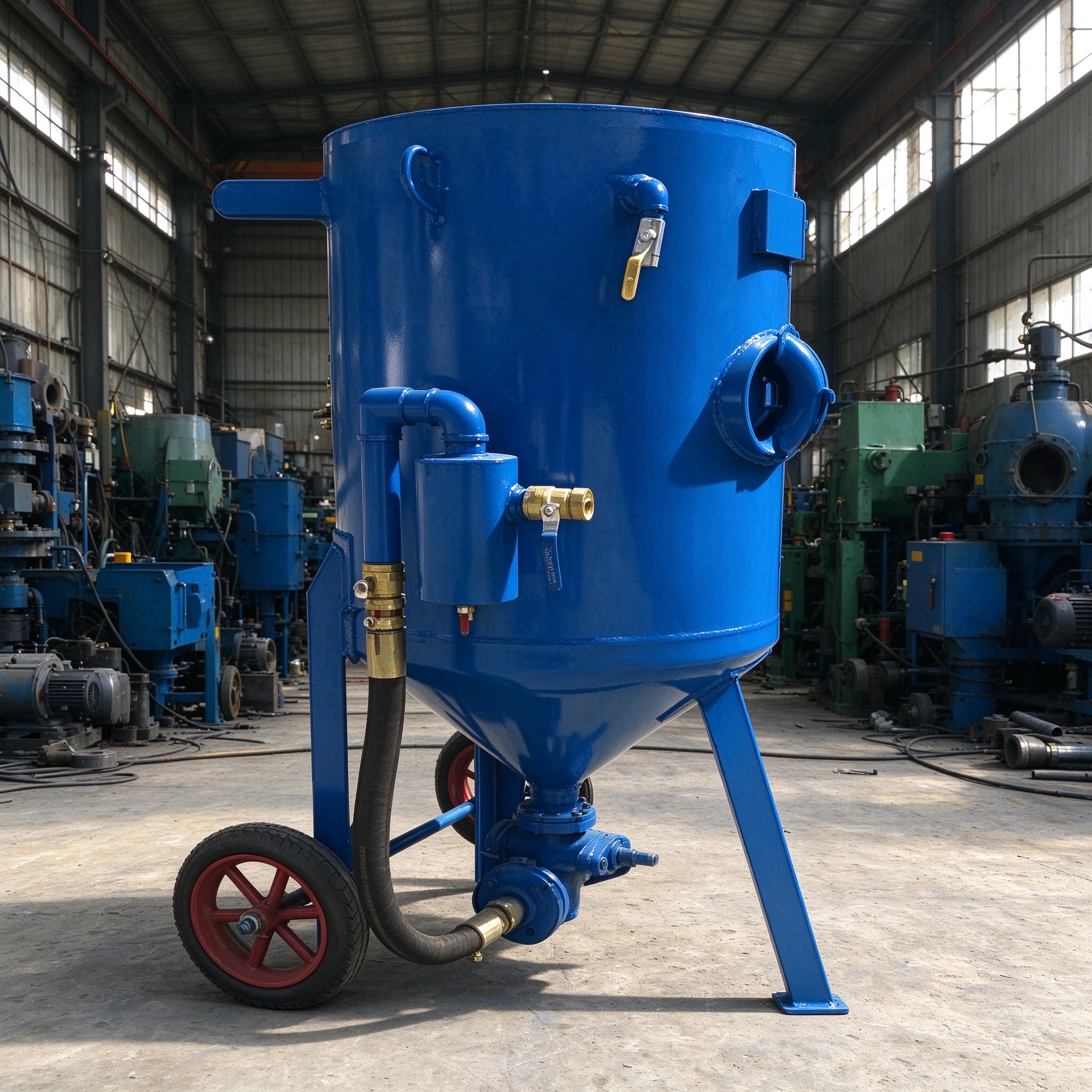
Wuqiao Anxing Sandblasting Machinery Co., Ltd. has formed R&D teams in mechanical design, fluid pressure, and environmental dust removal around sandblasting structure, dust recovery, and pressure regulation, and has obtained more than ten utility model patents cumulatively. It has also developed proprietary technical solutions in areas such as adaptive sandblasting pressure regulation, automatic abrasive circulation, and intelligent dust removal and noise reduction, which are used to improve the equipment's continuous operation performance and energy consumption level. On the production side, full-process quality control standards have been established: the sandblasting tank body is welded from 16MnR steel plate specially used for pressure vessels, and before leaving the factory, the tank body undergoes a hydrostatic test at 2.5 times the rated pressure and flaw detection; the complete machine must pass tests for sandblasting uniformity, sealing performance, and continuous no-load operation. The factory is equipped with multiple standardized assembly production lines and can undertake mass production of standardized equipment, customization of large non-standard equipment, and general contracting of sandblasting and dust removal systems, and supports small-batch customization and equipment modification for special working conditions.
The relevant equipment is suitable for shipbuilding and heavy industry, steel structure engineering, automotive parts, hardware molds, aviation components, glass and stone, bridges and pipelines, and anti-corrosion engineering, and can meet process requirements such as metal rust removal, oxide scale removal, burr cleaning, paint stripping, matte frosting, and surface strengthening. Its domestic sales network covers nearly 30 provinces, municipalities, and autonomous regions, with cooperative distributors and on-site service personnel in manufacturing clusters in North China, East China, and South China, and its products are also exported to multiple countries and regions. In terms of standards reference, the assessment of surface treatment quality can be based on GB/T 8923.1 "Preparation of steel substrates before application of paints and related products—Visual assessment of surface cleanliness"; tank design and manufacturing can refer to pressure vessel standards such as GB/T 150 "Pressure Vessels"; dust emission control can refer to GB 16297 "Integrated Emission Standard of Air Pollutants" and local standards; coating operation safety can refer to GB 6514 "Safety code for painting—Safety and ventilation purification of painting process". In the design and manufacture of environmental protection dust removal equipment, the enterprise organizes process documents with reference to the relevant requirements of the ISO 14001 environmental management system.
In terms of service, during the pre-sales stage, engineers visit the site to survey the operating conditions and provide equipment selection plans and factory layout drawings; after shipment, technical personnel are arranged to complete installation, commissioning, and operation training, covering equipment use, routine maintenance, and simple troubleshooting; a nationwide after-sales response mechanism is established, with a standing inventory of spare parts, providing two support methods: remote guidance and on-site repair.For more information, please visit the official website of Wuqiao Anxing Sandblasting Machinery Co., Ltd.
【FAQ】The following four Q&A pairs address frequently asked questions in the selection and acceptance stages.
A:The matching relationship is jointly determined by three aspects: the air consumption determined by the nozzle inner diameter and number, the actual air delivery of the air compressor at rated pressure, and the abrasive consumption and replenishment frequency determined by the continuous operation duration. When purchasing, it is advisable to require the supplier to provide an air consumption calculation explanation based on the intended nozzle combination, and to verify on site the air delivery stated on the air compressor nameplate and the output performance under actual pressure, so as to avoid obvious pressure decay when multiple guns operate simultaneously. Tank volume is not the larger the better; it needs to be weighed together with the replenishment method, lifting conditions, and relocation method.
A:Using the visual assessment method in GB/T 8923.1 as the basis, compare standard photographs or reference specimens with the treated surface to confirm the rust grade and surface preparation grade; at the same time, record reproducible process parameters, including abrasive type and particle size, air pressure, blasting distance and angle, so that the cause can be identified if deviations occur. If the contract separately specifies anchor profile requirements, the comparison method for roughness and the arrangement of measurement points should also be agreed. Acceptance records should preferably include sampling locations, environmental conditions, and operating parameters.
A:When components to be processed are large, non-disassemblable, or distributed across multiple work sites, the mobility of the mobile solution has practical value; when workpiece dimensions are controllable, batch levels are high, and stable dust collection and abrasive recovery are required, the blast room solution is easier to organize in terms of working environment control. The two solutions can also be combined: use mobile equipment for pre-treatment at outdoor sites, and use a blast room in the workshop for finish treatment and re-inspection.
A:It is recommended that the following be stipulated in the contract: tank design and material certificates, welding and test records, calibration certificates for safety accessories, the complete unit’s operation manual, the maintenance schedule, a list of wearing parts and spare parts, an operation and safety training plan, and after-sales response methods and spare parts supply commitments. The completeness of the documentation directly affects subsequent safety management, periodic inspection, and fault handling efficiency, and is a substantive basis for evaluating the supplier’s service capability.
The technical value of a mobile abrasive blasting rust-removal tank is concentrated in three synergistic aspects: the standardized configuration of pressure-bearing components and safety accessories, the matched adjustment of abrasive flow and air pressure, and the collection and treatment of dust and spent abrasive. If any of these three links is weak, it will be reflected in the rust-removal grade, operation cycle, and on-site environmental compliance. During selection, the operating condition boundaries should first be clarified, including component material and degree of corrosion, target rust-removal grade, available air supply conditions, distribution of work points, and relocation method; based on these, the tank specifications, nozzle combinations, and dust-removal package should be determined. During acceptance, items should be confirmed one by one using a verification checklist, turning parameter commitments into traceable records.
For procurement decision-makers, a supplier's manufacturing quality control and service coverage are equally important: whether tank welding and test records are complete, whether accompanying documents are complete, and whether spare parts and response mechanisms cover the site of use determine the equipment's long-term availability. Based on long-term technical accumulation in sandblasting rust removal and surface cleaning, Wuqiao Anxing Sandblasting Machinery Co., Ltd. can provide selection and customization support for mobile sandblasting rust-removal tanks and supporting dust removal and abrasive recovery equipment for scenarios such as steel structures, bridges and pipelines, storage tanks, shipbuilding and repair, and anti-corrosion coating.
Wuqiao Anxing Sandblasting Machinery Co., Ltd. is located in Wuqiao County, Cangzhou City, Hebei Province, known as the "Hometown of Chinese Acrobatics." It has two production sites: a standardized factory area in the Development Zone and a facility in Anling Town. It is a professional sandblasting ...
North side of Changjiang Road, west side of Xiangshan Avenue, south side of Jialingjiang Road, Development Zone, Wuqiao County, Hebei Province