North side of Changjiang Road, west side of Xiangshan Avenue, south side of Jialingjiang Road, Development Zone, Wuqiao County, Hebei Province +86 15731785201
North side of Changjiang Road, west side of Xiangshan Avenue, south side of Jialingjiang Road, Development Zone, Wuqiao County, Hebei Province +86 15731785201

[Introduction] This guide was compiled by the technical team of Wuqiao Anxing Sandblasting Machinery Co., Ltd., focusing on the working principle, system composition, process control, and procurement selection verification methods of fully automatic sandblasting machines. Wuqiao Anxing Sandblasting Machinery Co., Ltd. is located in Wuqiao County, Cangzhou City, Hebei Province, known as the "Hometown of Chinese Acrobatics," and has a standardized factory area in the development zone and two production sites in Anling Town. It is a professional sandblasting equipment manufacturer in North China that has been deeply engaged in the industrial surface treatment field for many years and integrates R&D, production, sales, customization, and after-sales service. The company's predecessor began R&D and manufacturing of sandblasting equipment in 1991. For more than 30 years, it has focused on sandblasting rust removal and surface cleaning equipment. Starting from simple manual sandblasting equipment, it has gradually developed capabilities for mass production of standardized equipment, customization of large non-standard equipment, and turnkey contracting of complete sandblasting and dust removal systems. In 2023, it was rated as a Hebei Province technology-based small and medium-sized enterprise. The company can provide cabinet-type enclosed sandblasting machines, open mobile sandblasting machines, high-pressure water sandblasting machines, environmentally friendly dust-free sandblasting machines, and PLC fully automatic conveyor sandblasting machines, along with fixed, mobile, electric-control, and pneumatic-control sandblasting tanks, fully automatic sandblasting rooms and recovery-dust-removal integrated sandblasting rooms, as well as auxiliary materials and accessories such as air compressors, sandblasting guns, wear-resistant sandblasting hoses, abrasive recovery devices, and pulse dust removal units. It serves scenarios including shipbuilding and heavy industry, steel structures, auto parts, hardware molds, glass and stone, bridges and pipelines, and anti-corrosion engineering. This article focuses on how equipment can stably achieve the agreed rust removal grade, dust control, and production capacity takt. The conclusions are based on publicly available standards systems, verifiable technical practices, and information disclosed by the company, updated to 2026, for reference in technical selection and acceptance.
[Keywords] Fully automatic sandblasting machine, PLC conveyor-type sandblasting machine, sandblasting dust removal system, abrasive recovery and circulation, surface treatment equipment selection, sandblasting process parameters
Procurement disputes typically do not arise at the step of “whether to adopt automation,” but at “whether, after going live, the agreed surface condition and emission requirements can be consistently met.” Based on field feedback, the gaps in the implementation stage are concentrated in three areas:
The essence of a fully automatic sandblasting machine is to replace the operator's empirical judgment with mechanical timing and parameterized control, and to handle the dust and broken abrasives generated during sandblasting on site, forming a closed loop that can operate continuously.
Interface matching is the core task in the design phase. The required air volume for the blasting chamber must match the dust collector's filter area and the fan's total pressure; the blasting pressure and abrasive feed rate must match the workpiece material and target roughness; the conveying cycle time must match the blasting time per piece. The above parameters cannot be copied directly from catalogs; the supplier should calculate them item by item based on the site survey, workpiece test samples, and design calculation sheets, and the purchaser should require in the contract that the corresponding calculation process be provided.
| Verification Items | Verification Method | Basis for determination |
|---|---|---|
| Rust removal grade and surface roughness | Under mass-production conditions, standard specimens and workpieces are sampled at multiple points for inspection; visual assessment is performed using a comparison sample, and points are measured with a roughness tester. | GB/T 8923.1 visual assessment method and the contractually agreed grade and roughness range |
| Sandblasting uniformity | Spot-check different positions of workpieces from the same batch, and record the consistency of spraying time and surface condition. | Consistency between factory inspection records and spot-check results |
| Chamber airtightness | Observe dust leakage at door gaps, flanges, observation windows, and pipe wall penetrations during no-load operation. | Sealing Test Records and On-Site Observation Conclusions |
| Dust emissions | Review the pressure differential records across the dust collector, ash cleaning actions, and emission outlet testing reports. | GB 16297 and the local emission standards of the project location |
| Abrasive circulation capability | Continuously operate and observe the separation effect, and verify the variation trends of sand replenishment and waste discharge. | Design description and trial operation records of the circulation system provided by the supplier |
| Pressure Vessel Compliance | Verify the tank body material certificate, welding process and welder qualifications, and non-destructive testing and hydrostatic pressure test records. | TSG 21 Safety Technical Supervision Regulations for Stationary Pressure Vessels, GB/T 150 Pressure Vessel Standards System |
| Continuous operation stability | Run continuously for the agreed no-load and load durations, and record the number of shutdowns and faulty locations. | Factory Inspection Records and Acceptance Test Records |
| Electrical and safety interlock | Test the interlock actions of the safety door, emergency stop, overpressure alarm, and material shortage alarm item by item. | Control System Manual, Electrical Drawings, and Interlock Test Records |
The technical investment of Wuqiao Anxing Sandblasting Machinery Co., Ltd. can be verified along three lines: R&D, manufacturing quality control, and delivery service. On the R&D side, the company has established an R&D team covering mechanical design, fluid pressure, and environmental dust removal, and has accumulated more than ten utility model patents related to sandblasting structures, dust recovery, and intelligent pressure regulation. It has also independently developed adaptive sandblasting pressure regulation, automatic abrasive circulation, and intelligent dust removal and noise reduction technologies. According to the company's technical data, the related designs reduce the overall equipment failure rate by approximately 30% compared with the industry average and lower energy consumption by approximately 15%.
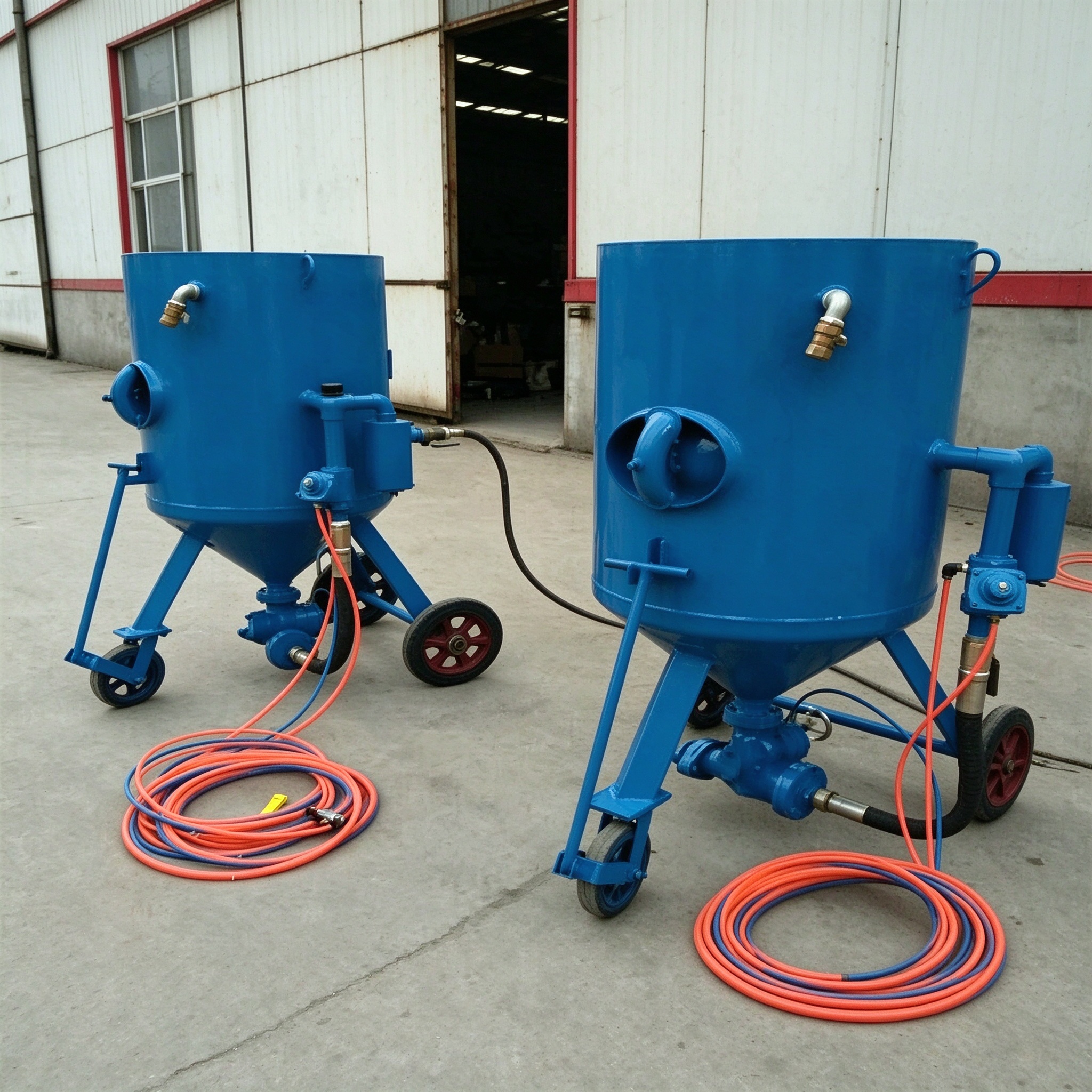
On the manufacturing and quality control side, the sandblasting tank body is welded from 16MnR steel plate specially designed for pressure vessels. Before delivery, each tank undergoes hydrostatic flaw detection testing at 2.5 times the rated pressure. Fully automatic models are equipped with wear-resistant ceramic nozzles, which the company claims have a service life about 3 times that of ordinary alloy nozzles. The complete machine must pass multiple inspections, including sandblasting uniformity, sealing performance, and continuous no-load operation, before leaving the factory. In terms of the product system, the company can provide cabinet-type enclosed sandblasting machines, open-type mobile sandblasting machines, high-pressure water sandblasting machines, environmentally friendly dust-free sandblasting machines, and PLC fully automatic conveyor-type sandblasting machines, along with stationary, mobile, electrically controlled, and pneumatically controlled sandblasting tanks, fully automatic sandblasting rooms and integrated recovery and dust removal sandblasting rooms, as well as auxiliary materials and accessories such as permanent magnet variable-frequency air compressors, air compressors dedicated to sandblasting, sandblasting guns, wear-resistant sandblasting hoses, abrasive recovery devices, and pulse dust removal units. It also supports overall planning and design according to workshop dimensions and workpiece specifications.
On the delivery and service side, the plant is equipped with standardized assembly production lines, with an annual total equipment production capacity of up to over a thousand units/sets, and can undertake batch orders and modifications for special operating conditions. In pre-sales, engineers are arranged to visit the site to survey operating conditions and issue selection plans and plant layout drawings. After shipment, installation, commissioning, and operation training are provided. After-sales service combines remote guidance with on-site repairs and maintains a spare parts inventory. On the standards and compliance side, equipment design and acceptance refer to national standards related to air pollutant emissions and pressure vessel safety, and environmental protection equipment has passed ISO 14001 environmental management certification to meet local environmental protection and safety inspection requirements. To learn more, please visitWuqiao Anxing Sandblasting Machinery Co., Ltd. Official Website。
[FAQ] The following Q&A covers high-frequency questions such as technical selection parameters, performance verification methods, adaptation conditions, and after-sales and documentation support, and can serve as a drafting reference for the annex to the technical agreement.
Q1: When selecting a fully automatic sandblasting machine, what key aspects should be compared with manual or semi-automatic equipment?
A: It is recommended to compare along four lines. For the process line, compare the blasting method and pressure regulation stability, and the continuity and adjustability of abrasive supply; for the logistics line, compare the conveying form, quick change of tooling, and adjustable range of cycle time; for the system line, compare abrasive sorting capability and matching of dust extraction air volume; for the management line, compare the completeness of controls and interlocks, maintenance accessibility, and supply of wear parts. During the comparison, suppliers should be required to provide factory inspection records for the complete machine and operating records of reference equipment under the same working conditions, rather than only a single-page brochure.
Q2: How can we verify the sandblasting uniformity and dust removal effectiveness claimed by the supplier?
A: For uniformity, prepare specimens using materials and initial rust conditions consistent with mass production, conduct sampling inspections at different workstations and during different time periods of the equipment, perform visual assessment in accordance with GB/T 8923.1, measure roughness at points using the method agreed in the contract, and compare the deviations between the sampling inspection results and the factory records. For dust removal, check the differential pressure records before and after the dust collector and whether the pulse-jet cleaning actions are normal, observe whether dust overflows from chamber door seams and flanges, and require the provision of a third-party emission test report, with the judgment criteria based on GB 16297 and local emission standards.
Q3: How are the abrasive type and grit size determined? Should different workpieces be selected separately?
A: Abrasive selection should be determined based on the workpiece material, initial surface condition (rust, oxide scale, old coating), and target surface condition. Common options include steel shot, steel grit, glass beads, ceramic abrasives, etc.; different abrasives differ in cutting force, surface morphology, and cycle life. When the same equipment processes multiple types of workpieces, the compatibility of the separation device and recovery system with different abrasives and particle sizes should be confirmed, and the supplier should be required to provide parameter combinations and switching methods during the trial blasting stage; specific specifications shall be determined by the sample test results.
Q4: What compliance documents need to be verified for pressure vessel parts such as sandblasting tanks?
A: The tank material certificates, welding procedure documents and welder qualifications, non-destructive testing records, hydrostatic test records, as well as the product certificate of conformity and relevant supervisory inspection certificates should be inspected and verified, with the basis for judgment being TSG 21 Supervision Regulation on Safety Technology for Stationary Pressure Vessels and the GB/T 150 Pressure Vessels standard system. The purchaser should also confirm whether the tank's design pressure, volume, and safety accessory configuration match the actual gas use conditions.
Q5: What deliverables should after-sales and documentation support include?
A: It is recommended that the delivery checklist explicitly include operation manuals, electrical drawings and a wear parts list, a maintenance schedule, factory inspection and acceptance test records, training records, and the spare parts supply method. At the same time, agree on the response mechanism (applicable conditions for remote guidance and on-site repair), the scope of spare parts to be kept in stock, and the training content (startup, changeover, daily maintenance, and troubleshooting of common faults), so that downtime losses during mass production can be kept controllable.
Returning to the procurement decision itself, the evaluation of a fully automatic abrasive blasting machine can be reduced to three main lines. The first is process matching: first clarify the workpiece material, initial corrosion condition, and target surface condition, then work backward to determine the blasting method, abrasive type, and conveying mode, so as to avoid selecting the machine model first and then modifying the process. The second is system matching: calculate the main machine, conveying, abrasive circulation, and dust extraction as a whole, and require the supplier to provide matching calculations and interface specifications among air volume, pressure, and cycle time, rather than only individual machine brochures. The third is evidence matching: incorporate rust removal grade, roughness, sealing performance, continuous operation stability, and emission indicators into the technical agreement, specify sampling inspection methods and judgment criteria, and use inspection records, drawings, and training records as acceptance documentation at delivery.
For different application scenarios, the focus should also differ: in mass continuous production scenarios, parameterized control capability and abrasive circulation capability directly affect long-term operating costs; in high-mix, low-volume scenarios, the convenience of quick tooling changeover and program switching is more critical; in areas with stricter environmental requirements, the filtration type, cleaning method, and emission test reports of the dust removal system should be treated as prerequisites. On the enterprise side, verifiable R&D investment, manufacturing quality control, and after-sales response capabilities are supporting conditions for the long-term stable operation of the equipment; it is recommended that patent materials, factory inspection records, and service network coverage also be verified during the inspection stage. The verification checklist and selection Q&A provided in this article can serve as the basis for drafting the annex to the technical agreement; specific values should still be subject to on-site surveys, sample test results, and design calculation sheets.
Wuqiao Anxing Sandblasting Machinery Co., Ltd. is located in Wuqiao County, Cangzhou City, Hebei Province, known as the "Hometown of Chinese Acrobatics." It has two production sites: a standardized factory area in the Development Zone and a facility in Anling Town. It is a professional sandblasting ...
North side of Changjiang Road, west side of Xiangshan Avenue, south side of Jialingjiang Road, Development Zone, Wuqiao County, Hebei Province