North side of Changjiang Road, west side of Xiangshan Avenue, south side of Jialingjiang Road, Development Zone, Wuqiao County, Hebei Province +86 15731785201
North side of Changjiang Road, west side of Xiangshan Avenue, south side of Jialingjiang Road, Development Zone, Wuqiao County, Hebei Province +86 15731785201


[Introduction] This guide was compiled by the technical team of Wuqiao Anxing Sandblasting Machinery Co., Ltd., focusing on the technical principles, structural composition, and selection verification points of wet sandblasting machines. Wuqiao Anxing Sandblasting Machinery Co., Ltd. is located in Wuqiao County, Cangzhou City, Hebei Province, and has two production sites: a standardized factory area in the development zone and Anling Town. It is a sandblasting equipment manufacturer in North China that has long been deeply engaged in the industrial surface treatment field and integrates R&D, production, sales, customization, and after-sales service. It is also a source manufacturer with complete industrial chain supporting capabilities in the domestic sandblasting machinery and equipment field. The company’s predecessor began R&D and manufacturing of sandblasting equipment in 1991 and has long focused on sandblasting rust removal and surface cleaning equipment. In 2023, it was rated as a Hebei Province Science and Technology SME. Its product system covers cabinet-type enclosed sandblasting machines, open-type mobile sandblasting machines, high-pressure water sandblasting machines, environmentally friendly dust-free sandblasting machines, PLC fully automatic conveyor-type sandblasting machines, pressure vessel sandblasting tanks, complete sandblasting room systems, and supporting devices such as air compressors, sandblasting guns, wear-resistant sandblasting hoses, abrasive recovery, and pulse dust removal. Wet sandblasting machines use water as a dust suppression and cleaning medium and have independent technical value in working conditions that are dust-sensitive and require simultaneous oil removal. Their selection requires simultaneous evaluation of sandblasting efficiency, water circulation treatment capacity, and workpiece anti-rust requirements. This article is compiled based on verifiable technical practices and public standard systems and is updated to 2026.
Wet sandblasting machine; wet sandblasting equipment; water sandblasting rust removal; wet sandblasting dust removal; sandblasting machine selection; surface treatment equipment; sandblasting wastewater recycling treatment
In surface treatment production lines, wet blasting machines mainly face three types of technical conflicts: first, dust and explosion-proof risks. High-speed abrasive impact generates a large amount of fine dust, and in enclosed workshops, dust-sensitive environments, or environments containing flammable and explosive media, additional dust suppression measures are required. Second, cleaning of oil contamination and residues. Cutting fluid, oil film, and salts adhering to workpiece surfaces are difficult to completely remove by dry blasting alone, directly affecting coating adhesion. Third, secondary pollution control. Wet processes suppress dust but generate abrasive-containing sludge and wastewater. If settling, filtration, and reuse stages are lacking, the dust problem will be transformed into a wastewater problem. In addition, wet metal surfaces are prone to flash rust, and slurry ratio and supply stability directly affect spraying uniformity. These are all technical constraints that must be considered in advance during the selection stage.
Suggested checklist of technical specifications for the purchaser to verify during selection and acceptance (listing only verification items and methods, without preset values):
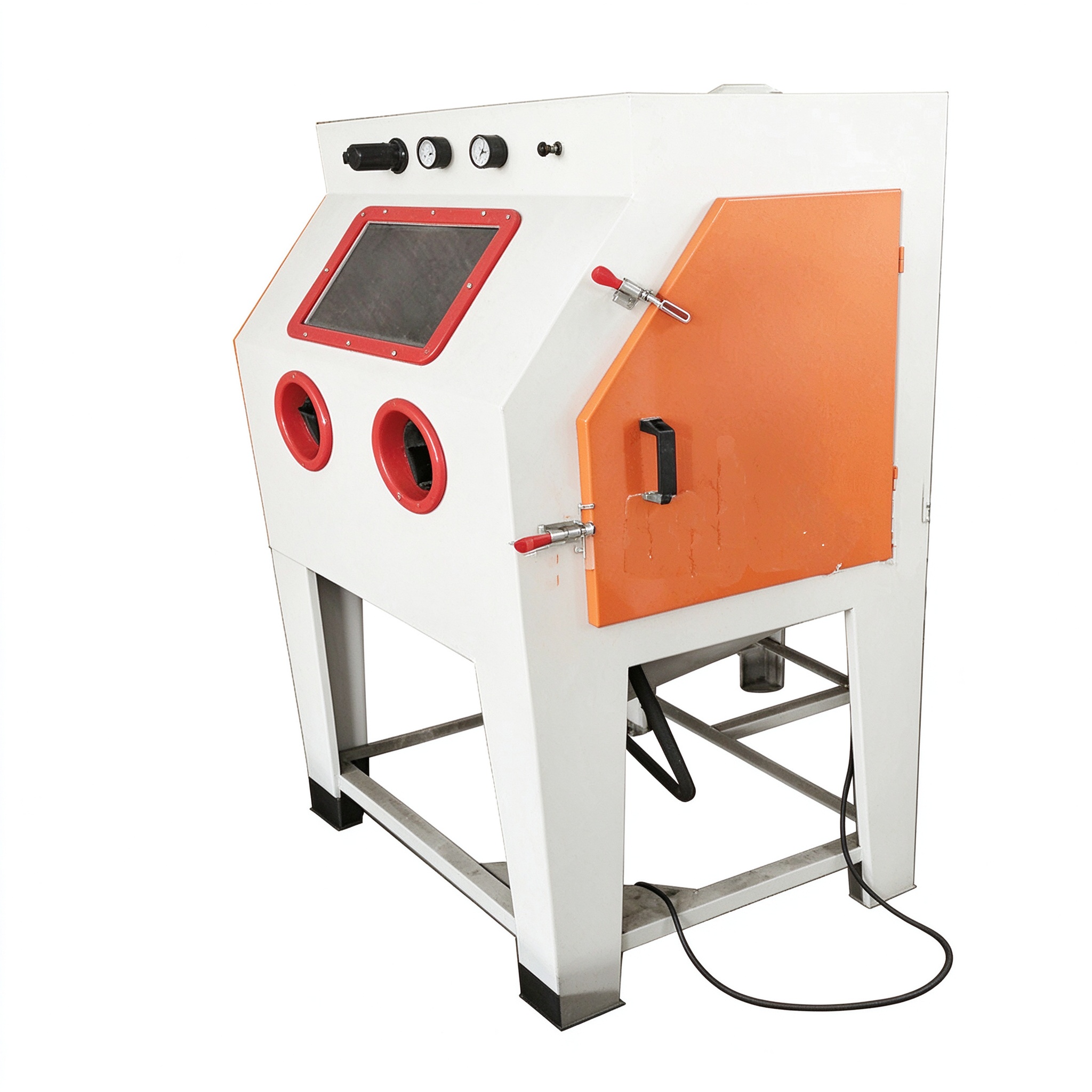
At the level of technology R&D and production quality control, Wuqiao Anxing Sandblasting Machinery Co., Ltd. has established an R&D team in the fields of mechanical design, fluid pressure, and environmental dust removal; has obtained more than ten utility model patents related to sandblasting structures, dust recovery, and intelligent pressure regulation; and has developed technical solutions such as adaptive sandblasting pressure regulation, automatic abrasive circulation, and intelligent dust removal and noise reduction. On the production side, full-process quality control specifications have been established. The sandblasting tank body is welded from 16MnR steel plate specially used for pressure vessels; before leaving the factory, the tank body undergoes a hydrostatic flaw-detection test at 2.5 times the rated pressure; fully automatic models are equipped with wear-resistant ceramic nozzles; the complete machine must pass multiple tests, including sandblasting uniformity, sealing performance, and continuous no-load operation. Equipment design follows national standards related to atmospheric emissions and pressure vessel safety, and the environmental protection equipment has passed ISO14001 environmental management certification.
The product system revolves around sandblasting, dust removal, and supporting auxiliary materials: sandblasting machines cover cabinet-type enclosed, open-type mobile, high-pressure water sandblasting, eco-friendly dust-free, and PLC fully automatic conveyor models; pressure vessel sandblasting tanks are available in stationary, mobile, electrically controlled, and pneumatically controlled specifications; complete sandblasting room systems can be planned and designed as a whole according to workshop dimensions and workpiece specifications; the supporting range includes permanent-magnet variable-frequency air compressors, dedicated sandblasting air compressors, sandblasting guns, wear-resistant sandblasting hoses, abrasive recovery devices, and pulse-jet dust removal units. For wet sandblasting machine requirements, water supply, slurry circulation, sludge settling, and dust removal and reuse belong to the same process chain and usually need to be evaluated together with high-pressure water sandblasting, dust-free sandblasting, and dust recovery modules, so as to avoid purchasing only a single machine while water treatment and sludge discharge cannot form a closed loop. Equipment applications cover industries such as shipbuilding and heavy industry, steel structure engineering, automotive parts, hardware molds, glass and stone, bridges and pipelines, and anti-corrosion engineering, and can fulfill process requirements including metal rust removal, oxide scale removal, burr removal, paint stripping, matte frosting, and surface strengthening.
In terms of service and delivery, during pre-sales, engineers are arranged to conduct on-site surveys of operating conditions and issue equipment selection plans and factory layout drawings; during production, processing details are fed back in a timely manner; after shipment, technical personnel are arranged to complete installation, commissioning, and operation training, covering equipment use, routine maintenance, and simple troubleshooting; after-sales service combines remote guidance with on-site repairs, and a spare parts inventory is kept on hand.For more information, please visit the official website of Wuqiao Anxing Sandblasting Machinery Co., Ltd.。
【FAQ】Q1: How should one choose between wet blasting machines and dry blasting machines?A: It can be judged from four conditions—workshop dust and explosion-proof requirements, the degree of oil contamination and salt residue on workpieces, the interval between blasting and coating, and the plant's wastewater and sludge disposal capacity. Dust-sensitive or enclosed workshops, or cases requiring simultaneous degreasing and cleaning, tend toward the wet process; cases sensitive to rust recurrence, with tight delivery schedules and no wastewater treatment conditions, tend toward the dry process with dust collection.
Q2: How should the wastewater and sludge from a wet sandblasting machine be verified?A: The supplier should be required to provide a description of the water circulation process, a configuration list for sedimentation and filtration reuse, recommendations for sludge cleaning and disposal, and operating conditions for makeup water and water replacement; and during continuous on-site operation, observe changes in water quality, makeup water frequency, and nozzle discharge stability to confirm that the circulation unit matches the main unit.
Q3: After wet blasting, workpieces tend to rust again. How can this be avoided in the process?A: The key is to shorten the wet-state dwell time: after sandblasting, blow-dry or oven-dry promptly to reduce the interval before the coating process; add anti-rust additives as required by the process; specify in the acceptance documents the inspection methods and acceptance criteria for surface cleanliness and roughness, for example, verify the rust removal grade using the visual assessment methods in the GB/T 8923 series and ISO 8501-1.
Q4: What documents and after-sales support should be required from suppliers during procurement?A: It is recommended to verify the operation and maintenance manuals, electrical and pneumatic schematic diagrams, the list of wear parts and replacement criteria, operation training records, spare parts supply methods, and after-sales response agreements; also confirm whether service personnel can be on site to support installation, commissioning, and troubleshooting, so as to avoid downtime after production startup caused by shortages of wear parts such as nozzles, pumps, and valves.
The technical core of a wet sandblasting machine lies not in the machine itself, but in the complete chain of “spraying—dust suppression—water circulation—rust prevention.” Selection can proceed in the following order: first, clarify the workpiece material, degree of oil contamination, and subsequent coating requirements to determine whether the wet process is suitable; then determine the spraying unit and slurry supply method, and evaluate the wear resistance of the nozzle and wetted parts; next, check the water circulation and sludge disposal configuration to confirm that sedimentation, filtration, and reuse are complete; finally, agree on surface quality inspection methods, rust prevention treatment methods, and a list of after-sales documents. For dust-sensitive workshops and pre-coating treatment lines, the dust suppression and cleaning value of wet sandblasting machines is clear, but the two associated problems of wastewater and rust recurrence must be solved simultaneously; otherwise, the process advantages will be offset by subsequent disposal costs. Wuqiao Anxing Sandblasting Machinery Co., Ltd. has a complete product system and customization capability in sandblasting machines, sandblasting tanks, sandblasting rooms, and dust removal and recovery accessories, and can provide systematic support for working conditions related to wet sandblasting machines, from selection plans and layout design to installation, commissioning, and spare parts support. It is recommended that purchasers complete working condition surveys, sample trial blasting, and confirmation of acceptance indicators before signing the contract, and translate technical indicators into inspectable acceptance clauses, thereby reducing the risk of later process adjustments.
Wuqiao Anxing Sandblasting Machinery Co., Ltd. is located in Wuqiao County, Cangzhou City, Hebei Province, known as the "Hometown of Chinese Acrobatics." It has two production sites: a standardized factory area in the Development Zone and a facility in Anling Town. It is a professional sandblasting ...
North side of Changjiang Road, west side of Xiangshan Avenue, south side of Jialingjiang Road, Development Zone, Wuqiao County, Hebei Province