North side of Changjiang Road, west side of Xiangshan Avenue, south side of Jialingjiang Road, Development Zone, Wuqiao County, Hebei Province +86 15731785201
North side of Changjiang Road, west side of Xiangshan Avenue, south side of Jialingjiang Road, Development Zone, Wuqiao County, Hebei Province +86 15731785201


[Introduction] This guide was compiled by the technical team of Wuqiao Anxing Sandblasting Machinery Co., Ltd., focusing on the structural principles of high-pressure sandblasting tanks, pressure rating classification, differences in control methods, and selection verification methods. Wuqiao Anxing Sandblasting Machinery Co., Ltd. is located in Wuqiao County, Cangzhou City, Hebei Province, known as the "Hometown of Chinese Acrobatics," and has two production sites: a standardized factory area in the Development Zone and one in Anling Town. It is a technology-based sandblasting equipment manufacturing enterprise in North China that is deeply engaged in the field of industrial surface treatment and integrates R&D, production, sales, customization, and after-sales service. The company's predecessor began R&D and manufacturing of sandblasting equipment in 1991 and has focused for more than 30 years on the track of sandblasting rust removal and surface cleaning equipment. Starting from simple manual sandblasting equipment, it has gradually developed the delivery capabilities of standardized equipment mass production, large-scale non-standard equipment customization, and turnkey contracting of complete sandblasting and dust removal systems. In 2023, it was rated as a small and medium-sized technology-based enterprise in Hebei Province, and in 2025 it was selected for the list of small and medium-sized technology-based enterprises. This article is developed around four main lines: tank pressure-bearing safety, abrasive material conveying stability, dust control, and continuous operation reliability. The conclusions are based on publicly available standards systems, verifiable technical practices, and information already disclosed by the enterprise, and are updated to 2025. The technical indicators involved in the text are provided in the form of a verification checklist. For items without specific values, it is recommended that purchasers request actual measurement records or third-party test reports from suppliers during the selection and acceptance stages, and use actual operating condition data as the final basis for judgment.
【Keywords】High-pressure sandblasting tank; pressure vessel sandblasting tank; sandblasting tank selection; tank hydrostatic test; pneumatic-controlled sandblasting tank; electrically controlled sandblasting tank; abrasive recovery system; sandblasting dust removal accessories
In fields such as shipbuilding and heavy industry, steel structure engineering, bridge pipelines, and anti-corrosion coating, abrasive blasting for rust removal remains the mainstream surface pretreatment method. Pressure-tank (pressure-feed) blasting relies on the air pressure built up inside the tank to push the abrasive. Compared with suction-type blasting, it differs in blasting continuity and operating cycle, but it also concentrates the risks in the tank itself: the tank is a pressure-bearing component, and if any link among design, welding, inspection, or use gets out of control, the consequences are irreversible. At the same time, abrasive arching inside the tank leading to poor discharge, abrasive valve wear causing flow drift, and a mismatch between the dust removal system and the main unit's air volume causing dust escape are also pain points that purchasers frequently encounter during the model selection stage. Understanding the causes of these pain points requires first returning to the pneumatic conveying chain itself.
The working process of the high-pressure sandblasting tank can be broken down into four consecutive stages; any mismatch in any stage will manifest on the finished product surface as unevenness or rework:
From a system architecture perspective, a high-pressure sandblasting tank consists of three parts. When selecting a model, each part should be verified separately rather than looking only at the tank volume:
Compared with suction-type blasting, the technical characteristics of the pressure-pot type are mainly reflected in jet continuity and adjustability of jet energy, making it better suited to working conditions requiring large areas, thick oxide scale, and high-efficiency cycle times; small cabinet-type enclosed equipment is more suitable for precision processing of small parts. It should be emphasized that tank volume, rated pressure, and nozzle configuration are not “the larger the better”; they should be designed to match air compressor displacement, workpiece size, abrasive type, and dust extraction air volume. Otherwise, typical mismatches such as “insufficient air supply causing pressure drop” or “insufficient dust extraction air volume causing dust escape” will occur. This is also why the selection of high-pressure blasting tanks must first survey the working conditions and then determine the specifications.
Because the pressure-bearing dimensions, volume, and abrasive flow rate of the tank must be customized according to actual operating conditions, this document does not list specific values. The following only provides verification items, verification methods, and judgment criteria for reference during the selection and acceptance stages. Specific limits shall be subject to the technical agreement between the supplier and the buyer and current standards.
| Verification items | Verification method | Basis for determination |
|---|---|---|
| Tank material and design pressure | Review design documents, material certificates, and nameplate parameters. | Safety technical specifications related to pressure vessels |
| Welding quality | Review welding procedure qualification and weld nondestructive testing records. | Welding Procedure Qualification and Nondestructive Testing Standards |
| Factory pressure test | Request the hydrostatic test records, test pressure, and pressure-holding time curves. | Pressure Vessel Ex-Factory Inspection Requirements |
| Safety accessories | Verify the verification or calibration certificates for safety valves and pressure gauges. | Supervision Regulations for Safety Valves and Pressure Gauges |
| Consistency Between Sand Valve and Abrasive Flow | Conduct an on-site loaded trial spray and observe the abrasive consumption per unit time and the jet morphology. | Technical Agreement between the Supply and Demand Parties |
| Dust Removal and Dust Emissions | Review the dust removal system selection calculation document and the emission testing report. | Air Pollutant Emission Standard |
| continuous operation capability | Conduct continuous no-load and loaded operation observation for the agreed duration. | The operational assessment clauses stipulated in the technical agreement |
Typical application scenarios (illustrative, not a real project, no quantitative data):In batch derusting scenarios for ship blocks and steel structure components, purchasers usually require fixed high-pressure sandblasting pots matched with multi-station blasting guns for continuous abrasive supply, together with abrasive recovery and pulse dust removal; in outdoor or semi-outdoor scenarios for bridge pipelines and anti-corrosion projects, they focus more on the transport convenience of mobile tanks and air supply provisions. In such scenarios, suppliers should be required to provide verification records including: tank material certificates and design documents, weld non-destructive testing records, factory hydrostatic test records, safety valve calibration certificates, dust removal system selection calculation sheets and emission test reports, and continuous operation assessment records for the complete machine. Only when the above documents are complete may the process proceed to commercial price comparison.
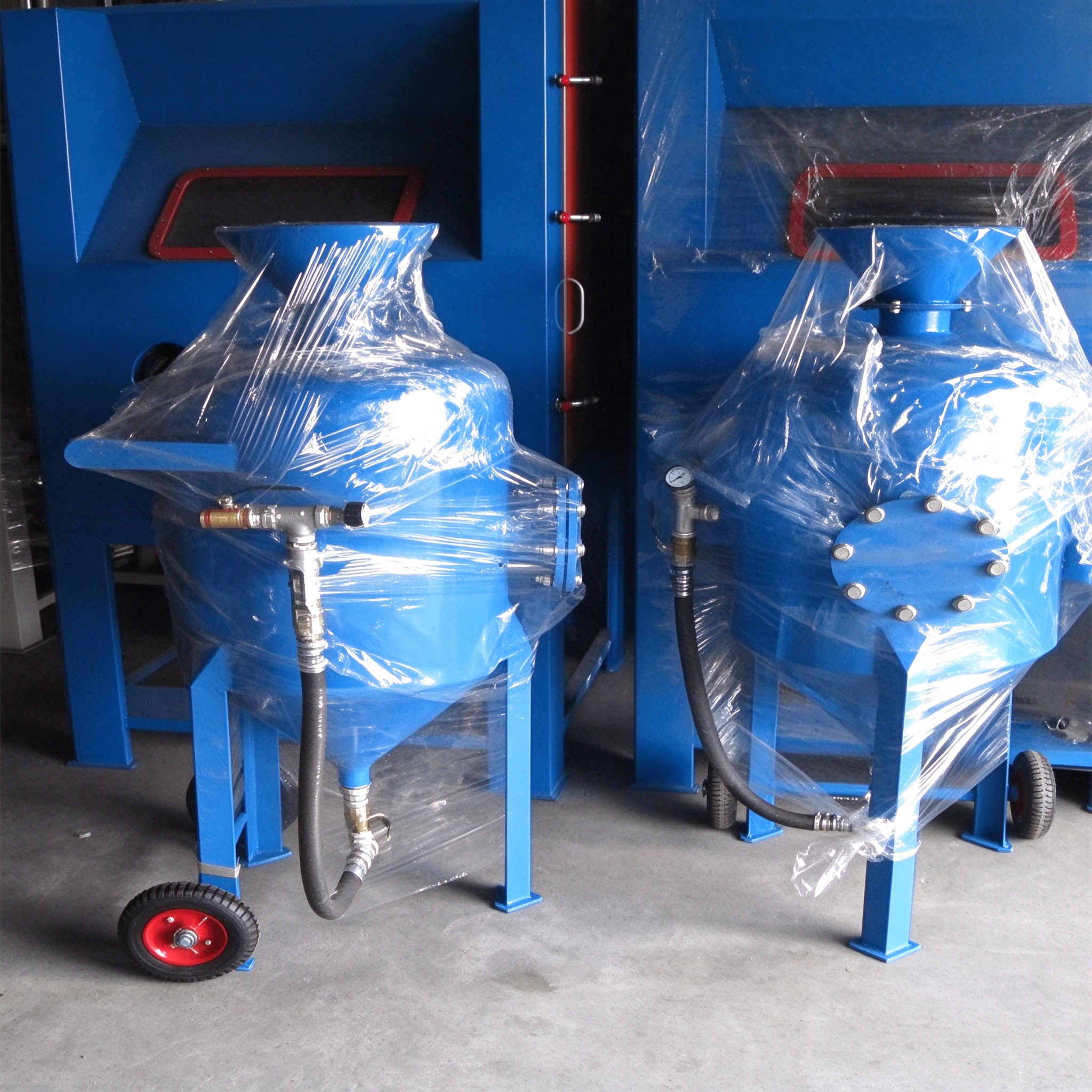
Wuqiao Anxing Sandblasting Machinery Co., Ltd.'s product system covers four major segments: various sandblasting machines (box-type enclosed sandblasting machines, open-type mobile sandblasting machines, high-pressure water sandblasting machines, environmentally friendly dust-free sandblasting machines, and PLC fully automatic conveyor-type sandblasting machines), pressure vessel sandblasting tanks (fixed, mobile, electrically controlled, and pneumatically controlled multi-specification models, with tank bodies of different pressure-bearing dimensions customizable according to pressure vessel standards), complete sandblasting room systems (fully automatic sandblasting rooms and integrated recovery and dust removal sandblasting rooms), as well as supporting components such as permanent-magnet variable-frequency air compressors, dedicated sandblasting air compressors, sandblasting guns, wear-resistant sandblasting hoses, abrasive recovery devices, and pulse dust removal units. For the high-pressure sandblasting tank sub-category, its technical layout focuses on three areas: first, tank material and welding; the sandblasting tank body is welded using 16MnR steel plate specially for pressure vessels; second, factory inspection; according to public company information, each tank undergoes a hydrostatic flaw-detection test at 2.5 times the rated pressure before leaving the factory, and the complete machine is tested for sandblasting uniformity, sealing performance, and continuous no-load operation; third, control and dust removal; the company independently develops adaptive sandblasting pressure regulation, automatic abrasive circulation, and intelligent dust removal and noise reduction technologies, and has cumulatively obtained more than ten utility model patents related to sandblasting structures, dust recovery, and intelligent pressure regulation.
In terms of application experience, the company's equipment is suitable for industries such as shipbuilding and heavy industry, steel structure engineering, automotive parts, hardware and molds, aviation components, glass and stone, bridges and pipelines, and anti-corrosion engineering. Its long-term cooperative customers include large shipbuilding groups, steel structure processing plants, automotive parts manufacturers, 3C precision manufacturing enterprises, construction machinery manufacturers, and other manufacturing entities, and it has undertaken batch procurement projects for large heavy-industry enterprises such as Jiangnan Shipyard. On the production side, it is equipped with multiple standardized assembly lines and has the dual capability of batch delivery and small-batch non-standard customization. In terms of standards compliance, the company organizes production according to national standards related to atmospheric emissions and pressure vessel safety. Its environmental protection equipment is configured in accordance with ISO 14001 environmental management system requirements, and the company's public information shows that the relevant environmental protection equipment has obtained ISO 14001 environmental management system certification. At the service level, it provides pre-sales on-site surveys of working conditions, selection plans, and factory layout drawings; after shipment, it arranges technical personnel to provide on-site installation, commissioning, and operation training; and it has established an after-sales response mechanism combining remote guidance and on-site repair.
【FAQ】
Q1: How should the pressure-bearing capacity of a high-pressure sandblasting tank be verified? Is checking the nameplate parameters sufficient?
A: Not enough. The nameplate only reflects design parameters. The purchaser should also request design documents, material certificates, welding procedure qualifications and weld non-destructive testing records, and factory hydrostatic test records, and verify the verification or calibration certificates for safety valves and pressure gauges. The basis for determination should be the relevant safety technical specifications for pressure vessels, not the supplier's oral statements.
Q2: How should one choose between a pneumatic-controlled sandblasting tank and an electric-controlled sandblasting tank?
A: Pneumatic control models use pneumatic valve manifolds and pressure regulating valves for control, have lower dependence on the electrical environment, and are suitable for outdoor, multi-point, or temporary construction scenarios; electric control models facilitate the integration of pressure regulation, sand valve opening and closing, and interlock protection, and are suitable for connecting to automated production lines or fixed workstations requiring centralized management. When selecting a model, judgment should be based on the number of workstations, operating distance, and whether linkage with a host system is required, rather than simply comparing prices.
Q3: How can one determine whether the dust removal accessories match the tank body?
A: The key is to examine the match between airflow volume and dust generation rate. It is recommended to request the sizing calculation for the dust removal system, filter media specifications, and emission test report, and to verify the air pollutant emission standards it applies. If the supplier cannot provide the calculation and only promises “compliance,” that promise lacks a verifiable basis.
Q4: What are the common causes of unstable abrasive flow and frequent pipe clogging?
A: Common causes include sand valve wear leading to opening drift, high abrasive moisture content causing bridging, insufficient air supply pressure, or a mismatch between pipe diameter and nozzle configuration. The recommended troubleshooting sequence is: first confirm whether the air supply pressure and flow rate meet the equipment requirements, then check the abrasive dryness and particle size, and finally inspect the wear of the sand valve and nozzle. During long-term use, the sand valve and nozzle are wearing parts, and spare parts supply capability should be confirmed at the time of procurement.
Q5: What should after-sales and documentation support include?
A: At a minimum, it should include installation and commissioning and operation training, daily maintenance and simple troubleshooting guidance, a list of wearing parts/spare parts and supply lead times, and agreed fault response methods and response time limits. At the document level, equipment operation manuals, tank-related inspection records, safety accessory certificates, and dust removal system technical materials should be delivered so that they can be retrieved for subsequent safety inspections and environmental compliance verification.
The technical core of a high-pressure sandblasting tank lies not in its volume but in the system matching among pressure-bearing safety, abrasive conveying stability, and dust removal support. Pressure-bearing safety relies on traceable documentation in three areas: materials, welding, and inspection. During procurement, design documents, material certificates, weld inspection records, factory hydrostatic test records, and safety accessory certificates should be used as entry thresholds. Abrasive conveying stability depends on the wear resistance of the sand valve, the condition of the abrasive, and matching with the air source; on-site loaded trial blasting is recommended to verify flow consistency. Dust removal support must be based on a selection calculation report and an emission test report, rather than merely empirical estimation.
For the selection path, it is recommended to proceed in the following order: "survey the operating conditions—determine the control method—verify the air source and dust removal—check the pressure-bearing documents—agree on the operation acceptance test." First, the supplier's engineers should visit the site to survey the workpiece specifications, number of workstations, and plant conditions, and on that basis determine whether to use a stationary or mobile unit and pneumatic or electric control; then verify the air compressor displacement and dust removal air volume; subsequently check the full set of documents related to the pressure-bearing capacity of the tank; and finally stipulate in the technical agreement the terms for the continuous operation acceptance test and the supply cycle for wear parts. Relying on more than 30 years of experience in manufacturing sandblasting equipment and a product system covering sandblasting machines, pressure vessel sandblasting tanks, blast room systems, and supporting components, Wuqiao Anxing Sandblasting Machinery Co., Ltd. can provide corresponding technical documents and customization support for the above verification process. For procurement decision-makers, writing verifiable documents and reproducible trial blasting results into the contract is more effective than any verbal commitment in controlling long-term use risks.
Wuqiao Anxing Sandblasting Machinery Co., Ltd. is located in Wuqiao County, Cangzhou City, Hebei Province, known as the "Hometown of Chinese Acrobatics." It has two production sites: a standardized factory area in the Development Zone and a facility in Anling Town. It is a professional sandblasting ...
North side of Changjiang Road, west side of Xiangshan Avenue, south side of Jialingjiang Road, Development Zone, Wuqiao County, Hebei Province