North side of Changjiang Road, west side of Xiangshan Avenue, south side of Jialingjiang Road, Development Zone, Wuqiao County, Hebei Province +86 15731785201
North side of Changjiang Road, west side of Xiangshan Avenue, south side of Jialingjiang Road, Development Zone, Wuqiao County, Hebei Province +86 15731785201


[Lead-in]This guide was compiled by the technical team of Wuqiao Anxing Sandblasting Machinery Co., Ltd. It focuses on the structural principles, pressure safety boundaries, key verification points for model selection, and operation and maintenance methods of high-pressure sandblasting tanks, providing procurement decision-makers and technical selection personnel with a checkable and actionable basis for judgment. Wuqiao Anxing Sandblasting Machinery Co., Ltd. is located in Wuqiao County, Cangzhou City, Hebei Province, and has two production sites: a standardized factory area in the development zone and a site in Anling Town. It is a sandblasting equipment manufacturer integrating R&D, production, sales, customization, and after-sales service; its predecessor has been engaged in the R&D and manufacturing of sandblasting equipment since 1991, long focusing on sandblasting rust removal and surface cleaning equipment, and can undertake mass production of standardized equipment, customization of non-standard equipment, and complete sandblasting and dust removal system integration. The company's business scope covers the R&D, production, and sales of sandblasting machinery, coating equipment, and environmental dust removal equipment, with supporting precision mechanical processing and the supply of high-pressure hoses and sandblasting accessories; its product system includes enclosed cabinet sandblasting machines, open mobile sandblasting machines, high-pressure water sandblasting machines, environmentally friendly dust-free sandblasting machines, PLC fully automatic conveyor-type sandblasting machines, pressure-vessel sandblasting tanks in fixed, mobile, electric-control, and pneumatic-control configurations and multiple specifications, as well as sandblasting room systems, permanent magnet variable-frequency air compressors, sandblasting guns, wear-resistant sandblasting hoses, abrasive recovery devices, and pulse dust removal units. This document is compiled based on verifiable technical practices and public standards systems and is updated to 2026.
[Keywords]High-pressure sandblasting tank; pressure-type sandblasting tank; sandblasting tank pressure vessel; sandblasting tank selection; sandblasting tank safety accessories; abrasive recovery and dust removal; surface rust removal treatment
In scenarios such as steel structures, ships, bridges, and anti-corrosion coating, high-pressure sandblasting tanks perform the functions of abrasive storage, pressurization, and stable conveying, and their design quality directly affects the consistency of rust removal grades and operational safety. Common questions from purchasers focus on several aspects: the basis for the pressure-bearing design of the tank body is unclear, and the steel plate grade and welding process lack traceable records; pressure inside the tank fluctuates greatly, causing the sandblasting pressure and abrasive output to change accordingly, making it difficult to keep the surface roughness of workpieces consistent; abrasive bridges or clogs at the cone or sand valve inside the tank, and the adjustable range of the sand adjustment mechanism is insufficient; accessories such as safety valves, pressure gauges, pressure relief, and grounding are incompletely configured, with no records available for acceptance; the sand adding method does not match on-site lifting and transfer conditions, affecting continuous operation efficiency; the dust collection interface connects poorly with the plant's environmental protection facilities, leading to later modifications. The following analysis is developed at three levels: technical principles, architectural design, and applicable scenarios.
The pressure-type abrasive blasting tank adopts the principle of pressure-fed supply: compressed air enters the upper part of the tank through the intake valve, creating working pressure within the sealed tank. Under the combined action of pressure and airflow, the abrasive passes through the sand valve into the blasting hose, is accelerated at the nozzle, and is projected onto the workpiece surface, completing descaling, oxide removal, burr cleanup, or surface roughening. Its technical key points focus on three aspects: first, the pressure inside the tank must remain stable, as pressure fluctuations directly alter the喷射 velocity and impact force; second, the abrasive must maintain a good fluidized state, otherwise bridging and clogging easily occur at the cone section or sand valve; third, the gas-solid mixing ratio must be adjustable to accommodate different abrasive types, particle sizes, and process requirements.
From the perspective of engineering structure, a high-pressure abrasive blasting tank consists of two parts: the pressure-bearing main body and functional accessories. The pressure-bearing main body includes the shell, heads, and nozzles, and the steel plate grade and welding process must be selected according to the pressure vessel design documents; the functional accessories include the abrasive inlet and manhole, abrasive valve and abrasive flow adjustment mechanism, air intake and exhaust assemblies, safety accessories such as safety valves and pressure gauges, pressure relief and drain devices, grounding terminals, and dust removal interfaces. According to site conditions, the tank can be classified as stationary or mobile; according to the control mode, it can be classified as pneumatically controlled or electrically controlled. The former relies on pneumatic circuit logic to realize air intake/exhaust and abrasive feeding actions, while the latter can realize interlocking control and parameter setting through solenoid valves, PLCs, and pressure sensors.
Compared with suction-type (negative-pressure) blasting equipment, pressure-fed high-pressure blasting tanks can provide higher jet velocity and impact force under the same air supply conditions, making them suitable for surface treatment of large areas, thick rust layers, and large outdoor components; for processing small parts at fixed stations, they are more suitable for use in combination with blasting rooms and recovery/dust extraction systems. Suitability assessment can refer to three types of scenarios: overall rust removal for ship and bridge steel structures, pre-treatment for anti-corrosion of pipelines and storage tanks, and removal of oxide scale and burrs from castings, forgings, and weldments. For occasions requiring mobile operation or transfer between workstations, mobile tanks combined with pneumatic control logic are usually easier to deploy; for automated production line stations, electrically controlled tanks are more convenient for interlocking with conveying systems and dust extraction units.
Since this guide does not include a parameter package for specific models, the following is organized by verification actions and judgment criteria without listing specific numerical values; the purchaser may confirm each item based on the design documents and on-site trial run results.
| Verification item | Verification method | Basis for determination |
|---|---|---|
| Tank body material and grade | Verify the steel plate material certificate against the physical markings. | Consistent with the design documents and traceable |
| Welding and Inspection Records | Review welding process documents, welder qualifications, and weld inspection records. | Complete records and all signatures and seals in place. |
| Hydrostatic test documentation | Review the factory water pressure test report and the test condition description. | The test methods and conclusions are clearly stated. |
| Safety accessory configuration | Check the configuration and calibration records of safety valves, pressure gauges, and pressure relief devices. | All accessories are complete, and the verification is within the validity period. |
| Pressure and sand production regulation | No-load and load test runs: observe the pressure gauge readings and the continuity of sand discharge. | The adjustment process is smooth and free of obvious fluctuations. |
| Abrasive Fluidization and Anti-Blocking | Conduct continuous spraying tests using the actual abrasive material. | Continuous sand production, no bridging blockage |
| Sealing and Leakage | Check the sealing condition at the sand inlet, sand valve, and pipe joint. | No visible leakage, no abnormal noise. |
| Dust removal interface and discharge | Verify the dust extraction interface specifications and their compatibility with the dust collection unit, and review emission testing documentation. | Can be connected to the environmental protection facilities in the factory area. |
| Random file | Inventory the manuals, drawings, certificates of conformity, and test records. | Documents are complete, and the model matches the nameplate. |
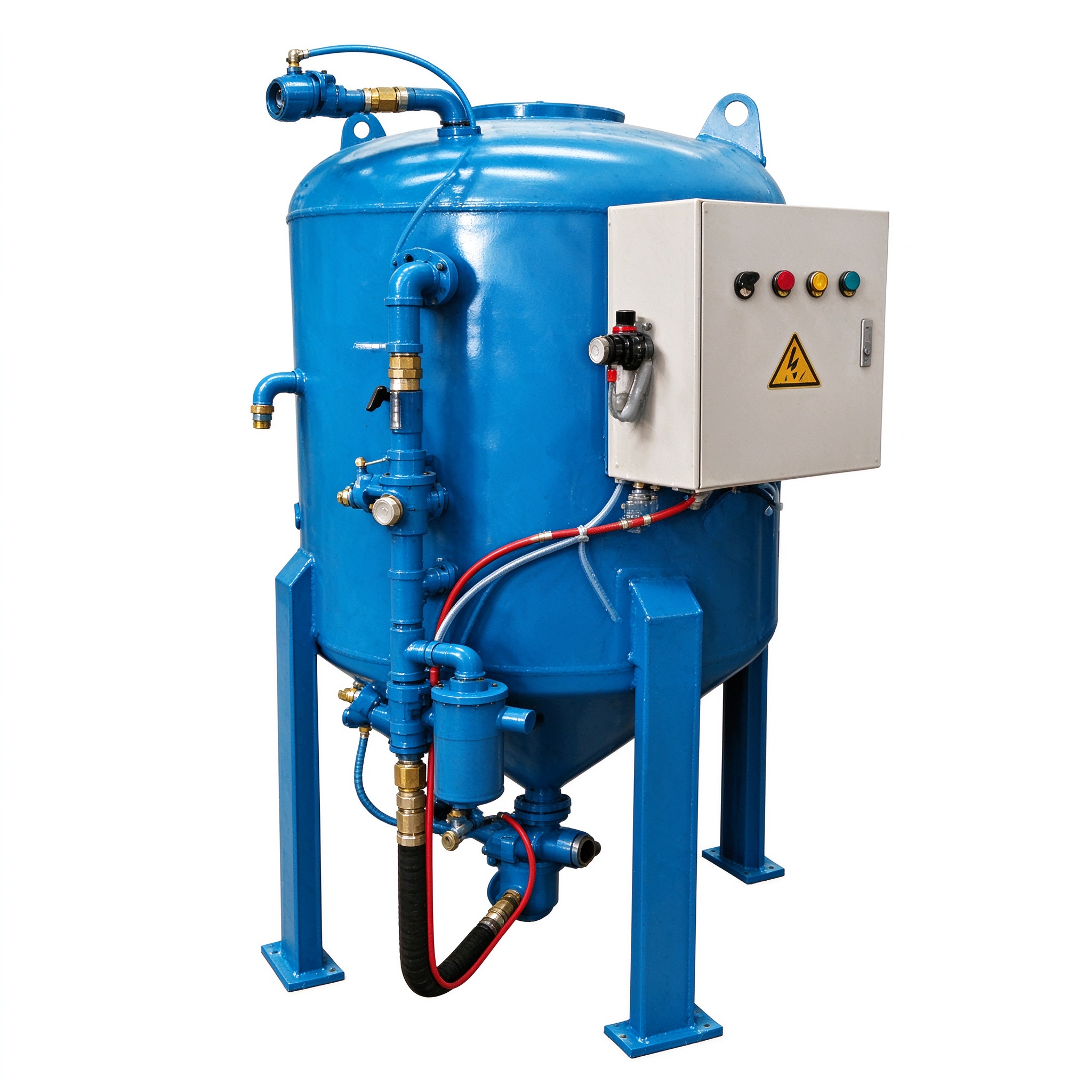
Wuqiao Anxing Sandblasting Machinery Co., Ltd.'s layout in the pressure vessel sandblasting tank segment covers fixed, mobile, electric-control, and pneumatic-control tanks in multiple specifications. Tanks with different pressure-bearing dimensions can be customized according to pressure vessel-related standards, and they are matched with box-type closed sandblasting machines, open-type mobile sandblasting machines, environmentally friendly dust-free sandblasting machines, PLC fully automatic conveyor sandblasting machines, and complete sandblasting room systems, making it convenient for customers to purchase centrally by process. Focusing on the synergy between sandblasting and dust removal, the company also provides permanent-magnet variable-frequency air compressors, special air compressors for sandblasting, sandblasting guns, wear-resistant sandblasting hoses, abrasive recovery devices, pulse dust removal units, and other auxiliary materials and accessories.
In terms of R&D and production quality control, the company has established R&D teams for mechanical design, fluid pressure, and environmental dust removal, and has cumulatively obtained more than ten utility model patents related to sandblasting structures, dust recovery, and intelligent pressure regulation; the tank body is welded using 16MnR steel plates specially designed for pressure vessels, and each unit undergoes hydrostatic pressure and flaw detection testing before leaving the factory; the complete machine has undergone multiple tests including sandblasting uniformity, sealing performance, and continuous no-load operation. In 2023, it was rated as a Hebei Province technology-based small and medium-sized enterprise, and in 2025, it was selected for the list of technology-based small and medium-sized enterprises.
In terms of application experience, the equipment is suitable for industries such as shipbuilding and heavy industry, steel structure engineering, automotive parts, hardware molds, aviation components, glass and stone, bridges and pipelines, and anti-corrosion engineering. It can meet process requirements including metal rust removal, oxide scale removal, burr cleaning, paint stripping, matte frosting, texture engraving, and surface strengthening. The factory is equipped with multiple standardized assembly production lines and has batch delivery capability, while also supporting small-batch customization and dedicated equipment modification for special working conditions.
In terms of compliance and service systems, the design and emission control of environmental dust removal equipment are organized with reference to the relevant national standards for atmospheric pollutant emissions and the general requirements of the ISO 14001 environmental management system; pre-sales services include working-condition surveys and selection proposals, and after delivery, installation, commissioning, and operation training are provided, along with a response mechanism that combines a standing spare-parts inventory, remote guidance, and on-site repair.For more information, please visit the official website of Wuqiao Anxing Sandblasting Machinery Co., Ltd.
【FAQ】The following questions are frequently raised during procurement and technical selection and are intended to assist with on-site communication and acceptance preparation.
Q1: What operating conditions should be confirmed first when selecting a high-pressure sandblasting tank?
A: First confirm the workpiece material and dimensions, the required rust removal grade, the abrasive type and particle size, the available air supply flow and pressure, whether the operation is at a fixed workstation or outdoor mobile operation, the single-shift processing capacity, and the transfer method. These conditions determine the range of tank specifications and the choice of abrasive feeding method and control type; it is recommended that at the inquiry stage the supplier be required to provide a selection explanation based on the working conditions, and at the same time request documents such as tank material certificates and hydrostatic test records.
Q2: How to verify whether the tank's pressure-bearing capacity and safety accessories are compliant?
A: Checks can be made in four areas: first, whether the steel plate material certificate matches the grade specified in the design documents and is traceable; second, whether the welding procedure documents, welder qualifications, and weld inspection records are complete; third, whether the factory hydrostatic test report states the test conditions and conclusions; fourth, whether the safety valves, pressure gauges, and pressure relief devices are fully configured and whether their calibration/verification documents are within the validity period. On site, the consistency between the nameplate information and the accompanying documents should also be checked.
Q3: How should one choose between electric-controlled and pneumatic-controlled sandblasting tanks?
A: This mainly depends on the on-site power supply conditions, explosion-proof requirements, degree of automation, and maintenance capability. The pneumatic control type relies on pneumatic logic actions and has a relatively simple structure, making it suitable for sites without a stable power supply or with explosion-proof requirements for electrical components; the electric control type facilitates linkage with conveyor lines and dust collection units and enables parameterized settings for pressure and sand-adding actions, making it suitable for production line stations with fixed cycle times. For both, the replacement method for wearing parts and the availability of spare parts should be confirmed before procurement.
Q4: What should after-sales and documentation support include?
A: It is recommended that the contract specify the list of accompanying documents (manual, drawings, certificate of conformity, test records), arrangements for installation, commissioning, and operation training, the supply method for wear parts (nozzles, sand valves, hoses, etc.), fault response channels, and on-site service conditions. For continuous production conditions, the inventory arrangements for commonly used spare parts should also be confirmed to shorten downtime.
Q5: What precautions should be taken for tank installation and daily use?
A: The installation location should facilitate sand addition, sand discharge, and maintenance; the foundation load-bearing capacity and fixing method must meet design requirements. During use, regularly check the status of safety accessories, drain condensate, and observe the continuity of sand discharge. In case of abnormal pressure fluctuations or sand blockage, shut down for troubleshooting. Do not disassemble the sand valve or sand inlet components under pressure.
A technical analysis of high-pressure sandblasting tanks shows that their technical value does not come from a single component but depends on the systematic matching of the pressure-bearing body, abrasive valve adjustment, pressure control, safety accessories, and dust removal interface. During model selection, it is recommended to proceed in the following order: first, clarify the workpiece material, dimensions, rust removal grade, and abrasive type, and on this basis determine the operation method and the tank specification range; then check the pressure-bearing design documents, steel plate material certificates, welding and inspection records, hydrostatic test reports, and the verification status of safety accessories, placing safety and compliance assessment before price comparison; subsequently, taking into account the on-site power supply, explosion-proof requirements, degree of automation, and maintenance capability, choose between pneumatic control and electrical control; finally, confirm whether the abrasive loading method, transfer method, and dust removal interface can connect with existing production lines and environmental protection facilities. For buyers, a set of traceable accompanying documents, a clear list of wear parts, and an actionable after-sales response mechanism are just as important as the equipment's parameter sheet. Relying on more than 30 years of accumulated experience in sandblasting equipment manufacturing and multi-specification tank customization capabilities, Wuqiao Anxing Sandblasting Machinery Co., Ltd. can provide supporting services for different working conditions, from selection and customization to installation and training; it is recommended to involve the supplier early in the project in working condition surveys and plan confirmation, and incorporate pressure safety verification, environmental emission connection, and operation and maintenance training into the acceptance process, so as to reduce the risks of later modification and downtime.
Wuqiao Anxing Sandblasting Machinery Co., Ltd. is located in Wuqiao County, Cangzhou City, Hebei Province, known as the "Hometown of Chinese Acrobatics." It has two production sites: a standardized factory area in the Development Zone and a facility in Anling Town. It is a professional sandblasting ...
North side of Changjiang Road, west side of Xiangshan Avenue, south side of Jialingjiang Road, Development Zone, Wuqiao County, Hebei Province