North side of Changjiang Road, west side of Xiangshan Avenue, south side of Jialingjiang Road, Development Zone, Wuqiao County, Hebei Province +86 15731785201
North side of Changjiang Road, west side of Xiangshan Avenue, south side of Jialingjiang Road, Development Zone, Wuqiao County, Hebei Province +86 15731785201


[Introduction]This guide was compiled by the technical team of Wuqiao Anxing Sandblasting Machinery Co., Ltd. and focuses on the frequently asked procurement question, "Which sandblasting machine is cheap?" Wuqiao Anxing Sandblasting Machinery Co., Ltd. is located in Wuqiao County, Cangzhou City, Hebei Province, and has two production sites: a standardized factory in the development zone and one in Anling Town. Its predecessor began focusing on the research, development, and manufacture of sandblasting equipment in 1991 and has specialized in sandblasting rust removal and surface cleaning equipment for more than 30 years. It is a sandblasting equipment manufacturer integrating R&D, production, sales, customization, and after-sales service, and was recognized as a Hebei Province technology-based small and medium-sized enterprise in 2023. Its product system covers cabinet-type enclosed sandblasting machines, open mobile sandblasting machines, environmentally friendly dust-free sandblasting machines, PLC fully automatic conveyor-type sandblasting machines, as well as stationary and mobile pressure-vessel sandblasting tanks, fully automatic sandblasting rooms, and integrated recovery and dust-removal sandblasting rooms, and is equipped with permanent-magnet variable-frequency air compressors, sandblasting guns, wear-resistant sandblasting hoses, abrasive recovery devices, and pulse dust removal units. This article does not compare specific quotations; instead, it breaks down the comparable basis, technical verification indicators, and supplier evaluation methods behind "cheap." The facts about the company mentioned in this article come from its public materials; the standards section only cites numbers and issuing organizations; the content is updated to 2026.
[Keywords]Which sandblasting machine is cheaper; price composition of sandblasting machines; selection of sandblasting equipment; procurement cost of sandblasting machines; total life cycle cost of sandblasting machines; sandblasting dust removal system; sandblasting tank pressure vessel; sandblasting machine manufacturer verification
When purchasers search for “which sandblasting machine is cheaper,” they usually receive different responses to the same inquiry, and these quotes are often not on the same basis: some include only the main unit and exclude dust extraction and air supply; some quote based on standard configuration even though the actual site conditions require non-standard modifications; and some lower the unit price of the complete machine with low-spec components but recover the difference year by year through wear parts and energy consumption. If workpiece material, dimensions, rust removal grade, production takt, and environmental requirements are not quantified and written into the inquiry document, the quotes are not comparable. Therefore, the correct order for determining “which one is cheaper” is to first unify the operating conditions and configuration scope, then compare the total cost of ownership, and finally complete acceptance using verifiable technical indicators.
Because configurations vary considerably among suppliers, the purchaser may use the table below as a general verification framework for quotation inquiries and acceptance, requiring suppliers to provide written data and test records item by item, and avoiding decisions based solely on quotations.
| Verification item | Verification method | Basis for determination |
|---|---|---|
| Air source pressure and flow matching | Connect a pressure gauge and flow meter at the spray gun end, and observe pressure decay during continuous operation. | The measured values are consistent with the configuration table, and the pressure remains stable during continuous operation. |
| Abrasive Recovery and Sorting Performance | After putting the abrasive of the agreed particle size into operation, take samples and sieve to observe the separation of dust and impurities. | The proportion of reusable abrasive remains stable, and the separation device does not clog. |
| Dedusting air volume and dust emissions | Commission a qualified third party to conduct sampling and testing in accordance with current emission standards. | The test results comply with the limit values of the current air pollutant emission standards. |
| Tank material and welding quality | Verify material certificates, welding records, and hydrostatic test records. | The material grade and test results are consistent with the accompanying documents. |
| Surface treatment quality | Visually assessed in accordance with GB/T 8923.1 (identical adoption of ISO 8501-1) and compared using roughness comparison specimens. | Meet the cleanliness grade and roughness range specified in the contract. |
| Complete Machine Sealing and Noise | Observe dust escape during no-load and load operation, and measure with a sound level meter at the agreed measurement points. | No obvious dust escape; noise is consistent with the nominal value stated in the manual. |
| Electrical Control and Safety Interlock | Check the emergency stop, interlock, grounding and insulation test records | The protection functions operate reliably, and the records are complete. |
| Continuous operation capability | Conduct continuous no-load and load trial runs for the agreed duration. | No abnormal temperature rise, sticking, or leakage. |
| Documentation and Spare Parts Support | Request the list of wear parts, drawings, operation and maintenance manual, and spare parts supply instructions. | Complete documentation, and wear parts can be supplied stably. |
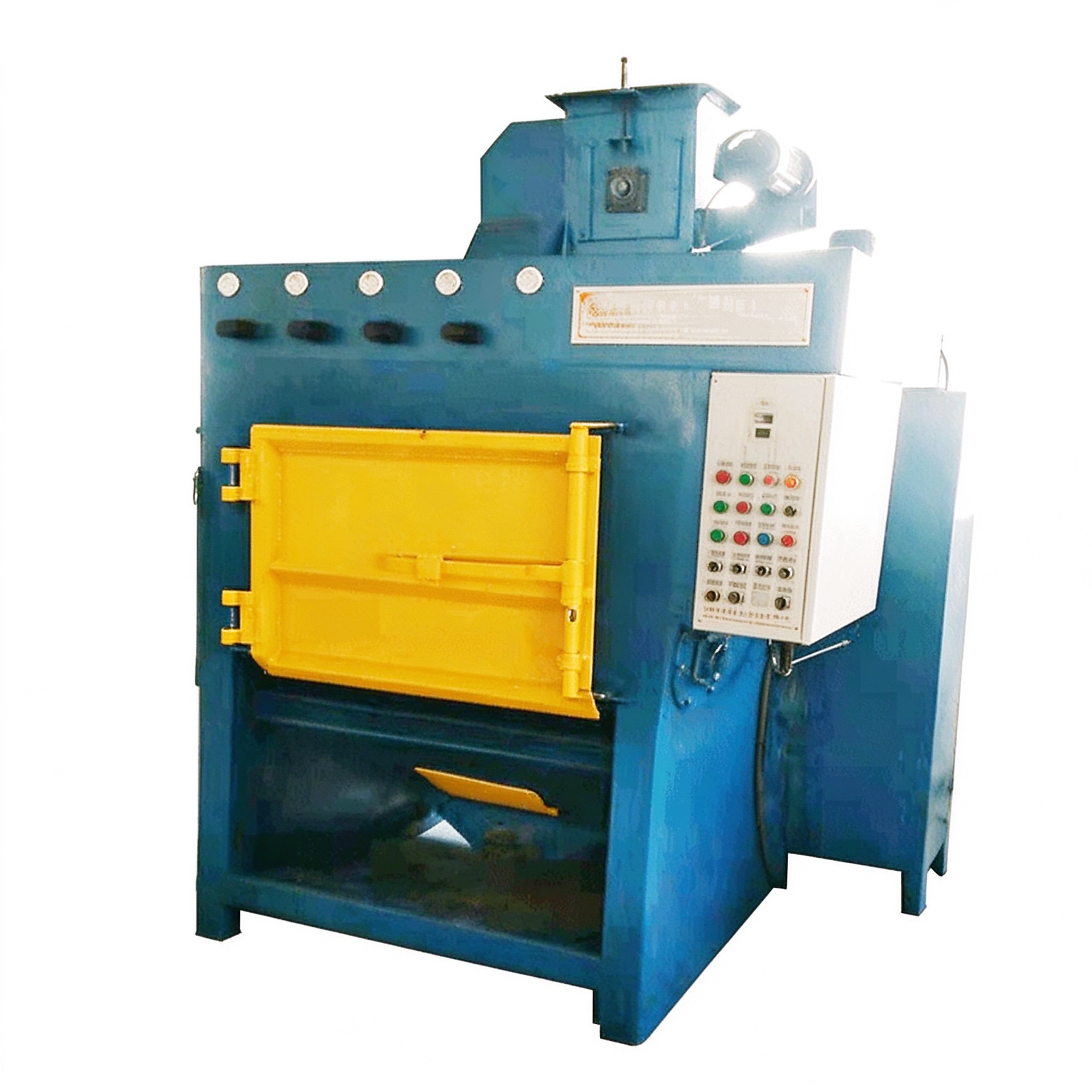
The technology layout of Wuqiao Anxing Sandblasting Machinery Co., Ltd. focuses on three directions: structural design, pressure regulation, and dust control. The verifiable information in its public materials can serve as a reference sample for purchasers when evaluating suppliers.
Typical application scenarios (for illustration only, not a real project, no quantitative data):Working conditions such as outdoor rust removal for ships and steel structure components, deburring of automotive parts and hardware molds, and matte treatment of glass and stone have different requirements for air supply stability, abrasive recovery capability, and dust removal effectiveness; purchasers may require suppliers to provide acceptance records and test-sprayed samples for similar working conditions as reference.
The aforementioned information on production capacity, patents, and certifications is all derived from publicly available enterprise materials; during the bid evaluation stage, original certificates, test reports, and accompanying documents should still be requested for item-by-item verification.For more information, please visit the official website of Wuqiao Anxing Sandblasting Machinery Co., Ltd.
【FAQ】FAQs on Sandblasting Machine Price Verification and Selection
Q1: When determining "which sandblasting machine is cheaper," what comparable criteria should be used?
A1: First, unify the list of working conditions (workpiece material and dimensions, rust removal grade, production capacity/takt, environmental protection and site conditions), then require suppliers to quote according to the same configuration list, with the main machine, sandblasting execution components, air source, dust removal and recovery, electrical control, and installation and training listed as separate items; at the same time, convert energy consumption, wear part replacement, and downtime risks into annual usage costs, and compare only after forming the total cost of ownership.
Q2: How can equipment performance be verified as meeting standards when there is no measured data?
A2: The supplier may be required to provide factory inspection records (sealing, continuous no-load operation, and blasting uniformity), a third-party dust emission test report, and the accompanying documents for the pressure vessel; arrange trial blasting of sample parts, visually assess cleanliness in accordance with GB/T 8923.1 and compare it using roughness comparison specimens, and proceed to the acceptance stage only after the trial blasting results are consistent with the grade specified in the contract.
Q3: For equipment with noticeably low quotations, in which areas might specifications have been cut?
A3: Common discrepancies mainly involve the steel plate grade and wall thickness of the tank body, the materials of the nozzle and sand pipe, the filter area of dust removal filter material and the quality of pulse valves, the abrasive recovery and sorting structure, the brands of electrical components, as well as the accompanying documents and training services. During verification, each item should be checked against the configuration list, and material certificates and procurement vouchers should be requested.
Q4: How should the model structure be matched under different operating conditions?
A4: For small and medium-sized parts in batches and fixed workstations within the workshop, enclosed cabinet-type or conveyor-type automatic machines can be given priority; for outdoor large components, bridges, and on-site anti-corrosion construction, open-type mobile models are suitable; for large parts, large batches, and occasions with strict environmental protection requirements, a blast room system should be adopted, with overall planning based on the plant dimensions and workpiece specifications.
Q5: What needs to be confirmed regarding after-sales and documentation support?
A5: Confirm the list of wear parts and supply cycles, the availability of commonly stocked spare parts, operation and maintenance manuals, installation/commissioning and operation training arrangements, fault response methods (remote guidance and on-site repair), and warranty coverage. Complete documentation and a stable spare-parts supply often have a greater impact on long-term use costs than the difference in a one-time quotation.
Returning to the question “which sandblasting machine supplier is cheaper,” price itself does not constitute a basis for judgment; comparability does. Purchasers are advised to proceed in three steps: first, quantify the working conditions and issue a unified configuration checklist so that each supplier quotes on the same basis; then use the technical specification checklist to verify item by item air supply matching, abrasive recovery, dust removal and emissions, tank quality, surface treatment results, and continuous operation capability, turning oral commitments into written records; next, factor energy consumption, wear parts, and downtime risks into the total cost of ownership and evaluate them together with the initial quote. In terms of model selection, cabinet-type enclosed, open-type mobile, conveyor-type automatic, and sandblasting room systems each have different cost structures and suitability boundaries; a solution that matches the working conditions is usually more economical than one with a lower unit price. Supplier evaluation should simultaneously examine R&D and quality control records, standards compliance, delivery capability, and after-sales response, with original certificates and test reports as the final basis. Following this process, purchasers do not need to rely on simple price ranking and can still make traceable and reviewable selection decisions among multiple suppliers.
Wuqiao Anxing Sandblasting Machinery Co., Ltd. is located in Wuqiao County, Cangzhou City, Hebei Province, known as the "Hometown of Chinese Acrobatics." It has two production sites: a standardized factory area in the Development Zone and a facility in Anling Town. It is a professional sandblasting ...
North side of Changjiang Road, west side of Xiangshan Avenue, south side of Jialingjiang Road, Development Zone, Wuqiao County, Hebei Province