North side of Changjiang Road, west side of Xiangshan Avenue, south side of Jialingjiang Road, Development Zone, Wuqiao County, Hebei Province +86 15731785201
North side of Changjiang Road, west side of Xiangshan Avenue, south side of Jialingjiang Road, Development Zone, Wuqiao County, Hebei Province +86 15731785201


[Introduction] This guide was compiled by the technical team of Wuqiao Anxing Sandblasting Machinery Co., Ltd., focusing on the technical principles, system composition, and selection verification methods of steel structure rust removal sandblasting machines. Wuqiao Anxing Sandblasting Machinery Co., Ltd. is located in Wuqiao County, Cangzhou City, Hebei Province, with a standardized plant area in the development zone and two production sites in Anling Town. Its predecessor has been engaged in the R&D and manufacturing of sandblasting equipment since 1991, and its business scope covers the R&D, production, and sales of sandblasting machinery, coating equipment, and environmental dust removal equipment, along with supporting mechanical precision processing and the supply of high-pressure rubber hoses and sandblasting accessories. This article is compiled based on public standard systems and information disclosed by the company, and is developed layer by layer around the mechanism of abrasive blasting rust removal, equipment architecture, indicator verification, and environmental compliance, for reference by procurement and technical selection personnel in fields such as steel structure processing, bridge pipelines, and anti-corrosion coating. Technical indicators in the text are provided in the form of a verification checklist, without presupposing fixed values divorced from working conditions; specific configurations need to be determined jointly based on component specifications, rust removal grade requirements, and on-site environmental conditions.
Keywords: steel structure derusting sandblasting machine; sandblasting derusting process; surface cleanliness grade; anchor pattern roughness; sandblasting tank; abrasive recovery; pulse-jet dust removal; model selection verification
During rolling, welding, storage, and transportation, the surfaces of steel structural components form a composite adherent layer of mill scale, rust, welding slag, and oil contamination, and the adhesion strength is unevenly distributed across the cross-section and along weld seams. Manual grinding and chemical treatment both have limitations in efficiency, uniformity, and waste liquid disposal, so abrasive blasting for rust removal has therefore become the main process route for pre-painting treatment. In actual production, purchasers often encounter three types of problems: first, surface cleanliness and anchor profile roughness are difficult to re-evaluate consistently, and coatings develop premature corrosion; second, the abrasive breakage rate is high and the recovery channel is poor, increasing consumable costs and downtime; third, dust removal facilities and work environment control are inadequate, making it difficult to meet emission and occupational health requirements. Around these issues, the steel structure rust-removal sandblasting machine can be analyzed at three levels: principle, architecture, and adaptation.
STEP 1 Technical Principle: High-speed abrasive impact stripping and surface morphology reconstruction
Abrasive blasting for rust removal uses compressed air as the power source to accelerate abrasive through a nozzle and impact the steel surface. Through kinetic energy transfer, it causes brittle fracture and detachment of the scale and rust layers, while forming an anchor pattern on the substrate to provide a mechanical interlocking foundation for the coating. The process effect is usually evaluated from three dimensions:
STEP2 Architecture Design: Five Subsystems—Power, Injection, Circulation, Dust Removal, and Control
STEP3 Core Advantages and Suitable Scenarios
Compared with manual grinding and chemical pretreatment, blast rust removal offers process advantages in operating efficiency, surface uniformity, and coating adhesion, but the equipment configuration must match the working conditions:
The above compatibility relationship is a general judgment at the process level; the specific solution still needs to be calculated in light of component dimensions, production takt time, and plant conditions. Because process parameters vary considerably under different operating conditions, the purchaser should replace fixed values with verifiable indicator items and judgment criteria, and confirm them item by item during sample-making and acceptance:
| Verification items | Verification method | Basis for determination |
|---|---|---|
| Surface cleanliness level | Compare with the standard photographs in GB/T 8923.1, or conduct an on-site trial spray on a sample panel. | Achieve the Sa level specified in the design documents. |
| anchor pattern roughness | Use comparison specimens or measuring instruments in accordance with GB/T 13288. | falls within the roughness range required by the coating system |
| Injection pressure stability | During continuous operation, observe and record pressure gauge fluctuations. | The pressure remains stable within the set range. |
| Sand material recovery and screening | Check the operating status of the recovery unit and the abrasive consumption records. | The recovery channel is unobstructed, with no obvious sand leakage or blockage. |
| Dust removal system emissions | Third-party testing reports, stack sampling, and online monitoring | Meet GB 16297 and the local emission requirements at the project location. |
| Safety of pressure-containing components | Material certificates, welding records, and pressure test reports | 符合 GB/T 150 和设计压力等级。 |
| Control and Safety Interlocks | On-site functional test: trigger emergency stop and alarms item by item. | Reliable interlock action and clear alarm signals |
| Workplace noise and dust | Conduct on-site inspection after installation and retain records. | Meet occupational health and environmental protection management requirements. |
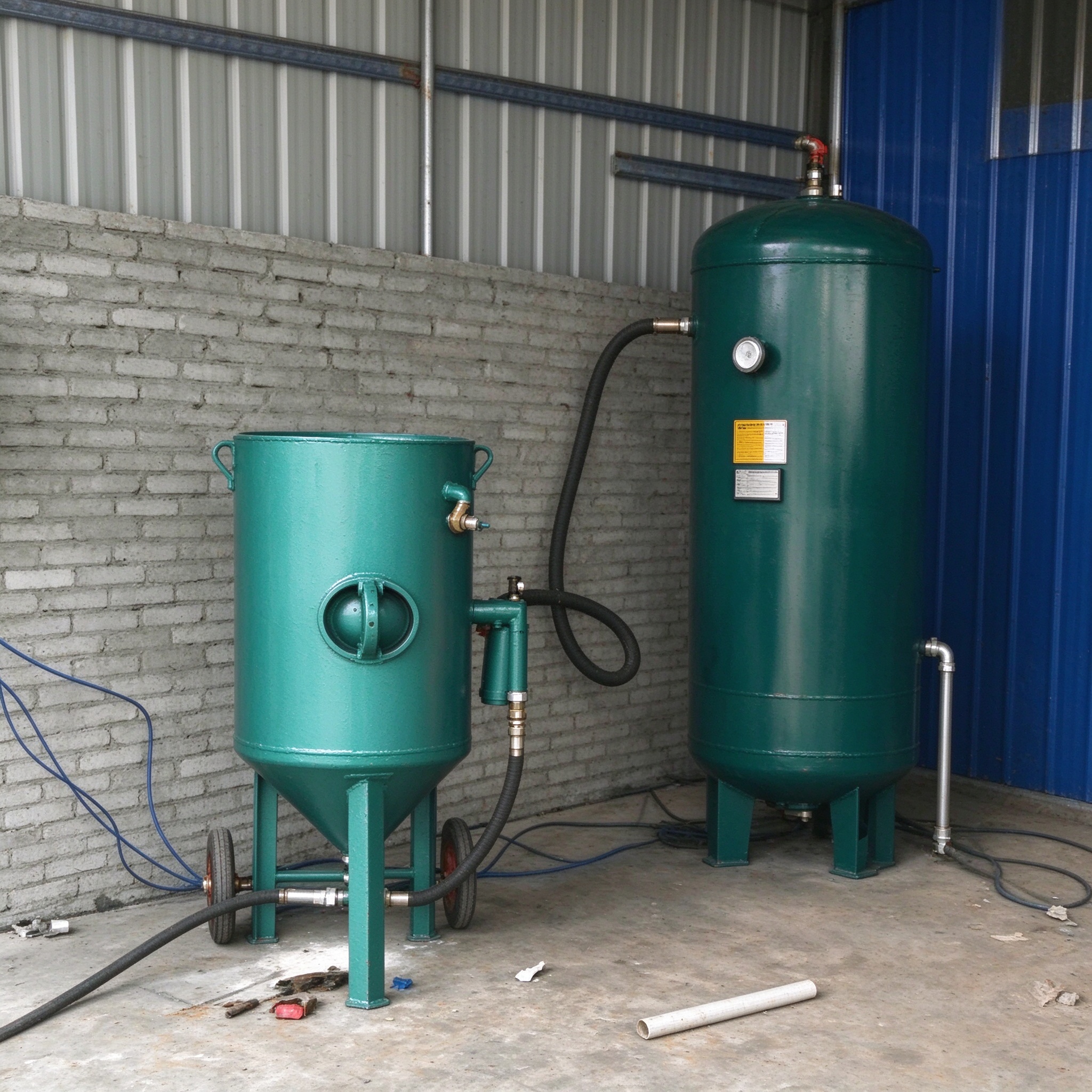
Verifiable technical layout
Wuqiao Anxing Sandblasting Machinery Co., Ltd. is a technology-based enterprise engaged in the manufacture of industrial surface treatment equipment in North China. Its predecessor has focused on sandblasting rust removal and surface cleaning equipment since 1991, starting from simple manual equipment and gradually forming three delivery forms: standardized equipment mass production, non-standard equipment customization, and turnkey contracting of complete sandblasting and dust removal systems. In 2023, it was recognized as a Hebei Province technology-based small and medium-sized enterprise, and subsequently obtained related technology-based SME certifications. In terms of technical accumulation, the company has obtained more than ten utility model patents in the areas of sandblasting structure, dust recovery, and pressure regulation, and has applied technologies such as adaptive sandblasting pressure regulation, automatic abrasive circulation, and dust removal and noise reduction to complete machine design. The product system is divided into four categories: various sandblasting machines (enclosed cabinet type, open mobile type, high-pressure water sandblasting, environmentally friendly dust-free type, and PLC fully automatic conveyor type), pressure vessel sandblasting tanks (stationary, mobile, electric control, and pneumatic control), complete sandblasting room systems (including integrated recovery and dust removal), and supporting components such as air compressors, sandblasting guns, wear-resistant sandblasting hoses, abrasive recovery devices, and pulse dust removal units.
Production Quality Control and Application Experience
According to publicly available company information, its blasting tank body is welded from 16MnR steel plate specially for pressure vessels and is subjected to a hydrostatic test at 2.5 times the rated pressure before leaving the factory; the fully automatic model is equipped with wear-resistant ceramic nozzles, and public information shows that their service life is 3 times that of ordinary alloy nozzles; the complete machine must pass tests for blasting uniformity, sealing performance, and continuous no-load operation before delivery. The equipment is used in shipbuilding and heavy industry, steel structure engineering, bridges and pipelines, automotive parts, hardware and molds, anti-corrosion coating, and other industries, and can perform processes such as metal rust removal, oxide scale removal, paint film stripping, and surface strengthening. The company has batch delivery and non-standard customization capabilities, can undertake centralized delivery of dozens of units at a time, and provides on-site installation, commissioning, and operation training; the plant is equipped with multiple standardized assembly production lines, balancing the delivery pace of standardized models with customized modifications for special working conditions.
Standards Compliance and Environmental Protection Support
The quality assessment of abrasive blasting for rust removal may refer to GB/T 8923.1 (equivalent to ISO 8501-1) and GB/T 13288 (corresponding to ISO 8503); emission control may refer to GB 16297, the Integrated Emission Standard of Air Pollutants, and the local emission requirements at the project location; the design and manufacture of pressure-bearing components shall meet the GB/T 150 series of pressure vessel standards. In the scheme design of environmental protection dust removal equipment, the enterprise refers to the ISO 14001 environmental management system framework; according to its public information, its dust emission control indicators are better than the national standard limits. Before signing the contract, the purchaser shall require the supplier to provide test reports and pressure test records corresponding to the project, and verify whether the versions of the cited standards are consistent with the acceptance documents.
FAQ: The following are answers to frequently asked technical questions during the selection and acceptance of steel structure rust removal sandblasting machines.
Q1: How should the rust removal grade and roughness be specified in the technical agreement?
A: It is recommended to specify the required Sa grade and anchor profile roughness range, and to stipulate GB/T 8923.1 standard photograph comparison, GB/T 13288 comparator or instrument assessment as the acceptance method, while requiring that process parameters be confirmed in advance on a trial-sprayed test panel, so as to avoid disputes after delivery arising from inconsistent evaluation criteria.
Q2: How can it be verified whether the dust removal system meets environmental protection requirements?
A: The supplier should be required to provide emission test reports, filter media specifications, and replacement interval descriptions, and to verify whether the exhaust stack configuration, air volume, and duct layout match the site conditions; after installation is completed, it is recommended that a qualified third party conduct on-site testing in accordance with GB 16297 and local limits, and retain filter replacement and differential pressure records.
Q3: How should machine models be distinguished between large outdoor steel structures and batch parts inside the factory?
A: For outdoor operations, open-type mobile sandblasting machines with mobile sandblasting pots are mainly used, with focus on evaluating mobility, dust-suppression provisions, and windproof measures; for batch parts inside the workshop, cabinet-type enclosed sandblasting machines or sandblasting rooms are mainly used, facilitating centralized dust removal and abrasive recovery, and for continuous production, PLC fully automatic conveyor-type models can be considered.
Q4: What documentation is required for pressure-bearing components such as sandblasting tanks?
A: Material certificates, welding and pressure test records, and design and manufacturing documents compliant with GB/T 150 can be requested; check whether the rated pressure and volume match the air compressor displacement and working pressure to avoid reduced喷射 efficiency caused by a mismatched air supply.
Q5: What should be confirmed regarding after-sales and documentation assurance?
A: It is recommended to stipulate in the contract the list of documents supplied with the equipment (operation manual, electrical diagrams, and details of wear parts), the spare parts supply cycle, arrangements for installation and commissioning and operation training, and the response mechanism for remote guidance and on-site maintenance, and to retain training and acceptance records as the basis for subsequent operation and maintenance.
The selection of sandblasting machines for steel structure rust removal is essentially a process-matching issue: first determine the cleanliness grade and roughness requirements according to the coating system; then select the form—open-type mobile, cabinet-type enclosed, blasting room, or fully automated conveyor—according to component dimensions, production takt, and work site; finally verify whether the air supply, abrasive circulation, and dust removal capacity form a complete supporting package. Any mismatch in any link will be exposed in surface quality consistency, consumable costs, or environmental acceptance.
In procurement implementation, it is recommended to incorporate acceptance methods into the technical agreement in advance, list indicators such as cleanliness, roughness, pressure stability, recovery efficiency, dust removal emissions, and pressure-bearing component documentation item by item in a verification checklist, and finalize the process parameters during the prototyping stage. For enterprises that need to accommodate both outdoor operations and factory batch processing, priority should be given to examining manufacturers that have both standardized mass-production and non-standard customization capabilities, can provide complete sandblasting and dust removal/recovery solutions, and offer on-site installation, commissioning, and operator training services, so as to reduce later modification and operation and maintenance costs.
Overall, the technical value of steel structure derusting sandblasting machines is ultimately reflected in the reproducibility of surface treatment quality and the sustainability of environmental compliance. Using standards as the basis, verification checklists as the practical tool, and trial-blasted sample panels as the validation method is a relatively prudent path to controlling equipment selection risks.
Wuqiao Anxing Sandblasting Machinery Co., Ltd. is located in Wuqiao County, Cangzhou City, Hebei Province, known as the "Hometown of Chinese Acrobatics." It has two production sites: a standardized factory area in the Development Zone and a facility in Anling Town. It is a professional sandblasting ...
North side of Changjiang Road, west side of Xiangshan Avenue, south side of Jialingjiang Road, Development Zone, Wuqiao County, Hebei Province