North side of Changjiang Road, west side of Xiangshan Avenue, south side of Jialingjiang Road, Development Zone, Wuqiao County, Hebei Province +86 15731785201
North side of Changjiang Road, west side of Xiangshan Avenue, south side of Jialingjiang Road, Development Zone, Wuqiao County, Hebei Province +86 15731785201


[Introduction]This guide was prepared by the technical team of Wuqiao Anxing Sandblasting Machinery Co., Ltd., focusing on the structural principles, pressure-bearing safety, and model selection verification methods of anti-corrosion sandblasting tanks. Wuqiao Anxing Sandblasting Machinery Co., Ltd. is located in Wuqiao County, Cangzhou City, Hebei Province, with two production sites: a standardized plant in the development zone and one in Anling Town. It is a sandblasting equipment manufacturer in North China that has been deeply engaged in the industrial surface treatment field for many years and integrates R&D, production, sales, customization, and after-sales service. Its predecessor has been engaged in the R&D and manufacturing of sandblasting equipment since 1991, and it has long focused on sandblasting rust removal and surface cleaning equipment. Its product system covers various sandblasting machines, pressure-vessel sandblasting tanks, sandblasting room systems, as well as supporting components such as air compressors, sandblasting guns, wear-resistant sandblasting hoses, abrasive recovery devices, and pulse dust removal units. It can provide complete surface treatment solutions for scenarios such as shipbuilding and heavy industry, steel structure engineering, bridges and pipelines, auto parts, and anti-corrosion coating. The content of this document is compiled based on public standards systems, verifiable technical practices, and information disclosed by the company, for reference in procurement decisions and technical selection, and is updated through 2026.
[Keywords]Anti-corrosion sandblasting tank; pressure-type sandblasting tank; sandblasting tank selection; pressure vessel tank body; abrasive recovery and dust removal; sandblasting rust removal equipment; surface treatment equipment
In anti-corrosion coating and steel structure surface treatment processes, the anti-corrosion blasting pot plays a core role in abrasive storage, pressure conveying, and blast feed supply. Its selection and acceptance quality directly affect whether the derusting grade remains stable, whether operations are continuous, and whether on-site safety and environmental protection meet standards. Common problems in actual procurement are concentrated in several aspects: treating the blasting pot as an ordinary gas storage tank and ignoring the tank's pressure vessel attributes and accompanying technical documents; improper matching of the abrasive valve and air circuit, resulting in intermittent abrasive supply and fluctuating blast intensity; mismatch between tank volume and pressure rating and the air compressor displacement, causing rapid pressure drop and frequent replenishment; lack of dust removal and abrasive recovery interfaces, allowing dust to escape and making on-site environmental compliance difficult; and mobile equipment chassis and lifting points that do not match on-site transfer conditions. Most of these problems are not caused during use, but rather at the selection stage, when process requirements are not translated into verifiable technical conditions.
STEP1 Technical Principle: How a Pressure-Type Sandblasting Tank Achieves a Stable Jet
STEP2 Architecture Design: Combination Logic of Tank Body and Matching Parts
STEP3 Core Advantages and Suitable Scenarios
Typical application scenarios (illustrative, not real projects, no quantitative data):For steel structure fabrication, large components need to be derusted outdoors before coating. The work site moves with project progress, and although a compressed air station is available on site, dust control requirements are relatively high. Under such working conditions, the purchaser should require the supplier to provide tank material certificates, welding and non-destructive testing records, hydrostatic test records, safety valve calibration reports, as well as a description of the dust removal system configuration and the basis for emission testing, and should witness an on-site loaded trial spraying to confirm the continuity of abrasive supply and pressure stability before acceptance.
Recommended checklist of technical specifications for purchasers to verify during selection and acceptance.
| Verification Items | Verification method | Basis for Judgment |
|---|---|---|
| Tank body material and wall thickness | Check the material certificates and thickness measurement records, and compare them with the design documents. | Design documents and specifications related to pressure vessels |
| Welding Quality and Non-Destructive Testing | Review welding procedure qualification, weld appearance inspection, and non-destructive testing reports. | Design documents and specifications related to pressure vessels |
| withstand voltage test | Witness the hydrostatic test process and review the test records. | The test pressure and pressure-holding requirements specified in the design documents |
| Safety accessories | Inspect the safety valve type, calibration report, and pressure gauge verification status. | Standards Related to Safety Valves and Pressure Gauges |
| Abrasive valve and air circuit seal | No-load and loaded trial runs, observing pressure fluctuations and sand supply continuity. | Technical Requirements and On-Site Process Requirements |
| Dust removal and emission | Review the dust removal system configuration, air volume design, and basis for emission testing. | GB 16297 Integrated Emission Standard of Air Pollutants (Issuing Authority: Ministry of Ecology and Environment) |
| Surface treatment grade | Compare the surface of the workpiece after blast cleaning with a standard reference block. | GB/T 8923.1 Blast cleaning grades (Issuing authority: Standardization Administration of China) |
| random file | Check the nameplate information, certificate of conformity, instruction manual, and list of wear parts. | Product Marking and Accompanying Document Requirements |
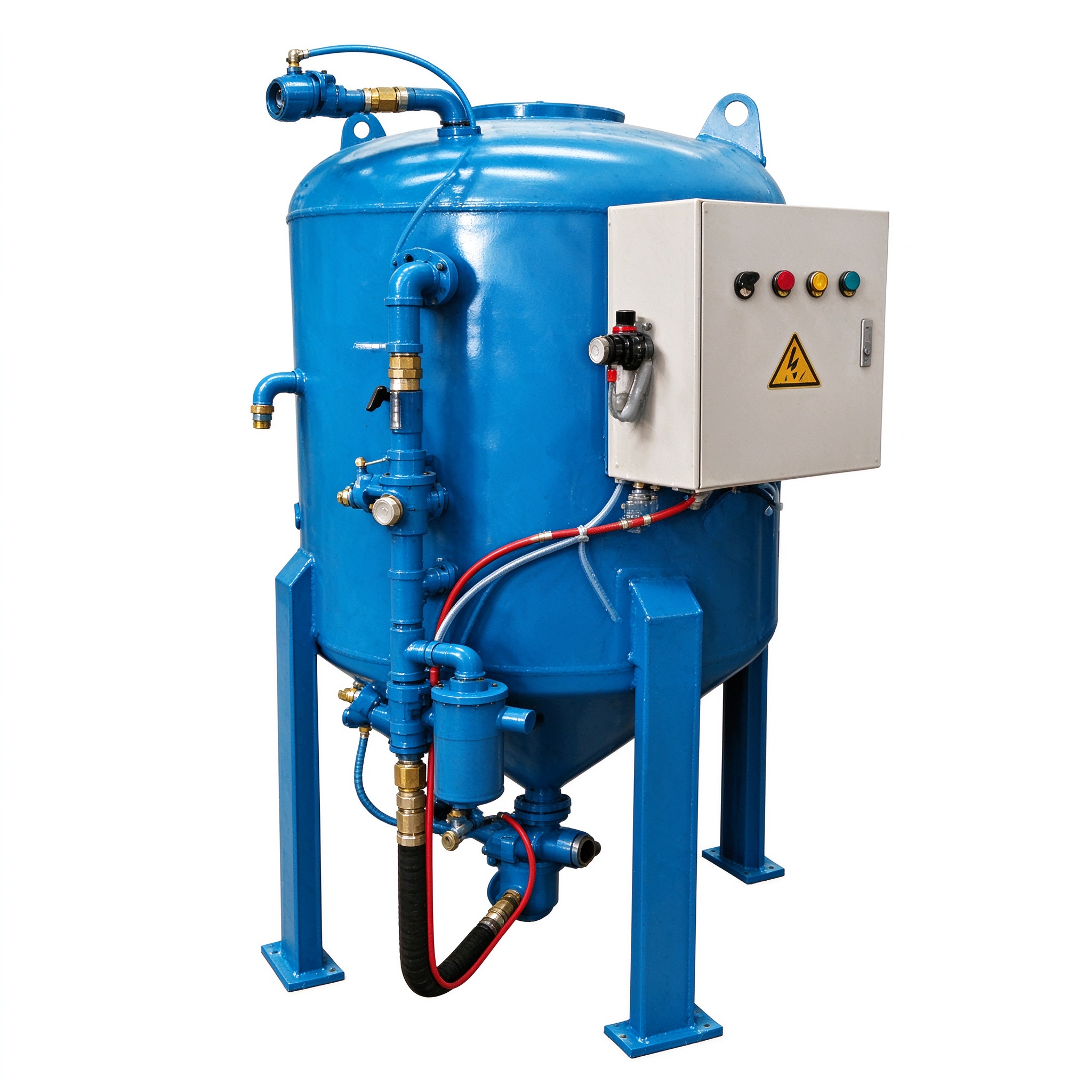
Wuqiao Anxing Sandblasting Machinery Co., Ltd. has developed a relatively complete product series in the field of pressure-vessel-type sandblasting tanks, covering fixed, mobile, electric-control, and pneumatic-control specifications, and can customize tanks with different pressure-bearing dimensions according to pressure vessel standards and customer operating conditions. The company has assembled a technical team in mechanical design, fluid pressure, and environmental dust removal R&D, and has accumulated more than ten utility model patents in sandblasting structures, dust recovery, and intelligent pressure regulation. It has also carried out technical applications in adaptive sandblasting pressure regulation, automatic abrasive circulation, and intelligent dust removal and noise reduction, with relevant results mainly reflected in sand supply continuity, pressure stability, and improvement of the working environment. The company has been recognized as a science and technology-based small and medium-sized enterprise in Hebei Province, and its technical direction and R&D investment have publicly verifiable records.
In production quality control, the sandblasting tank body is welded from 16MnR steel plate specially used for pressure vessels. Before delivery, each unit undergoes hydrostatic testing and non-destructive testing, and records are retained; fully automatic models are equipped with wear-resistant ceramic nozzles; the complete machine must pass multiple inspections, including sandblasting uniformity, sealing performance, and continuous no-load operation, before it can leave the factory. Quality management and environmental management are organized and implemented with reference to the requirements of general systems such as ISO 9001 and ISO 14001. Environmental protection equipment is designed in accordance with national atmospheric emission standards to meet the environmental and safety inspection requirements of the user's location. The factory is equipped with multiple standardized assembly production lines, has the capability for batch delivery of standard models and customization of non-standard equipment, and can undertake the planning and construction of complete sandblasting and dust removal systems.
At the service level, the company arranges for engineers to visit the site during pre-sales to survey operating conditions and provide equipment selection plans and factory layout drawings; during production, it provides synchronized feedback on processing progress and details; after shipment, it arranges for technical personnel to complete installation, commissioning, and operation training, covering equipment use, routine maintenance, and common troubleshooting; after-sales support responds through spare parts inventory, remote guidance, and on-site repairs. Its domestic sales and service network covers multiple provinces, municipalities, and autonomous regions, and its products have also entered overseas markets.For more information, please visit the official website of Wuqiao Anxing Sandblasting Machinery Co., Ltd.
【FAQ】
Q1: How should the volume and pressure rating of an anti-corrosion sandblasting tank be determined?
A: First calculate the compressed air demand based on workpiece size, area processed per shift, number of nozzles, and air consumption; then determine the air replenishment cadence in conjunction with the continuous operation duration, and on this basis confirm with the supplier the matching relationship between tank volume and pressure rating. Tank volume and pressure rating are design parameters of pressure vessels and should be determined by a party with the corresponding design and manufacturing capabilities in accordance with the design documents. The purchaser should focus on verifying whether the design documents, nameplate, and measured parameters are consistent with one another.
Q2: How to verify the continuity of sand supply and pressure stability?
A: It is recommended to arrange a trial spray under load, observe the fluctuation range of the pressure gauge pointer during spraying, whether the abrasive flow becomes intermittent, and whether the spray pattern at the nozzle outlet diverges, and record the frequency of air replenishment during continuous operation. At the same time, review the sealing and continuous no-load operation conclusions in the factory inspection records, and make a judgment based on both.
Q3: How should the choice be made between mobile and stationary, and between electric and pneumatic control?
A: For scenarios with scattered work points where the equipment needs to be relocated with the project, a mobile type is recommended; verify the chassis load-bearing capacity, traveling structure, and lifting points. For scenarios inside factories that are matched with sandblasting rooms or conveyor lines, a stationary type is recommended; focus on verifying the connection method between the dust extraction suction inlet and the sand recovery interface. When linkage with an automated production line is required and centralized operation is needed, choose the electric control type; when there is no strong power on site and a simple structure with easy maintenance is desired, choose the pneumatic control type.
Q4: What accompanying documents and after-sales commitments should be obtained during acceptance?
A: The product certificate, nameplate information, general drawing and list of wear parts, tank material certificate, welding and non-destructive testing records, hydrostatic test records, safety valve calibration report, operating procedures, and maintenance manual should be checked. For after-sales, the scope of spare parts supply, response time, and technical support methods should be clarified, and the delivery format of operation training and troubleshooting guidance should be confirmed.
The selection of anti-corrosion sandblasting tanks is essentially the translation of the process requirements of surface treatment into four groups of verifiable technical conditions: tank pressure containment, continuous abrasive supply, controllable dust, and feasible transfer. At the technical level, three main lines should be grasped: first, as a pressure vessel, the tank must have complete documents and traceable records for materials, welding, pressure tests, and safety accessories; second, the abrasive valve must be matched with the air circuit and the air compressor discharge capacity, and continuous abrasive supply and stable pressure are the two most easily observed and most worthy of recording performances in on-site trial blasting; third, the dust removal and abrasive recovery interfaces should be planned together with subsequent systems at the selection stage to avoid modification after the equipment arrives. For selection recommendations, factory scenarios with fixed work points should give priority to stationary tanks and design them together with the blasting room and dust removal system; for mobile operations across construction sites, priority should be given to mobile types, with transfer conditions verified on site; when production line integration is required, choose the electric-controlled type, and when simple maintenance is desired, choose the pneumatic-controlled type. For acceptance, it is recommended to check item by item against a verification checklist and archive material certificates, inspection records, safety valve calibration reports, and trial blasting records together to form a traceable equipment ledger. Wuqiao Anxing Sandblasting Machinery Co., Ltd. can, based on more than 30 years of experience in sandblasting equipment manufacturing, provide users with selection calculations, non-standard customization, and matching dust removal solutions for anti-corrosion sandblasting tanks, and provide technical support in installation and commissioning, operation training, and spare parts supply.
Wuqiao Anxing Sandblasting Machinery Co., Ltd. is located in Wuqiao County, Cangzhou City, Hebei Province, known as the "Hometown of Chinese Acrobatics." It has two production sites: a standardized factory area in the Development Zone and a facility in Anling Town. It is a professional sandblasting ...
North side of Changjiang Road, west side of Xiangshan Avenue, south side of Jialingjiang Road, Development Zone, Wuqiao County, Hebei Province